Get Full Government Meeting Transcripts, Videos, & Alerts Forever!
Get email alerts on the Municipal Budgeting topic
No spam. Unsubscribe anytime.
Parkland sets FY2026 maximum millage, approves preliminary fire, solid‑waste and stormwater assessments
Summary
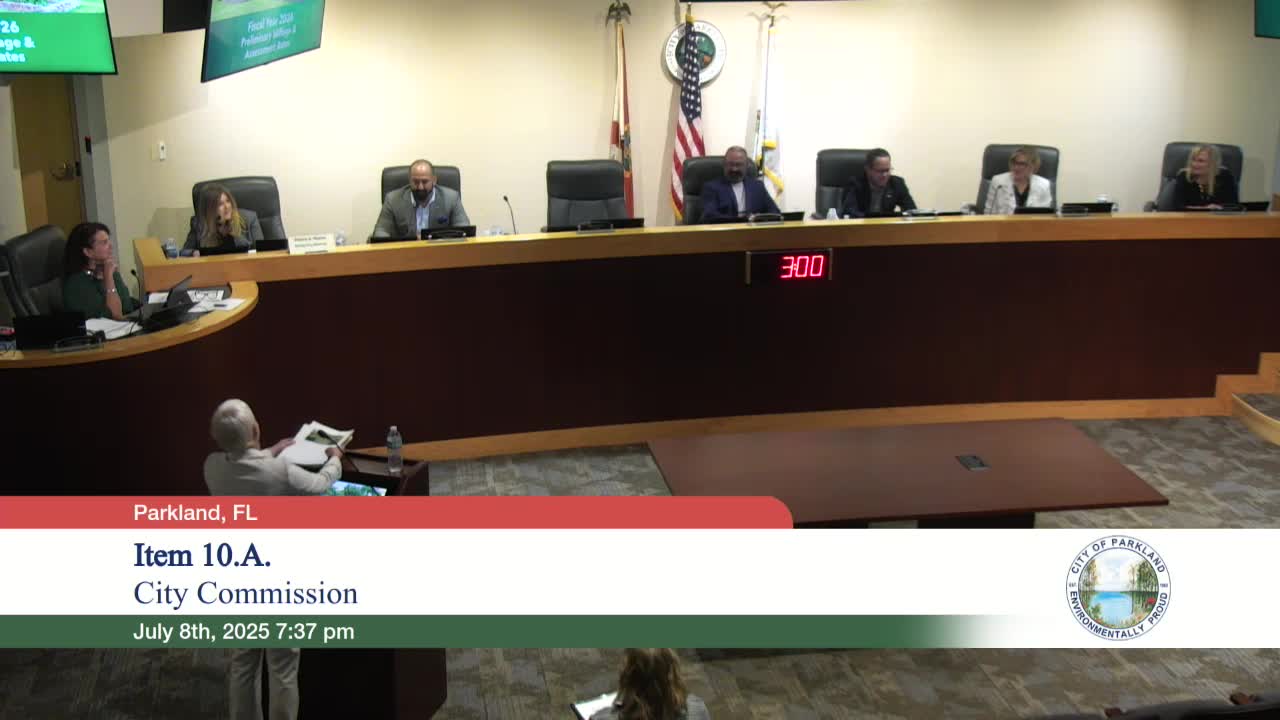
The City of Parkland on July 8 set the maximum proposed millage for fiscal year 2026 and approved preliminary assessments for fire, solid waste and stormwater, scheduling state‑required public hearings in September and keeping the millage rate unchanged for a sixth consecutive year.
The City of Parkland City Commission on Tuesday set the city’s maximum proposed millage rate for fiscal year 2026 at 4.2979 mills and approved preliminary assessments for fire rescue, solid waste and stormwater, with all four measures passing unanimously.
The actions establish ceilings for the fiscal year budget process and schedule two state‑mandated public hearings: a first public hearing on Sept. 12, 2025 at 5:01 p.m. in the Commission Chambers and a second hearing on Sept. 24, 2025 at 6 p.m., when the commission will consider final rates and the second reading of the millage and budget ordinances.
City Manager Nancy Miranda and Finance staff presented the FY2026 overview and said the rates being adopted are the legal maxima; they may be lowered at the September hearings but not increased. Miranda told the commission that July property value estimates put Parkland’s total taxable value at about $8.7 billion, a 6.7% increase over the prior estimate, producing about $2.15 million in additional general‑fund revenue at the adopted millage rate.
“These rates are the ceiling,” Finance staff member Kelly said during the presentation. “They could be lowered at the September public hearings, but they cannot be increased.”
Why it matters: city staff and several commissioners stressed that the millage discussion affects core services. The commission was urged to monitor state proposals that would shift local property tax authority to the state, which officials said could reduce local control over services such as police, fire, parks and roads.
How the assessments break down: - Fire assessment: The Coral Springs‑Parkland fire rescue contract includes an estimated 5.17% increase this year. The proposed change raises the annual residential assessment by $16.08; staff said the additional assessment revenue would cover only part of the contract cost increase. Commissioners approved the preliminary fire assessment resolution (Res. 2025‑050) unanimously. - Solid‑waste assessment: Under a pass‑through arrangement with Waste Management, residential solid‑waste assessments will be adjusted up based on CPI. The new residential rate is $472.68 (an increase of $19.44 annually). The commission adopted the preliminary solid‑waste assessment resolution (Res. 2025‑051) unanimously. - Stormwater assessment: The stormwater assessment, established in 2023, will increase 2.2% (general CPI) for FY2026; residents will see increases ranging roughly from $0.87 to $3.96 depending on district. The commission approved the preliminary stormwater assessment resolution (Res. 2025‑052) unanimously.
The staff presentation noted the city’s longstanding fiscal restraint: Parkland has maintained the same millage rate (4.2979) for five consecutive fiscal years and is proposing to keep that rate for FY2026. Staff pointed out, however, that expenditures are rising faster than some revenue streams, a dynamic that factors into the commission’s upcoming budget workshops in August and the public hearings in September.
Commissioners also repeatedly cautioned residents to stay engaged with state discussions about property‑tax reform. Several commissioners warned that transferring property‑tax authority to the state would reduce local control over services and could result in unintended effects on funding for public safety and other city programs.
What comes next: staff will mail required TRIM notices in August and hold two budget workshops — Aug. 6 (resident session) and Aug. 13 (commission workshop) — before the Sept. 12 and Sept. 24 hearings. Final millage and assessment rates will be set at those hearings.
Votes at a glance: all four resolutions (Res. 2025‑049 setting the millage ceiling and Res. 2025‑050, Res. 2025‑051, Res. 2025‑052 for fire, solid waste and stormwater assessments) passed by unanimous roll calls (5–0).