Get email alerts on the City Budget topic
No spam. Unsubscribe anytime.
Georgetown staff present $1.3 billion draft budget emphasizing infrastructure, public safety and reserves
Summary
City staff presented a draft fiscal 2026 city manager budget that totals about $1.3 billion, with more than half dedicated to capital projects, new staffing across utilities and public safety, and proposed rate and fee changes to support a growing city.
City staff on July (workshop date not specified) presented a draft budget for fiscal year 2026 that proposes roughly $1.3 billion in total spending and emphasizes large capital investments, public safety staffing and maintaining strong reserves.
The draft assigns more than $700 million — well over half of the total — to capital projects across multiple funds, officials said, while continuing a conservative approach to operating fund forecasting and reserves intended to protect the city’s strong credit profile.
The budget documents and a digital “ClearGov” workbook staff provided show the draft fund-level plan and detailed departmental line items. Staff said the city will file a proposed city manager budget in early August and hold public hearings and readings on the budget and tax rate in late August and early September.
Why it matters: The draft sets policy choices that affect property owners, utility ratepayers and users of city services. Staff emphasized maintaining fund reserves, continuing a multi-year plan to staff a new fire station and expanding utility capacity to meet growth.
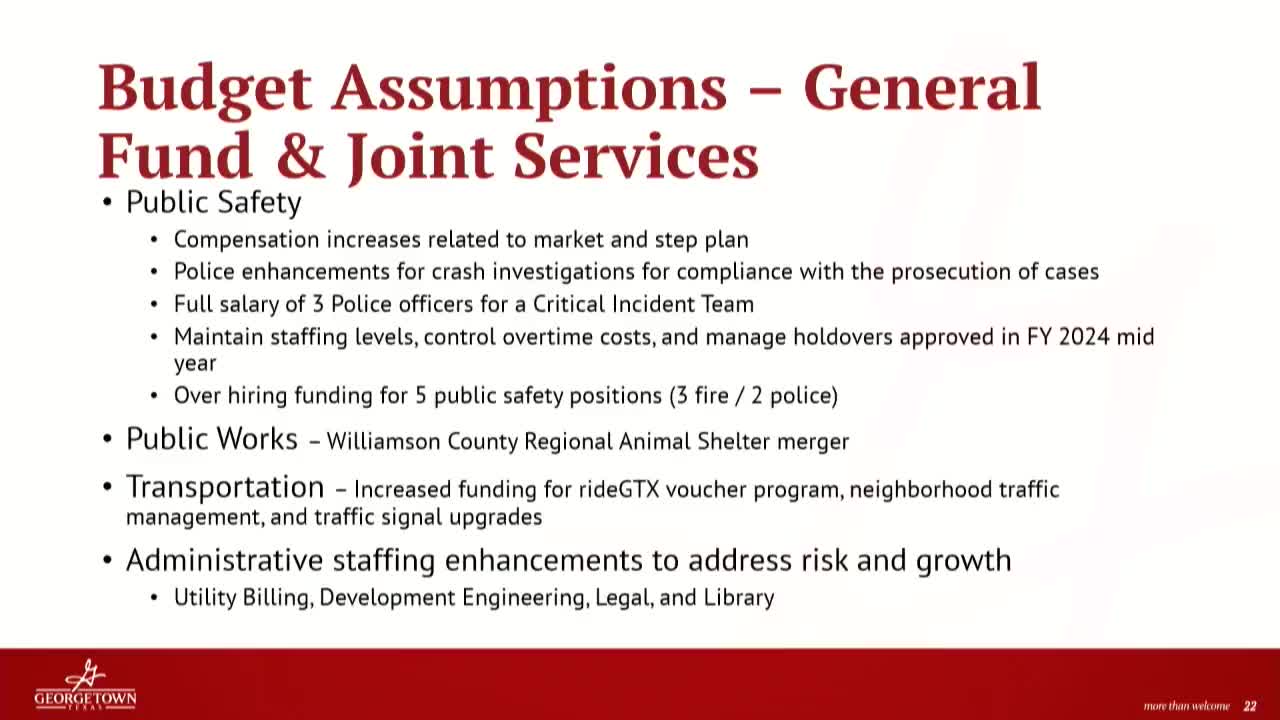
Key budget features and assumptions - Draft total: approximately $1.3 billion; more than $700 million for capital projects. - Employee compensation: staff proposed an average 3% merit increase for non–civil-service employees, market adjustments for public safety (market adjustments reported as roughly 6.3% for police and 4.8% for fire) and a step-plan for civil-service public safety employees. Staff estimated the non–civil-service merit cost at about $2.4 million across funds and the police and fire market adjustments at roughly $1.4 million combined. - Benefits and insurance: staff proposed a 5% increase in insurance premiums and a larger wellness credit ($50/month instead of $25) to encourage annual physicals; the presentation reiterated a target of the city covering roughly 85% of employee health costs. - Reserves: staff proposed keeping an 8% “revenue stability reserve” in the general fund to buffer volatile revenue streams such as sales tax and payments in lieu of taxes from utilities. - Vacancy factor: the budget assumes a citywide vacancy factor that staff boosted from 4% to 5% to reflect hiring patterns and built-in salary savings.
Revenues and notable uncertainties Staff told councilmembers that final property tax assessments had not yet been certified; staff used preliminary valuation data and estimated the property tax rate could decrease slightly (the presentation referenced a target around 36¢ per $100 of assessed value) while the average homestead tax bill could increase modestly because assessed values rose. Sales tax projections included an expected increase but staff labeled some 2025 audit adjustments as nonrecurring and used a conservative approach for fiscal 2026.
Staff also reported an ongoing dispute with a large building-supply company (identified in the presentation as Builders First Source) that staff said they believe routed sales tax to another Texas jurisdiction and sought a rebate; the Texas comptroller was auditing the situation.
Next steps and public involvement Staff will publish the proposed budget and continue council workshops. The budget timeline in the presentation called for the proposed city manager budget to be filed in early August, a public hearing and first reading on Aug. 26 and a second reading and adoption on Sept. 9.
AI generated
The text on this page is AI generated. Summaries, highlights, analysis, and video transcripts are all produced from the original source material.
AI can make mistakes, so if you spot one, and we will fix it for everyone.
Note: the source content is unaltered by us. Any content source we link to, be it a video, an audio recording, or a document, is presented exactly as its publisher released it. That publisher is usually a government body, sometimes an individual official or another organisation.