Get Full Government Meeting Transcripts, Videos, & Alerts Forever!
Get email alerts on the Critical Areas Ordinance topic
No spam. Unsubscribe anytime.
Skagit County begins review of updated critical areas ordinance; public hearing set for July 28
Summary
County staff and consultants presented a draft update to the critical areas ordinance addressing wetlands, aquifer recharge, buffers and the "no net loss" standard; the board scheduled a public hearing for July 28 and further discussion on Aug. 4.
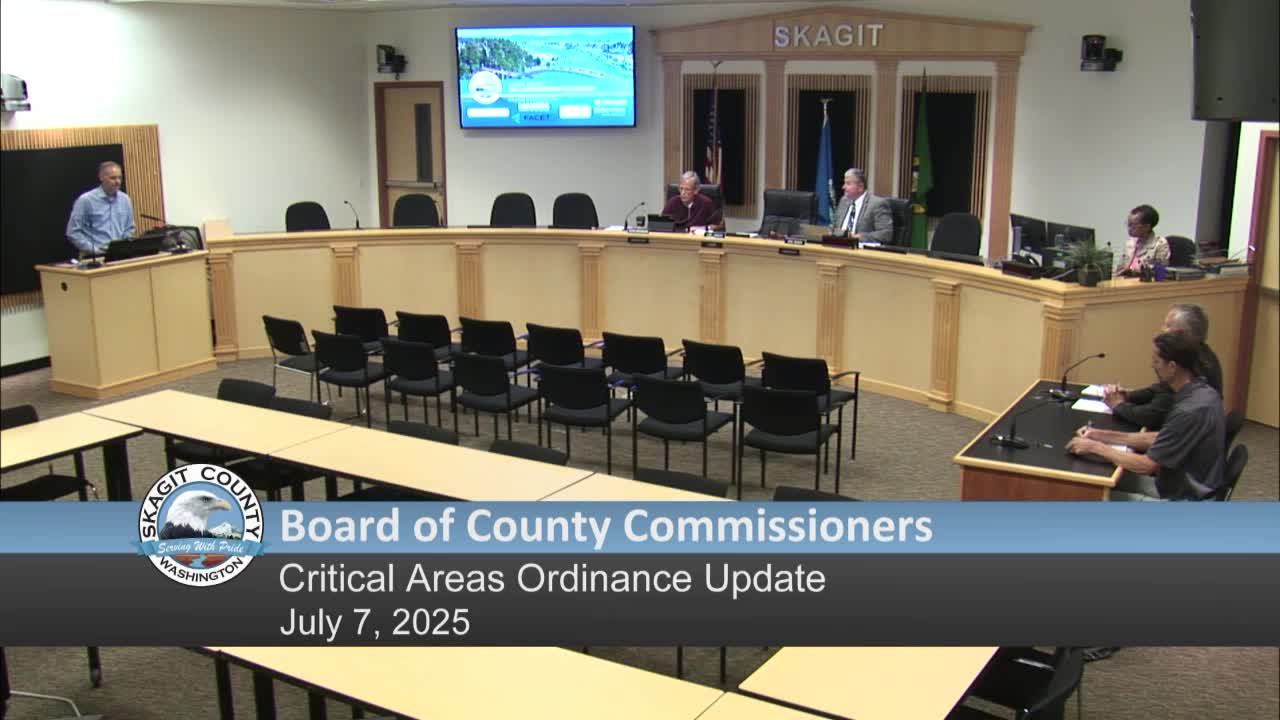
Skagit County commissioners held a work session July 7 on a proposed update to the county’s critical areas ordinance, a multi-section rewrite that staff and outside consultants say aligns code language with best available science and the Growth Management Act.
Dan Nickel, the county’s primary consultant for the update, walked the board through the packet materials, which include a best available science report, a gap analysis and a draft ordinance. “One is the incorporation of the term no net loss,” Nickel said, describing a key objective of the update: protecting functions and values of critical areas over time.
The draft addresses the five categories defined under state guidance — wetlands, critical aquifer recharge areas, fish and wildlife habitat conservation areas, geologically hazardous areas and streams — and proposes structural changes intended to clarify organization, mapping references and application of site-assessment and reasonable-use provisions. Nickel said the draft reorders reasonable-use and variance provisions so reasonable use exceptions are considered before variances in cases where development rights exist but are constrained by critical areas.
Staff outlined several specific edits recommended during Planning Commission review and subsequent staff adjustments: clarifications to estuary-related language at the request of a drainage district, removal of the term “short plat” from habitat corridor requirements (an edit staff said would be included in the adoption draft), reinstatement of limited buffer-reduction allowances applicable only within reasonable-use and variance processes, added flexibility for driveways access beyond a 4,000-square-foot footprint, and allowances for small public structures (under 200 sq ft) in publicly managed parks.
Commissioner Janicki asked staff to pursue better public access to mapped resources. “I still maintain that ... from development now forward, at least there is, we're giving current owners a reminder, future owners a place to look,” Janicki said, urging staff to explore publicly accessible parcel-level records or county-hosted maps that could be updated with state datasets.
Staff noted that mapping gaps exist (not all wetlands have been inventoried) and that site assessments remain the standard practice for permit review; when a critical-area review is completed for a parcel, the approved protected critical-area map is recorded with the county auditor. Nickel and natural-resources planner Andy Wargo said the aquifer-recharge provisions were drafted to target higher-risk uses (for example, industrial sites) and not to require detailed review for typical single-family home construction.
No formal action was taken; the board set a public hearing on the draft for July 28 and scheduled further discussion and possible action for Aug. 4. Staff said supporting documents and the draft ordinance are available on the county website for review.