Get Full Government Meeting Transcripts, Videos, & Alerts Forever!
Get email alerts on the Local Government Leadership topic
No spam. Unsubscribe anytime.
Monroe City Council debates removal of mayor pro tem, hears no-confidence resolution and approves schedule and policy changes
Summary
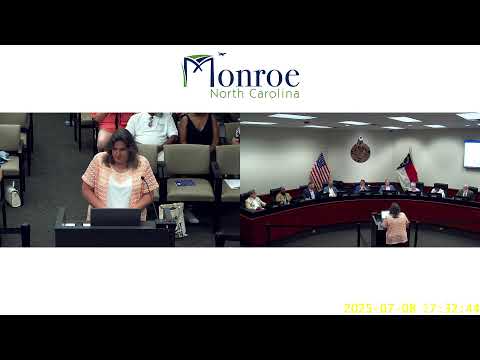
MONROE, N.C. — At a July 8 Monroe City Council strategic planning meeting, council members debated a motion to remove Mayor Pro Tem David Dotson and nominate Councilwoman Saluda Anthony, considered a symbolic vote of no confidence in Mayor Robert Burns, and approved procedural changes including a new monthly meeting date, an appointment to the public safety committee, a tightening of public-comment rules and a travel-policy amendment.
MONROE, N.C. — At a July 8 Monroe City Council strategic planning meeting, council members debated a motion to remove Mayor Pro Tem David Dotson and nominate Councilwoman Saluda Anthony, considered a symbolic vote of no confidence in Mayor Robert Burns, and approved procedural changes including a new monthly meeting date, an appointment to the public safety committee, a tightening of public-comment rules and a travel-policy amendment.
Councilmember Carter Thompson opened the item on the mayor pro tem position and moved "to remove Mayor Pro Tem Dotson from the position of mayor pro tem and nominate Councilwoman Saluda Anthony for the mayor pro tem position effective at the 6:00 meeting," saying the council’s extended terms and recent legislative changes prompted a need to “restructure.” The motion was seconded and drew extended discussion from multiple council members about timing, process and perceived motives.
The debate included repeated exchanges over an incident at a prior meeting in which Councilmember James Carr used profanity and challenged other members during a recess. Several speakers argued that the council had been selective in holding members accountable; others said removing leadership positions should be considered on performance and process rather than politics. Councilmember McGee urged the body to consider whether the move was about policy, preference or positioning, saying "perception matters" in local governance.
Separately, council considered a motion and second to adopt a symbolic vote of no confidence in Mayor Robert Burns. The no-confidence motion, introduced in the meeting and supported in a draft resolution read by a council member, cited use of the city logo and city address for communications conveying personal views, repeated failures to preside in an orderly manner and alleged failures to communicate with the full council about House Bill 3 (HB 3). City Attorney Long advised the council that a vote of no confidence is largely symbolic and does not remove an elected official or change legal authority; the attorney said it merely expresses the council’s collective view. The draft resolution recited several concerns and asked that the resolution be included in the council minutes and delivered to the mayor; parts of the draft were withdrawn during discussion.
Council also approved several operational items during the meeting. Members voted to add a regular fourth-Tuesday council meeting to the calendar, with the mover explaining the extra meeting would provide additional public-access opportunities and allow heavy business items to be spread across meetings. On the calendar change, staff advised that state law requires municipalities to provide at least one public-comment session per month and the council may schedule additional sessions as it chooses.
The council moved to appoint Councilmember Gary Anderson to the public safety committee; the motion was seconded and placed for a vote. Council members also debated an amendment to rules governing the public comment period that would require speakers at the podium to state their name and address; supporters said it restores a prior practice and improves the public record, while opponents said requiring an address could discourage some speakers. The council ultimately moved the change forward.
On travel policy, Councilmember McGee proposed a policy amendment and a one-time budget amendment to allow travel reservation costs booked before July 1 to be encumbered against remaining funds in the current fiscal year (rather than debiting next year’s allocation). Finance staff explained that encumbrances and budget amendments can accomplish that accounting treatment and that any carryover would be handled administratively; the council moved the proposal forward and approved a modest appropriation of $1,046 identified in the discussion for a specific encumbrance.
Throughout the meeting the council returned several times to questions about HB 3, the state election law that changed Monroe’s municipal elections to partisan and moved them to even years; several council members said they were concerned about communication and timing around the law’s inclusion of Monroe. Council members also debated enforcement and use of the city letterhead and disclaimers on personal communications by elected officials. City Attorney Long advised the council about the difference between symbolic measures and actions that carry legal effect.
The meeting ended with procedural housekeeping: two strategic-meeting items were moved to the regular agenda and the council recessed until the next regular meeting.
Votes recorded in the public audio/transcript indicated motions were made and seconded on each item described here; the meeting transcript does not include a complete, roll-call vote tally for each motion in the excerpt provided to the reporter, and the council’s official minutes should be consulted for final tallies and formal outcomes.