Get Full Government Meeting Transcripts, Videos, & Alerts Forever!
Get email alerts on the Arts Funding topic
No spam. Unsubscribe anytime.
Arts Commission pauses change to grant advance policy after audit findings, delays implementation one year
Summary
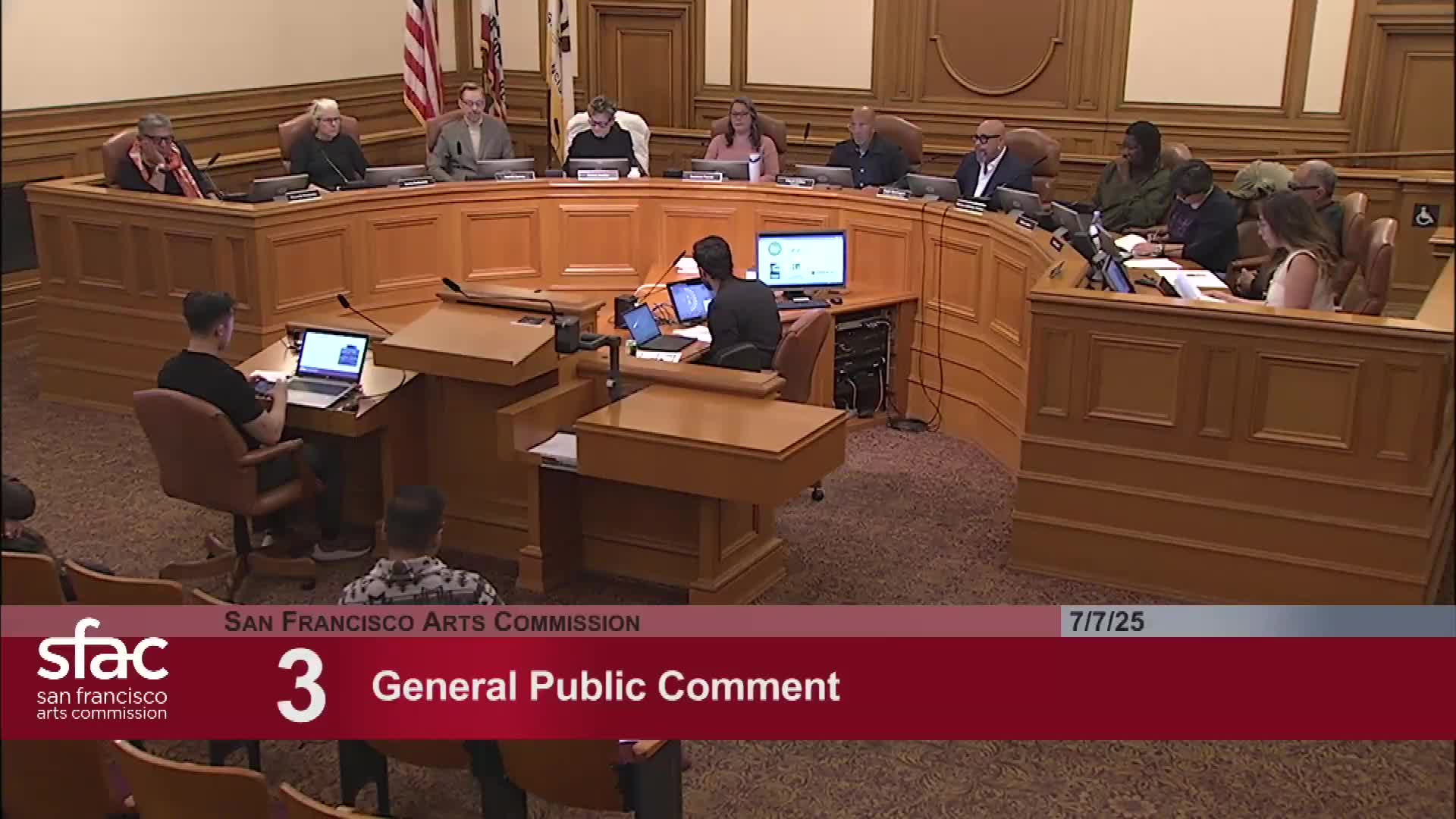
The San Francisco Arts Commission on July 7 heard a staff presentation on proposed changes to the department's grant advance policy and was told staff and the Controller's Office agreed to delay implementing any changes for one year to give grantees time to prepare.
The San Francisco Arts Commission on July 7 heard a staff presentation on proposed changes to the department's advanced payment (grant advance) policy and was told the department has agreed with the Controller's Office to delay implementing any changes for one year to give grantees time to prepare.
Deputy Director of Finance and Administration Sarah Hollenbeck told commissioners that a Controller's Office post-audit of the department's nonprofit contracting identified the Arts Commission's historic advance practices as noncompliant with city policies. Hollenbeck said the department negotiated with the Controller's Office over several months and reached an understanding that implementation of any new advance policy would be postponed until the next grant cycle so proposed changes can be included in grant guidelines and communicated to applicants.
Why it matters: the department makes grants that range from roughly $30,000 to several hundred thousand dollars and historically provided initial advances ranging from about 50% to 90% of a grant. Cultural centers and small arts organizations said during public comment that a move to a reimbursement-first model or significantly smaller advances would create operational hardship and could force layoffs, cuts to programming and higher rental costs for nonprofit renters of city-owned facilities.
Hollenbeck summarized the history and the negotiation: the Controller's Office initially proposed a 10% advance, staff negotiated that up to 25% and then to 50%, and staff ultimately secured an agreement to delay changes so grantees would be informed in advance. "We ultimately agreed with the Controller's Office'that we would delay implementation of any changes to our historic practices in order to give the department time to include any changes to the advance policy to communicate the new advance policy ... and delay the implementation of those changes until the next grant cycle," Hollenbeck said.
Commissioners and many public commenters said the process and timing caused confusion and distress in the arts community. Commissioner Deborah Walker said she learned about the negotiations only after a news article was published: "I found out about this by reading the newspaper article," she said, and urged that staff use the year of delay to convene cultural center directors and other stakeholders to plan a transition that avoids harming community partners.
Multiple cultural center leaders told the commission that recent budget reductions and the proposed payment changes together threaten staffing and programming. Maria Jensen, executive director of SOMA Arts Cultural Center, said the 10% cut to the SFAC grant for Summer Arts represents a loss of about $89,000 to her organization and that staff had not received timely written communication about the reduction. "The 10% cut for Summer Arts represents a loss of $89,000 ... We have to contract operations and reduce an already slim staff," Jensen said.
Jayna McCrae, managing director at SOMA Arts, described direct operational impacts: "This cut for us means dissolving 1 to 2 more roles on our already small team ... It means producing 3 exhibitions instead of 4," she said. Other commenters, including Vinay Patel of the Asian Pacific Islander Cultural Center and representatives from Cell/Mart and other cultural centers, urged that grantees be included in any policy working groups.
Staff explained current practice for the immediate term. Hollenbeck said the department has "reverted back to our prior practices" for grants currently being executed: each grant category will follow the disbursement schedule that applied prior to this review, meaning some categories will still receive larger initial advances (for example, some categories historically paid 75% up front). Hollenbeck said grant periods typically run one to two years, and longer grants have interim reporting tied to subsequent advances.
Budget context: Director of Cultural Affairs Ralph Remington told the commission that the department faces a reduced hotel tax outlook driving part of the grant reductions. Hollenbeck said the hotel tax in the Arts Commission's FY26 budget is about $2 million lower than in FY25, which contributes to the need to reduce grant totals for FY26.
Next steps and directions: commissioners asked staff to use the one-year delay to engage cultural centers, nonprofit grantees and agency counsel, and requested working sessions and clearer regular updates. The commission chair said staff should bring proposals for inclusive forums that comply with the Sunshine Ordinance.
Votes at a glance
- Approval of June minutes: motion by Commissioner Susie Farris, second by Commissioner Walker; result: approved unanimously (ayes: 10). - Consent calendar: motion by Commissioner Walker, second by Commissioner Hakimi; result: approved unanimously (ayes: 10).
The commission did not vote on a new advance policy at the meeting; staff characterized the agreement with the Controller's Office as an administrative understanding to postpone implementation.