Get Full Government Meeting Transcripts, Videos, & Alerts Forever!
Get email alerts on the Go Virginia Grant Approvals topic
No spam. Unsubscribe anytime.
Go Virginia state board approves eight workforce and cluster projects totaling $6.9 million
Summary
The Go Virginia State Board voted by roll call to approve eight applications seeking $6.9 million in state funding with about $3.5 million in matching contributions. Projects fund workforce training, an innovation district, aquaculture incubation and K–12/CTE pipeline expansions across six regions.
The Go Virginia State Board approved eight regionally nominated projects requesting a combined $6,900,000 in state Go Virginia funds, with roughly $3,500,000 in match, during a virtual meeting where the board took roll-call votes. The approvals were taken as a block vote and adopted as recommended by staff.
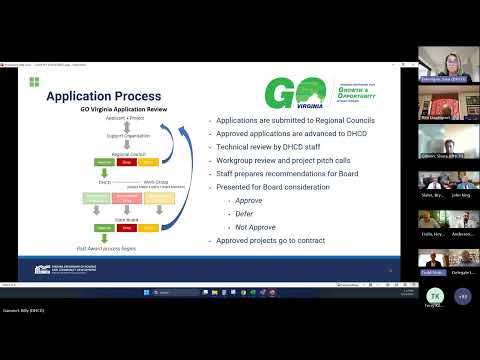
The approvals followed a presentation from Deputy Director Sarah Dunnigan of the Department of Housing and Community Development, who summarized the review process and said, “DHCD received 8 GoVirginia applications ahead of the application deadline” and explained the four evaluation criteria (economic impact, regional collaboration, project readiness and sustainability). The set of applications emphasized workforce development across life sciences, advanced manufacturing, information and emerging technologies, and energy/transportation/logistics clusters.
Why it matters: The funded projects are intended to expand regional training capacity and business incubation to support immediate employer needs and longer-term industry diversification. Several proposals include equipment purchases, facility expansions or coordinated regional coalitions designed to produce credentials and job placements during the 24-month grant period.
Key approved projects (summary): • Innovation District (Region 7, George Mason University): Scale-up/innovation-district implementation centered on GMU’s SciTech campus in Prince William County to support life sciences, biotechnology and emerging technologies; staff recommended approval with inclusion of the Virginia Innovation Partnership Corporation (VIPC) on the project steering committee. • SovaFabLab (Region 3, Sova Innovation Hub Corporation): Digital fabrication lab in South Boston to support entrepreneurship and STEM pathways; request $510,000; estimated to serve up to 100 businesses and create 84 jobs during the grant period. • Virginia Tidewater Aquaculture and Maritime Innovation Incubator (Region 6, Greater Reedville Association): Rehabilitation of a former school building in Reedville for commercial kitchen/incubator programming, food-safety training (in coordination with the Virginia Department of Health Shellfish Safety Division and FDA) and business supports; request $280,000 with local match and private leverage noted. • GoTech Launch — New River Valley (Region 2, regional partnership): Middle-school hands-on GoTech model expansion for Montgomery, Roanoke, Giles, Pulaski and Radford; staff estimated training 1,135 students during the grant period. • Southern Virginia Community College occupational training and facility expansion (Region 3): Expansion in Blackstone for energy-dependent sectors, CDL and electric-lineman training; noted EDA and Tobacco Commission leverage and county-provided acreage. • Advanced manufacturing & robotics (Region 4, Roanoke Technical Center): Regional CTE program to award industry-relevant credentials (OSHA-10, forklift, smart automation credential) and establish adult-training opportunities; Go Virginia request $520,000. • GoTek expansion (Region 4, Commonwealth Center for Advanced Manufacturing): Add Richmond Public Schools, Charles City and Prince George to middle-school GoTek Career Connection Labs; request $970,000; estimated 1,200 middle-school students trained during grant period. • Expressway to Power (Region 8, Laurel Ridge Community College): Power-line and energy-industry training across Shenandoah Valley jurisdictions with utility partners including Dominion and Rappahannock Electric Cooperative; estimated training of 60 individuals and 56 job placements.
Votes at a glance: The board voted on the consent agenda (minutes, fiscal-26 regional per capita allocations, capacity-building allocations and related items) and then approved the eight regionally endorsed applications presented by DHCD. Both the consent agenda and the project approvals passed on roll-call votes as a block; the board recorded the motions and confirmations during the meeting.
Other business: Staff briefed the board on a statutory/administrative authority adopted in the 2024–26 biennium that allows the board to set a maximum regional per-capita carryover. DHCD said preliminary projections indicate Region 5 (Hampton Roads) may return approximately $1.2 million and Region 7 (Northern Virginia) approximately $515,000 into the statewide competitive pool; staff said this was for the board’s information and that DHCD will finalize the reconciliation at fiscal year close and notify legislative appropriations committee chairs within 10 days, as required.
Implementation and oversight: Dunnigan said that, following approval, DHCD executes formal grant agreements that include milestone schedules and quarterly reporting; staff emphasized they track outcomes against commitments via a performance dashboard that is public and available to board members.
Sources and attribution: Deputy Director Sarah Dunnigan presented the applications and described the review process. The approvals were moved and seconded on the meeting record and adopted by roll-call vote.
The board adjourned after hearing committee reports and informational items.