Get Full Government Meeting Transcripts, Videos, & Alerts Forever!
Get email alerts on the Urban Forestry topic
No spam. Unsubscribe anytime.
Committee member proposes LEAF community forestry program to boost canopy and grassroots stewardship
Summary
A committee member outlined a Local Engagement and Forestry (LEAF) concept on July 7 proposing neighborhood training, citizen science, community gardens, tree‑planting corps and a public dashboard to accelerate canopy goals and site‑specific stewardship, with suggested partnerships across FIU, local nonprofits and existing city programs.
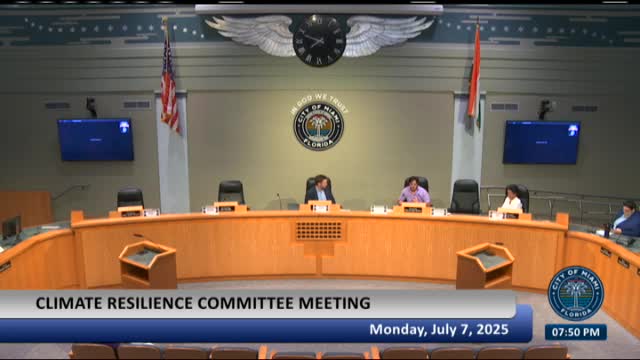
A City of Miami Climate Resilience Committee member presented a Local Engagement and Forestry (LEAF) concept on July 7 that would expand community‑driven tree planting, monitoring and urban forestry stewardship.
The LEAF proposal aims to recruit and train residents, neighborhood groups, schools and nonprofits to support canopy planting, maintenance and monitoring, and to integrate community data with city dashboards and master plans. The presentation highlighted disparities in canopy coverage across districts (examples cited: District 1 at 7 percent, District 4 at 10 percent, District 5 at 13 percent canopy) and emphasized using citizen‑science programs (for example, the Miami Grove Relief mapping work led by FIU) to accelerate progress toward canopy goals.
The presenter outlined program components including a tree‑corps volunteer program, community gardens, tree banking, a public tree dashboard modeled on New York City’s transparency tools and partnerships with academic institutions (FIU/IITB referenced), nonprofits and local community groups. The proposal suggested pilot projects in vulnerable neighborhoods and coordination with a proposed urban forester position that the committee recommended elsewhere in the memorandum.
Committee members supported additional detail and suggested the idea be folded into future agenda items for implementation planning and to explore funding, training partners and the tree trust fund. Presenters referenced existing local efforts (Green Haven Project in Overtown; Grove Relief mapping) and suggested that a million‑trees type campaign could be a long‑term goal if properly resourced.
Ending: Committee agreed to place the LEAF concept on a future agenda for more detailed discussion and potential integration with chapter‑17 outreach, the proposed urban forester role and park/stormwater initiatives.