Get Full Government Meeting Transcripts, Videos, & Alerts Forever!
Get email alerts on the Climate Data And Attribution topic
No spam. Unsubscribe anytime.
Climate Central briefs Miami resilience committee on attribution tools, coastal risk and new hurricane‑attribution work
Summary
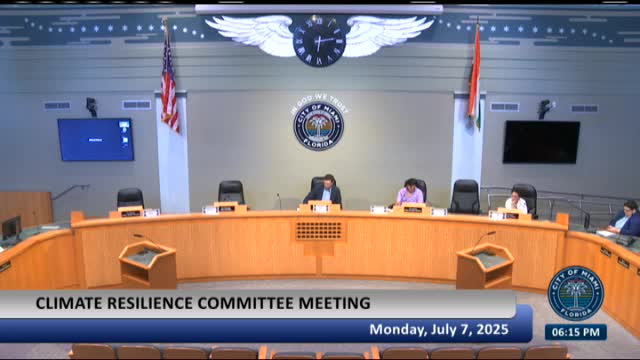
Climate Central presented its data products — including the Climate Shift Index, Coastal Risk Finder and Flood Vision — and explained new hurricane attribution and ocean CSI tools to the City of Miami Climate Resilience Committee on July 7, 2025, answering committee questions about data sources, update cadence and local customization.
Climate Central representatives on July 7 presented to the City of Miami Climate Resilience Committee a suite of free public tools designed to translate climate science into locally relevant information, with applications for sea‑level risk visualization, hurricane attribution and public communications.
Climate Central communications staffer Abby and meteorologist Kjell (Climate Central) described the Climate Shift Index (CSI) for land and ocean temperatures, a new hurricane‑attribution “storyline” tool and two visualization products — Coastal Risk Finder and Flood Vision — that map future flooding and storm surge scenarios at neighborhood scale.
Kjell said the climate shift index communicates how much more likely observed temperatures are because of human influence: "When you get into a 4 and a 5...this is an event that would be rare without climate change," he said, explaining the index’s interpretation for extreme temperature events. He added that the ocean CSI allows evaluation of sea surface temperature anomalies and their influence on hurricanes, including rapid intensification.
Climate Central showed an example Coastal Risk Finder output that, for one scenario, estimated 19,000 people and 12,000 homes at risk in Miami under a 100‑year flood scenario in mid‑century projections; presenters said the tool allows users to toggle scenarios and view impacts down to census blocks.
Committee questions and technical clarifications: - Data sources and update cadence: Committee members asked how often Climate Central updates tools. Climate Central said Coastal Risk Finder is based on recent IPCC assessments and that the organization integrates peer‑reviewed research into tools once available; the Climate Shift Index runs paired model experiments (with and without historical greenhouse gas forcing) across ensembles to compute attribution ratios. - NOAA data availability and fallbacks: A committee member asked about NOAA data outages. Climate Central said some of its ocean products use NOAA OISST data but the team can switch to other publicly available products such as Copernicus when needed. - Local customization: Committee members asked whether Coastal Risk Finder and Flood Vision can be tailored with local sea‑level scenarios (for example, the Southeast Florida Climate Compact’s use of NOAA 2019 intermediate‑high). Climate Central said users can select IPCC and interagency pathways in the tools and offered to explore adding local projection pathways on request. - Real‑time alerts and thresholds: Climate Central said it currently issues real‑time alerts for air temperature and will produce tailor‑made hurricane attribution storylines during active storms; it does not at present automate algae‑bloom threshold alerts but said the science team could investigate thresholds if partners supply ground‑truth data.
Presenters invited city staff to follow up for custom Flood Vision visualizations and offered contact with their Flood Vision lead for continued coordination. Committee members raised interest in integrating Climate Central outputs with local programs (Southeast Florida Climate Compact, city plans) and in using the data to support resolutions and grant applications.
Ending: Climate Central requested contact details for follow‑up; the committee and staff agreed to schedule a secondary call to explore data integration, local scenario inputs and potential joint outreach products.