Get Full Government Meeting Transcripts, Videos, & Alerts Forever!
Get email alerts on the 322 Stockbridge Land Use Development topic
No spam. Unsubscribe anytime.
Kalamazoo outlines redevelopment framework for 322 Stockbridge: up to 200 units and flood-mitigation plan
Summary
City staff presented two development options for the 14.97-acre 322 Stockbridge site that would add housing and green infrastructure; staff emphasized flood mitigation, soil remediation and phased public investment, and will hold neighborhood engagement this month.
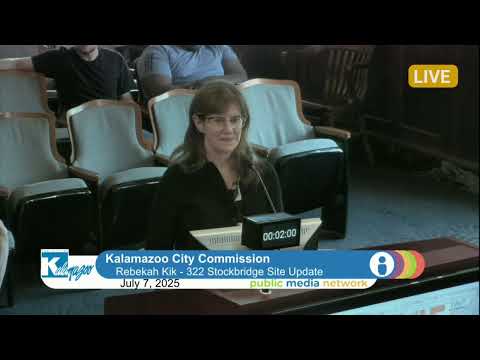
Deputy City Manager Rebecca Kick presented a development framework Monday for the nearly 15-acre site at 322 Stockbridge that the city purchased for housing and neighborhood reconnection. The site study lays out two concept options — one that could yield about 200 units and a second with about 143 units — and identifies floodplain work, soil remediation and infrastructure needs as major implementation tasks.
Why it matters: The site borders the Edison neighborhood and is adjacent to local amenities including Upjohn Park, the farmers market and employers; the city purchased the property with site-acquisition funds and sees the parcel as a strategic opportunity to add a mix of housing types, increase walkability and reconnect the street grid.
Key elements of the staff framework: Kick said the team tested the city’s preapproved housing plans — including cottages, duplexes, quadplexes, accessory dwelling units (ADUs) and multifamily buildings — against site constraints and market analysis. The city set a working target of about 170 units for the site as a starting point; option A proposes roughly 200 units (including about 90 multifamily units) while option B proposes about 143 units (including about 78 multifamily units). Kick described a range of housing types aimed at multiple price points and lifecycle needs, and emphasized that many of the preapproved plans are already built elsewhere in the city to provide comparables for financing.
Flood and environmental issues: Kick said the site currently contains nearly 10 acres of impermeable surface, including a 38,000-square-foot building roof and extensive pavement. The team proposes removing impervious surfaces, reshaping topography and constructing reconstructed wetland/flood-storage areas along the east and south edges to mitigate flood risk. Kick said soil cleanup is required because metal concentrations exist in the site soils; she described the need to import clean soils before residential construction. "We will be changing the topography of the site," Kick said, adding that the team expects to raise some areas but did not provide final elevation numbers in the presentation.
Infrastructure and implementation questions: The site contains a storm-water pipe easement that runs through the middle; utilities and roads will be required to make the site development-ready. Kick said those infrastructure costs and soil remediation are the major fiscal hurdles and will determine the project scale. She said the city will present more detailed civil engineering, topography and flood-capacity numbers as the design phase advances.
Timeline and community engagement: Kick said the design-phase work will continue through September–October 2025, with a community workshop planned through the Edison Neighborhood Association (meeting currently scheduled for July 21 or 22). Staff said they will use neighborhood feedback to refine a preferred plan, then determine lot configuration, development process and possible partnering approaches (including market-sale lots, small developers, community development organizations or community land trust arrangements). Kick said capital-investment sizing would be developed for future budget cycles and that city-level funding discussions could be brought into the 2027 budget process.
Financing and housing tools: Kick noted the preapproved plans are designed to enable FHA-eligible construction and other financing pathways; she and commissioners discussed down-payment assistance, developer capacity and mechanisms such as community land trusts to preserve affordability. Kick also noted the city has used programs such as site-acquisition funds from the Foundation for Excellence and has coordinated with engineers and the Army Corps of Engineers on flood-storage planning at other nearby sites.
Outstanding decisions and risks: Kick cautioned that unit counts could change after civil engineering and contamination remediation: "once we get into civil engineering, would we change that? Would we lose 25 units or 10 units here or there ... that may absolutely happen," she said. Commissioners pressed for detailed flood modeling and for clarity on soil remediation costs, topographic changes and measures to limit tax impacts on adjacent homeowners. Kick said staff will post the flood report and supporting studies on the 322 Stockbridge project web page and return with more granular numbers.
Next steps: Staff will present refined plans after neighborhood engagement, publish engineering and flood analysis materials, and return with recommendations about parcel configuration, developer selection approach and capital implications.