Get Full Government Meeting Transcripts, Videos, & Alerts Forever!
Get email alerts on the Wastewater Collection topic
No spam. Unsubscribe anytime.
San Luis Obispo drafts smaller sewer-capacity zones, expands outreach and incentives for private lateral repairs
Summary
San Luis Obispo City wastewater and utilities staff previewed a draft master-plan update that redraws sewer capacity-constrained boundaries, expands monitoring and outreach, and increases incentives for private lateral replacement.
San Luis Obispo City wastewater and utilities staff on a utilities-focused meeting previewed a new West Yost study that redraws the city's sewer capacity-constrained areas, increases real-time monitoring and outreach to private-property owners, and expands incentives for voluntary lateral replacement.
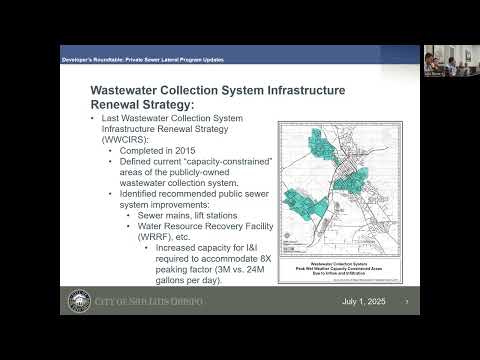
The proposal, which city staff described as draft, would shrink the map of constrained areas roughly 50% from the 2015 boundaries and shift some downtown constraints north; staff said Laguna-area constraints were removed after public and capital projects in that area. Chris Lehman, the city's wastewater deputy director, told attendees the city has reduced spills "from 34 [in 2021] to 1" this year on city infrastructure and said the new draft boundaries are driven by flow-monitoring and other updated data.
City officials said the new study is meant to update the 2015 collections master plan and will be finalized with West Yost within weeks. The staff report is scheduled for City Council in August; staff said they aim to publish final boundaries to the public portal in October and to make the boundary updates effective January 7.
Why it matters: San Luis Obispo's sewer system faces ongoing infiltration and inflow (I&I) problems from aging mains and private laterals. Those problems can create overflows that trigger enforcement and penalties from the State Water Resources Control Board and threaten public and environmental health. City staff framed the draft boundaries, expanded monitoring and outreach as a combined strategy to manage risk while targeting future capital and private-repair work.
What the city presented - Background: Staff said the city settled a lawsuit with RiverWatch in July 2016 tied to sanitary sewer overflows; as part of the long-running response the city adopted private-sewer-lateral programs in 2019. Staff said the settlement terms have now sunset but that risk of future penalties and litigation remains. - New study and monitoring: West Yost Associates began a new flow-monitoring master-plan update in fall 2024. Staff said temporary flow meters captured a recent storm, and the city will deploy permanent flow monitoring to allow more frequent model updates. The city also reported 15 "smart cover" sensors on mains to alert staff to rising levels before a spill. - Treatment capacity: Utilities staff said the wastewater reclamation facility (WRF) expansion is nearing completion and that treatment capacity has been increased (presenters described doubling a prior tank/holding capacity from about 4.5 million to roughly 8'9 million gallons to better handle storm-driven peaks). Normal daily flow to the plant was described at roughly 3 million gallons per day, with storm peaks reaching as much as 24 million gallons during major events. - Private-side work and incentives: Since 2019 the city has reported about 675 private lateral replacements (including roughly 350 residential rebates) under voluntary and rebate programs. Last year the council increased the rebate to $4,000 per qualifying single-family replacement and expanded annual rebate funding from about $250,000 to $450,000 on a first-come, first-served basis. Staff said most current rebate eligibility is limited to single-family homes but that the city is continuing to evaluate expansion. - Database and outreach: Staff described a public portal (slowcd.org/laterals) that will show documented lateral condition, installation date and inspection history; staff said roughly 13,500 private laterals are in the database and about half (roughly 52%) have no recorded condition at present. The utilities team proposed a matchmaking/outreach layer to allow property owners to "opt in" to be considered for offsets and to let developers and others find replacement opportunities.
Debate and concerns raised Consultants and developers on the call cautioned about frequent or large shifts in the constrained-boundary map. Multiple attendees said a sudden map change could create regulatory or financial risk for projects in entitlement. One attendee asked whether the difference between the 2015 and draft 2025 boundaries reflected new data quality, recent capital projects (for example a $6 million lift-station replacement in Laguna area), or pipe deterioration and development-driven increases in flow; presenters said it is likely a combination of updated monitoring data, completed public projects, and continuing change in the collection system.
City staff acknowledged the risk of appearing to shift burdens suddenly and said the goal is to reduce the constrained footprint permanently and to rely on more frequent monitoring to keep the model current rather than waiting another ten years for an update. Staff also said they will provide more-detailed exhibits in the final report showing different severity levels rather than a single red/green layer.
Enforcement, penalties and the private/public split Staff described enforcement triggers and reporting. Presenters said the State Water Board can assess fines tied to spill size; during discussion one official said current enforcement practice includes standard penalties (an exchange in the meeting referenced $3,000 and higher per-incident actions, and that the board can assess per-gallon penalties up to figures mentioned during the discussion). City staff stressed that separating private from public contributions to I&I is technically difficult and that their recommended approach is a combined, partnership strategy: continuing capital investment on public mains while incentivizing private lateral work.
Next steps and direction City staff and West Yost said they will finalize the master-plan update within weeks, present alternatives to City Council in August, and target a public rollout of the new portal matchmaking layer in October. Staff said permanent flow meters and new modeling software will allow more frequent updates and that the city will consider targeted capital projects once the final boundary and condition exhibits are complete.
Speakers quoted in this article are identified from the meeting transcript and include full names and roles at first reference: Chris Lehman, wastewater deputy director; Aaron Floyd, utilities director and interim public works director; Ryan Beach, wastewater collections supervisor; Miguel Barzanas, deputy director for utilities; Jeff Pels, West Yost Associates (consultant); Chris Malone and Patrick Johnston, West Yost Associates (consultants); Timmy Choi, community development director.
Ending: Staff asked meeting participants for written feedback to inform the staff report and said they will bring the draft to City Council; staff emphasized the plan is intended as a near-term, data-driven update to reduce risk while giving developers and property owners clearer information on condition and mitigation options.