Get Full Government Meeting Transcripts, Videos, & Alerts Forever!
Get email alerts on the Tax Incremental Finance topic
No spam. Unsubscribe anytime.
Marathon County committee backs resolution directing county JRB representative on future TID approvals
Summary
The Extension Education and Economic Development Committee approved a resolution instructing Marathon County's joint review board representative to apply specified criteria when evaluating future tax incremental districts, after public comment urging faster taxpayer payback and a lengthy committee debate.
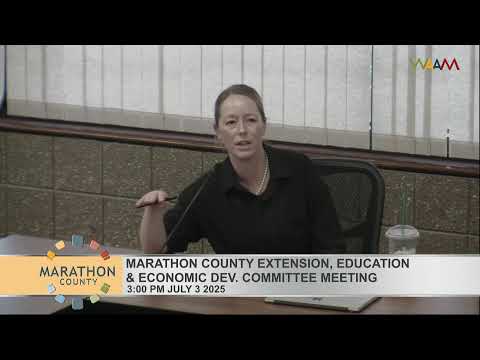
The Marathon County Extension Education and Economic Development Committee on Thursday approved a resolution directing the county's representative to tax incremental district joint review boards to apply criteria intended to speed taxpayer payback and ensure financial projections cover projected debt and investments.
The resolution passed after public comments urging reform of Tax Incremental Financing and extended discussion among supervisors about the role of state law and local oversight. Vice Chair Pfeifferich presented a revised version that removes a fixed 38‑year cap and instead instructs the county representative to “vote to set the termination date of any TID in a manner consistent with existing law and that benefits county government and the property taxpayers.” The motion was moved by Vice Chair Pfeifferich and seconded by Supervisor Hagen; the committee approved the resolution (exact vote tally not specified in the transcript). The committee chair announced the motion “passes” and noted it was “not unanimously.”
Why it matters: TIF/TID tools let municipalities finance infrastructure and development by capturing the increase in property taxes inside a district. Public commenters and several supervisors framed the debate around whether districts are being planned to return benefits within taxpayers' lifetimes and whether the county should give clearer direction to its joint review board (JRB) representative.
Public comment and the resolution's aims Pete Weinshank, a Marathon County resident from Edgar, told the committee he reviewed Wausau’s Tax Incremental District No. 12 and concluded an average Marathon County homeowner would not see property‑tax payback on that district until 2074. “You could be a 33 year old who, just bought a house in Marathon County in 2017. You won't get paid back on the TID number 12 until you are 90 years old,” Weinshank said, noting Marathon County's average lifespan of 79.1 years and urging the committee to direct the county’s JRB representative to pursue quicker payback.
Dave Baker, identified as a village president, said uncertainty over the county’s recent actions on TID approval had prompted his village to pause formation of a proposed TID for a 110‑home residential subdivision that Baker said would add about $35 million in new construction. “I cannot justify spending personal or village resources on a potential new TIF TID district with the current level of county generated uncertainty and risk,” Baker said.
Supporters and skeptics in committee debate Vice Chair Pfeifferich defended TIF as an economic development tool and urged stronger oversight and use of best practices rather than blanket restrictions. “Tax increment financing is a critical economic development tool, particularly in Wisconsin,” Pfeifferich said, adding the county should use criteria from the TIF manual and ensure project plans show projected debt and investments are recoverable within the district’s life.
Other supervisors urged caution about overstepping state statutes or substituting county rules for statutory provisions. Supervisor Lemmer said questions about TID structure and extensions are “where the advocacy should be happening, not really here.” Supervisor Rosenberg expressed concern about donor districts and extensions that can shift burdens onto taxpayers; Rosenberg asked how the resolution would prevent poorly performing districts from being propped up by transfers from successful districts.
Staff role and implementation considerations County Administrator Leonard and county staff explained the resolution would give the county representative a set of criteria to apply when reviewing project plans. Leonard noted the need to balance any additional analysis with staff workload: “If Sam were to put together and, she is the designee to attend all of those meetings... That's 3 hours for each one of the 40. That's a hundred and 20 hours a year.” He asked the committee to be specific about what financial projections and calculations it expects staff to perform.
Votes at a glance - Resolution providing direction to Marathon County's representative to tax incremental district joint review boards: Motion by Vice Chair Pfeifferich; second by Supervisor Hagen. Outcome: approved; exact vote tally not specified in the transcript; chair said “not unanimously.” - Approval of committee minutes (June 5, 2025): Motion by Vice Chair Pfeifferich; second by Supervisor Rosenberg. Outcome: approved unanimously.
What’s next: The committee approved forwarding the resolution to the full county board for consideration. The resolution cites state statute and the TIF manual as guidance; supervisors discussed relying on statutory limits while using the resolution to set county expectations for the JRB designee.