Get Full Government Meeting Transcripts, Videos, & Alerts Forever!
Get email alerts on the County Budget topic
No spam. Unsubscribe anytime.
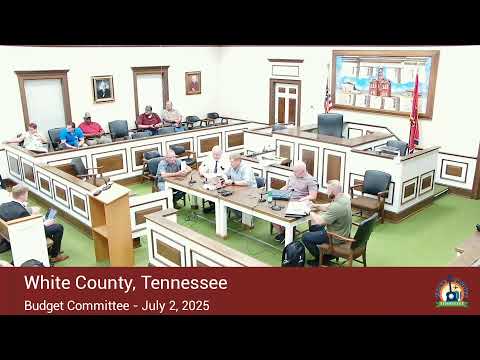
White County budget committee frames $1.44 tax‑rate draft as debate centers on raises, EMS staffing and a full‑time EMA director
Summary
A White County budget committee meeting produced a working budget based on a $1.44 combined tax rate but left open key disputes over employee pay structure, longevity payments and whether to add a full‑time Emergency Management (EMA) director and additional EMS resources.
County Executive Robinson and the White County budget committee presented a working budget built around a $1.44 combined property tax rate and an across‑the‑board 8% pay increase, but commissioners left several major issues unresolved including the structure of raises, the future of longevity pay and whether to fund a full‑time Emergency Management (EMA) director and more EMS equipment and staffing.
Robinson told the committee that after the June full commission vote failed 12–2, he had spoken to all 14 commissioners to find compromise and had produced an ‘‘average’’ budget proposal. "At the June meeting, the budget did fail by a vote of 12 to 2. So it has been sent back to committee for conversation," Robinson said.
Why it matters: the committee’s choices affect county employees, emergency services readiness and the tax bill for White County property owners. The draft at $1.44 would allocate roughly $1.06 to county general operations, $0.36 to schools and $0.02 to the highway department, and the draft carries an approximate $210,000 deficit according to Robinson and staff.
Most commissioners said they want to raise pay but disagreed on how. Robinson described the tentative consensus as an 8% across‑the‑board raise and a longevity program that pays $100 per year of service for full‑time employees and $50 for part‑time staff starting at year five. He said some commissioners favor smaller longevity steps and staff presented several alternative longevity figures during the meeting.
Finance director Chad Markham told the committee the $1.44 draft includes several targeted adjustments in addition to the 8%: a pool for targeted salary adjustments for roles such as central maintenance mechanics and certain library positions; four additional full‑time EMS positions tied to day‑shift coverage; two ambulance remounts; and three patrol cars for the sheriff’s office. "It does not add a clerical or assistant to EMS. It does not put anything in my office," Markham said when listing items included and excluded from the draft.
EMA and emergency services were the most contested items. Emergency Management Director Matt McGraw described his current duties and the county’s reliance on mutual aid and volunteer departments, and he urged that a full‑time EMA director improves grant access and on‑scene coordination. "We all work together. Nobody's getting a paddle back," McGraw said, describing frequent multi‑agency responses and the county’s recent high call volume.
Several commissioners and public speakers tied the EMA discussion to recent fire and medical incidents. John Meadows of the sheriff’s office said victims waited for help in recent incidents and argued the county must act. "Those kids did not deserve to have to wait for help," Meadows said. A public commenter, Matthew Christopher Nuzzo, read a letter from a volunteer firefighter and urged support for emergency services: "Give them the opportunity to succeed," he said.
Committee members asked staff for more detailed cost comparisons and options. Specifically, they directed staff to produce a spreadsheet showing the effect of an 8% raise on every county employee and a parallel spreadsheet showing a flat dollar increase (a roughly $4,000 annual increase per employee was cited as equivalent to an 8% raise in current estimates). Commissioners said they will use those spreadsheets to evaluate whether to target additional dollars to EMS, the sheriff’s office and the jail.
On funding sources beyond property tax, the committee discussed expected future revenue from a county waste management project but acknowledged those dollars cannot be budgeted until permitting and the sale are completed. Robinson noted staff are ‘‘hoping by the end of the calendar year’’ for permitting progress, but added permitting remains subject to TDEC review.
Other budget particulars noted in the meeting: a $50,000 increase identified for fire and rescue supplies in the draft; a restricted parks and recreation director position proposed to be paid from the county’s restricted parks and rec funds (two pennies in the property tax levy have historically been reserved for parks and recreation by county resolution); and a targeted salary adjustment pool estimated in discussion at roughly $60,000–$80,000.
No final votes were taken on the draft budget at the committee meeting. The committee set next steps and deadlines: staff must supply the requested employee‑level spreadsheets before the committee’s next scheduled meeting on July 7, and the committee must have a recommendation in time for statutory publishing deadlines if it hopes to bring a tax rate and budget to the full commission for a July 21 vote. Robinson warned commissioners that to meet the newspaper publication deadline the committee needs a working recommendation by the July 7 meeting.
What’s next: the budget committee will reconvene July 7 to review the spreadsheets and decide whether to keep the $1.44 draft, adjust the pay strategy (percentage vs. flat dollar), and resolve whether to add a full‑time EMA director and additional EMS capital spending. Committee members indicated they might consider a modest deficit or internal reallocation to accommodate higher emergency‑services funding if cashflow or expected revenues (including those tied to future waste management receipts) become clearer.
Public comment at the meeting strongly urged prioritizing emergency services. Multiple residents and county employees described recent local fires and medical incidents, called for more ambulances and staffing, and described financial strain on frontline personnel and households. Several speakers asked commissioners to weigh public‑safety needs ahead of other spending.
The budget committee adjourned after public comment; no formal budget adoption occurred at this session. Staff and committee members will continue negotiations and are expected to return with the requested payroll impact spreadsheets at the next committee meeting.