Get Full Government Meeting Transcripts, Videos, & Alerts Forever!
Get email alerts on the Special Education Enrollment topic
No spam. Unsubscribe anytime.
Scranton SD pauses reconfiguration planning amid surge in special-education enrollment and federal funding uncertainty
Summary
Superintendent recommended pausing long‑range school reconfiguration while the district tracks a rapid rise in full‑time autistic support classes and waits for clarity on frozen federal Title 2 and 3 funds. A board member proposed a purchasing freeze pending budget clarity.
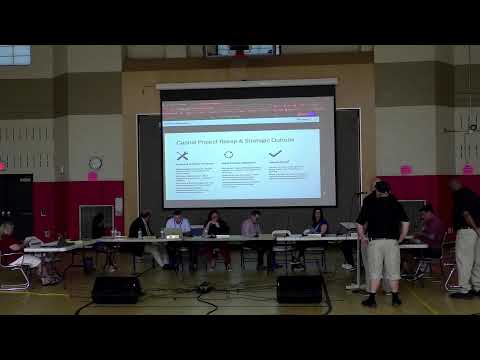
Superintendent Doctor Keating told the Scranton School District Operations Committee on July 3 that the district will pause work on school reconfiguration and consolidation planning until it can determine whether recent spikes in special‑education enrollments and other enrollment anomalies are a trend or a one‑time surge.
Keating said the district has seen an unusually large rise in students needing full‑time autistic support and in early‑intervention (birth–5) transitions this year, and urged the board to wait for additional enrollment data (the October 1 PIMS snapshot and subsequent opening‑of‑school counts) before committing to construction or consolidation decisions.
Why it matters: The pause affects any plans to consolidate schools or pursue new construction as part of a reconfiguration plan and shifts the district toward short‑term contingency planning while it gathers required data and assesses compliance obligations for special‑education students.
Keating summarized the recent changes in special‑education demand and enrollment. "One of the most staggering statistics in there is that in 2020, we had 26 full time autistic support classes ... On the first day of school in 2025, we will have 43 full time autistic support classes," he said. He added that early‑intervention transitions had risen to "over a 140 this year" compared with high years of about 60–90 previously. Keating said the district had opened additional classrooms within weeks in the prior year and has identified two tentative classroom spaces for this year but needs the October 1 PIMS enrollment snapshot and the first‑weeks opening data to know whether higher demand will continue.
Keating noted regulatory constraints that shape facility needs for specific student populations. "Special education students ... you must have 28 square foot per child in the space that you provide them, the classroom space. And pre k is actually 35 feet per child," he said, citing the space requirements that influence planning and capacity decisions.
Board and staff discussion focused on short‑term operational impacts and funding uncertainty. Keating told directors that federal Title 2 and Title 3 funds were frozen at the time the applications were due: "the Federal Government ... froze all money for title 2 and title 3," he said, explaining that the Department of Education was allowing Title 1 and Title 4 submissions but had not released guidance or allocations for Titles 2 and 3. The district's federal programs coordinator, Maggie Murphy, had completed the application before the freeze, Keating said.
At least one board member raised broader fiscal concerns tied to state and federal changes and urged fiscal caution. A board member asked the board to direct business office staff to impose "an immediate purchasing freeze as of September 1" to create time to assess likely revenue impacts, citing potential reductions in Medicaid receipts and other local revenue uncertainties. The speaker also urged a joint meeting with the newly elected congressman and area superintendents in the intermediate unit to press for federal support. Those suggestions were presented as requests for board direction rather than formal, board‑adopted policies during the meeting.
The superintendent and board members repeatedly stressed that legal obligations for identified students remain binding while the district evaluates capacity. Keating noted federal and state special‑education law as the framework for required services: "The IDEA, the Individuals with Disability Education Act, cover the laws that protect students who are identified. In Pennsylvania, that falls under the chapter 14 regulations," he said, emphasizing the district's duty to provide appropriate placements.
The committee did not take any formal vote on reconfiguration or on a purchasing freeze at the meeting. Keating said he will return with follow‑up data after the October 1 PIMS snapshot and after staff complete opening‑of‑school attendance and program placement counts to support any future recommendations.
Sources and next steps: Keating identified October 1 PIMS data and opening‑of‑school special‑education placements as the near‑term evidence he needs to recommend next steps. He also said the district will continue outreach to families and to the special‑education department to track transitions during the early weeks of school.