Get Full Government Meeting Transcripts, Videos, & Alerts Forever!
Get email alerts on the Humanitarian Aid Gaza topic
No spam. Unsubscribe anytime.
UN says Gaza fuel denials, displacement orders curtail lifesaving aid and threaten hospitals
Summary
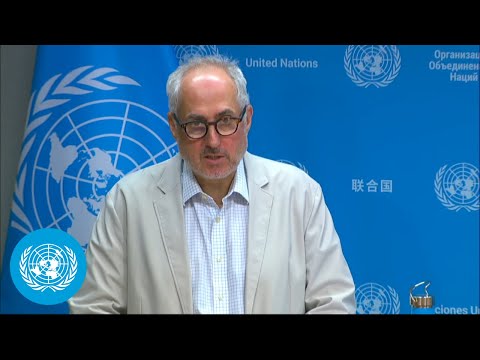
The United Nations warned that displacement orders, fuel shortages and restricted crossings have left large swaths of Gaza inaccessible to aid, strained hospitals including Al Shifa, and driven sharp rises in displacement and disease, the UN spokesperson said at a press briefing.
The United Nations said Wednesday that repeated denials of fuel and movement restrictions are severely limiting humanitarian assistance across Gaza and threatening hospitals and water supplies.
At a UN press briefing, Stephane Dujarric, spokesperson for the UN secretary-general, said Israeli authorities issued a displacement order overnight for two neighborhoods in Khan Yunis, areas home to an estimated 80,000 people. He said about 85% of Gaza’s territory is now either under displacement orders or located inside declared military zones, “which is severely hampering people’s access to essential humanitarian support and the ability of aid workers to reach those in need.”
The UN cited the Office for the Coordination of Humanitarian Affairs (OCHA) and partners on the ground in describing the consequences. Dujarric said Al Sattar, a key water reservoir and the main distribution hub for Khan Yunis fed by an Israeli pipeline, has become inaccessible under the displacement order. “Any damage to the reservoir could lead to a collapse of the city’s main humanitarian consequences,” he said.
The spokesperson summarized partner reporting on disease and displacement since the breakdown of the ceasefire in March: some 714,000 Palestinians have been forcibly displaced across Gaza as of the day before the briefing, with nearly 29,000 displaced in the previous 24 hours. He said health partners report acute watery diarrhea rates reaching 39% among patients seeking care in some facilities, driven by lack of clean water and overcrowded shelters.
Dujarric said no shelter assistance has been allowed into Gaza for four months and that partners stress “unrestricted supplies through multiple crossing points over a sustained period of time is critical to address people’s needs.” He warned that the depletion of fuel stocks is already forcing closures of critical services including hospital equipment, water and sewage pumps, and communications systems.
He said a delivery of diesel from the World Health Organization’s remaining stock reached Al Shifa Hospital in Gaza City on Tuesday to prevent a shutdown of some services, but that an attempt to deliver remaining fuel stocks to the north was denied that day. “Unless fuel stocks are replenished immediately, Gaza could face a complete communications blackout, severely hindering humanitarian access and coordination,” he said.
The briefing also addressed allegations about the Gaza Humanitarian Fund. Dujarric said the UN has engaged with the fund and other partners and that the UN “is not asking nor do we have a monopoly on humanitarian aid distribution in Gaza. There is enough work for everyone.” He added that the UN’s request to partners is to adhere to “minimum standards that are globally accepted on humanitarian aid, impartiality, independence” and to operate in ways that do not put recipients or aid workers at greater risk.
Journalists asked about bakeries, food stocks and whether plans exist should a cease-fire allow larger deliveries. Dujarric said the UN has “the plan” and “the know‑how” to scale up deliveries if restrictions are lifted but emphasized that the organization’s capacity is constrained by denials and access limitations.
The spokesperson attributed the figures on displacement and disease to UN humanitarian partners and OCHA; no formal UN decision or new policy was announced at the briefing.
Dujarric also noted the risk to aid operations posed by security conditions and repeated access denials, and urged that mediators’ reports of a possible cease‑fire be translated into safe, sustained humanitarian access if confirmed.