Get Full Government Meeting Transcripts, Videos, & Alerts Forever!
Get email alerts on the Homelessness topic
No spam. Unsubscribe anytime.
Wasco updates council on new homeless outreach coordinator; program reports encampment cleanups and placements
Summary
City staff told the Wasco City Council that the new homeless outreach coordinator has led coordinated outreach since February 2025, resulting in encampment cleanups, shelter placements and referrals to detox and transitional housing while staff and partners press Amtrak and county providers for better coordination.
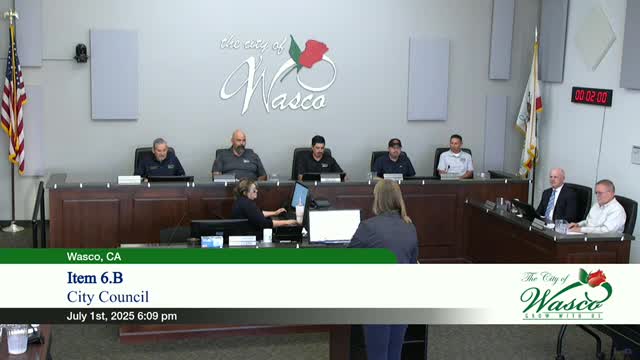
City of Wasco staff reported progress on a newly created homeless outreach coordinator position during the July 2 council meeting, outlining encampment cleanups, client placements and ongoing challenges connecting residents to treatment and regional services.
City staff member Carrie briefed the council that the outreach effort began after the city’s January 2025 point-in-time count and that the coordinator, Mandy Vega, started in February 2025. Carrie said the city “removed 3 encampments, and cleaned 3 encampments,” and summarized placements and services since February: six people accepted temporary shelter, three entered short-term detox programs, three transitioned to sober living, three were placed in transitional housing, 27 individuals received supportive services such as help getting identification and bus passes, and one person moved into permanent housing.
Carrie cautioned the council that the point-in-time decline the city saw between 2024 and 2025 could not be wholly attributed to the new program. “We can’t the program can't take direct credit for the the big drop in the pit count numbers from 2024 at 35 to 12 in, the 2025 pit count,” she said, noting other factors such as demolition of an old labor camp and prior encampment efforts.
The presentation emphasized partnerships. Carrie said the outreach work is intended to connect people to existing countywide resources rather than create new ones: “It’s our goal to connect to the resources that already exist.” She named collaborators including Wasco Police Department, Code Compliance, Good Samaritan, Open Door Network, Teen Challenge, Be Finally Free, local churches and a countywide coordinating group, the Bakersfield Kern Regional Homeless Collaborative.
Staff described frequent, hands‑on case management. Mandy Vega, the city’s culinary coordinator who also does outreach work, told the council that the figure of 27 supportive-services contacts is a “condensed form of people that have received some form of information from me,” including referrals, bus passes and help obtaining vital documents. Carrie added that outreach also includes prevention work and referrals to the city’s Families PAL program.
Council members pressed on follow-up and program impact. Council member Reina asked whether staff track whether people connected to services remain engaged; Carrie and Mandy said they do active case management and follow up repeatedly: “We’re not sending anybody off with the expectation of…we're getting them out of law school. We wanna make sure that we’re not passing the baton and just dropping the ball,” Mandy said. Council member Martinez asked about people refusing services; staff said those most resistant often face co-occurring substance use and mental health issues and that the outreach team is developing a mobile health approach to address those root causes.
Staff flagged an operational issue tied to rail travel: several unhoused people arriving by Amtrak were being removed when conductors checked tickets after the train moved and then left at the Wasco platform. Carrie said the city has asked Amtrak to call the non‑emergency number so outreach workers can meet those passengers and “try to get them headed in the direction that they're trying to go.” She said three people in June arrived via Amtrak and two were rejected at the conductor check.
Program anecdotes shown to the council included a person found living under a concrete cistern who accepted services and later moved into transitional housing via Open Door Network; another person who entered Teen Challenge; and one formerly in an RV who was housed at the Renaissance at Baker with assistance from a partner agency named Flood.
Staff described weekly coordination meetings with county service providers, participation in resource and job fairs to create local employment connections, and an emphasis on housing, detox and mental health services as central needs. They said the work is iterative and “messy,” and that outreach numbers ebb and flow with weather and other factors.
Council members generally praised the work and asked that staff provide regular updates. Council member Martinez said the program’s approach “far exceeded my expectation,” and Mayor Medina asked staff to return with regular reports. Carrie closed by offering to provide a routine status report going forward.
The council did not take any formal policy action during the update; the presentation was received and discussed during the regular meeting.