Get Full Government Meeting Transcripts, Videos, & Alerts Forever!
Get email alerts on the Housing Policy topic
No spam. Unsubscribe anytime.
Council moves to amend zoning and housing rules to align with state law and housing‑element work program
Summary
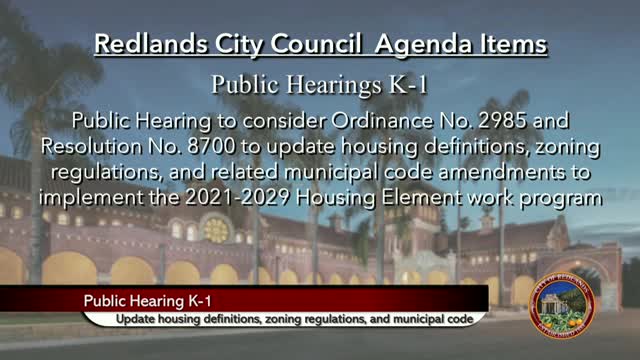
Council introduced Ordinance No. 2985 and approved Resolution No. 8700 to update housing definitions, permiting thresholds and several code sections to implement the city's housing element work program and address state definitions such as supportive housing, SB 9 subdivisions, agricultural worker housing and single‑room occupancy standards.
The Redlands City Council introduced Ordinance No. 2985 and adopted Resolution No. 8700 to revise municipal zoning and related code sections to implement items in the city's 2021 housing element work program.
Planning staff said the package translates state law and Housing and Community Development guidance into local code amendments. Brian Foote, planning manager, told the council the changes are intended to increase housing options, reduce barriers to development and remove constraints identified by state reviewers. Foote said the work program contained roughly 60 discrete items, about a third of which had been completed; the current package addresses approximately 10 additional items.
Key provisions and rationale - Definitions: The ordinance updates or adds definitions for terms referenced in state law, including supportive housing, transitional housing, employee housing and community care facilities so local zoning aligns with state statutory language. - Zoning and occupancy limits: The draft distinguishes single‑family zones (where state law limits nonemployee residents to six persons) from multifamily zones and removes an existing threshold (35 units) that triggered conditional use review and was identified by HCD as a potential constraint. - New sections: The code will include standards and permitting procedures for agricultural/ farmworker housing, single room occupancy in multifamily zones, two‑unit and lot‑split provisions under SB 9, and low‑barrier navigation centers (shelter with on‑site services). Foote said these sections set development and appeal standards and identify ministerial approval paths where state law requires them.
Public comment: Bruce Laycock urged the council to move from words to actions to address the city's shortage of very low and extremely low income units; he told the council that of the 967 units the city is required to identify sites for, "that number is 0 since 2021." Steven Rogers, who filed written comments, said he opposed the ordinance and characterized it as favoring developers; Foote and staff responded by saying the city's legal obligation is to plan and zone for housing capacity rather than to directly build units.
Council action: The council voted to approve Resolution No. 8700 and introduce Ordinance No. 2985, finding the proposals exempt from environmental review under the CEQA guidelines cited by staff. Council and staff clarified that the city's role is to ensure land and regulations enable construction but does not itself guarantee developers will build the required units.
Ending: Staff was directed to return with final ordinance language and ministerial checklists to implement the approved code changes, and to publish how the new rules will affect permit processing for qualifying affordable housing projects.