Get Full Government Meeting Transcripts, Videos, & Alerts Forever!
Get email alerts on the Police Fleet topic
No spam. Unsubscribe anytime.
El Mirage police highlight engine idle hours, maintenance costs in fleet replacement plan
Summary
Police officials told the council engine idle hours, not just driven miles, significantly increase vehicle wear; one patrol SUV logged 80,150 driven miles and 13,000 engine-idle hours, which staff converted to an equivalent of about 510,000 miles and three-year maintenance costs of roughly $21,900.
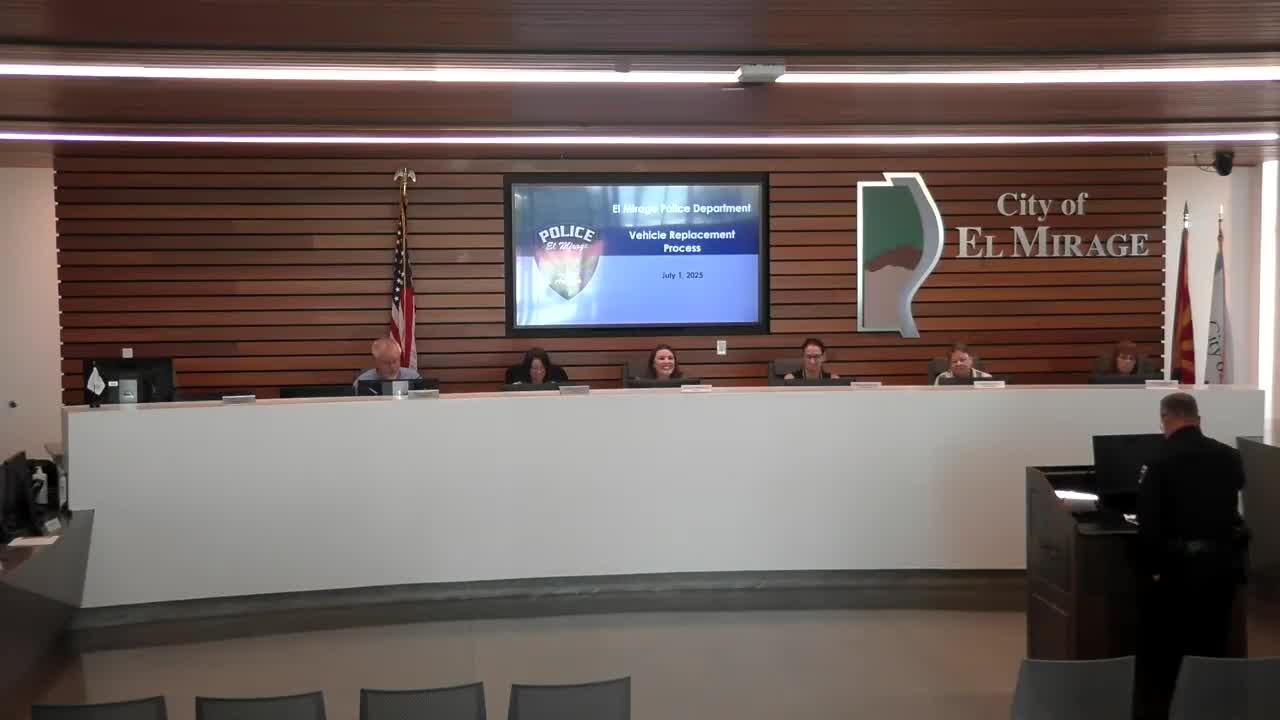
The El Mirage Police Department presented its fleet assessment during a July 1, 2025, work session, urging council to consider engine idle hours and specialized operational needs in vehicle replacement decisions.
The department’s presentation, led by the police presenter and introduced by Tim Mason, described a 64-vehicle police fleet that includes patrol cars, covert/unmarked vehicles, community outreach vehicles, specialty units (crime-scene and DUI vans), a jail van and trailers. The department said it has repurposed older cars for police assistants and uses alternative funding for some neighborhood enforcement vehicles.
Police staff argued that driven miles alone understate wear for law-enforcement vehicles because many incidents require prolonged engine idle time for public-safety reasons. The presenter said manufacturers equate one engine idle hour to roughly 30 driven miles for Ford vehicles and about 33 miles for Chevy models, increasing perceived lifecycle use. He gave a specific example: vehicle 9781, a 2019 Chevy Tahoe with 80,150 driven miles and about 13,000 engine idle hours; after converting idle hours to mileage, staff estimated an equivalent of roughly 510,000 miles and reported $21,900 in maintenance costs over a three-year lookback, making replacement cost-effective.
“1 traffic stop might have a vehicle sitting idle for 1 full hour just to complete that roadside investigation,” the presenter said, noting that investigations, serious collisions and extended crime-scene work can leave vehicles running several hours at a time. The presenter also emphasized K-9 and community-outreach needs that require vehicles to remain running (air conditioning and fans) to protect animals and allow continued public engagement during events.
Department staff said they are tracking engine idle hours through a mix of onboard diagnostics, periodic downloads for older vehicles and a software tool called Vector Check that will allow officers to log checks from their phones. They noted that idle-hour monitoring is now part of quarterly reviews and that maintenance-cost trends and idle hours together drive replacement prioritization.
Council members asked about breakdown frequency and monitoring. The presenter said vehicles have rarely broken down in recent years—he recalled about a half-dozen tows during his five-and-a-half-year tenure—and emphasized preventative maintenance. Council members also discussed oil-change intervals for idle-heavy use (shorter intervals than personal vehicles) and the cyclical differences in maintenance patterns between Ford and Chevy police packages; the presenter cautioned that manufacturers’ reliability can change over time.
After discussion across council members, the council indicated a majority preference to continue using the current benchmarks—allowing staff discretion to weigh engine idle hours, maintenance costs and mission needs—rather than changing the methodology. Any specific purchases must return to council for approval.
The police department recommended replacing high-cost units first as costs dictate; staff said replacement priorities remain a moving target and will be reprioritized quarterly based on maintenance and operational needs.