Get Full Government Meeting Transcripts, Videos, & Alerts Forever!
Get email alerts on the State Legislation topic
No spam. Unsubscribe anytime.
Assembly Health committee advances bills on maternity access, prenatal vitamin safety, data sharing and other public‑health measures
Summary
A California Assembly Health Committee hearing on July 1 advanced bills aimed at improving maternity‑care access, requiring testing and disclosure for toxic elements in prenatal vitamins, protecting parents’ birthplace privacy on birth certificates, strengthening valley fever surveillance, prioritizing local Medi‑Cal community providers, codifying nondiscrimination and prescribing rules for hormone therapy, and creating governance for statewide health data exchange.
A California State Assembly Health Committee hearing on July 1 advanced a set of bills addressing maternal health access, prenatal vitamin safety, public‑health surveillance and data sharing.
SB 32 (time and distance standards for perinatal units) and SB 646 (mandatory testing and public disclosure of toxic elements in prenatal vitamins) drew the most extended testimony on maternal‑health concerns. The committee also moved a bill to move parents’ birthplace information to a confidential section of birth records (SB 313), advanced a measure requiring annual identification of high‑incidence valley fever regions (SB 297), and voted to advance bills on Medi‑Cal contracting with local community providers (SB 324), codifying nondiscrimination protections and permitting 12‑month prescriptions for hormone therapy (SB 418), and creating a governance mechanism for California’s health data exchange framework (SB 660).
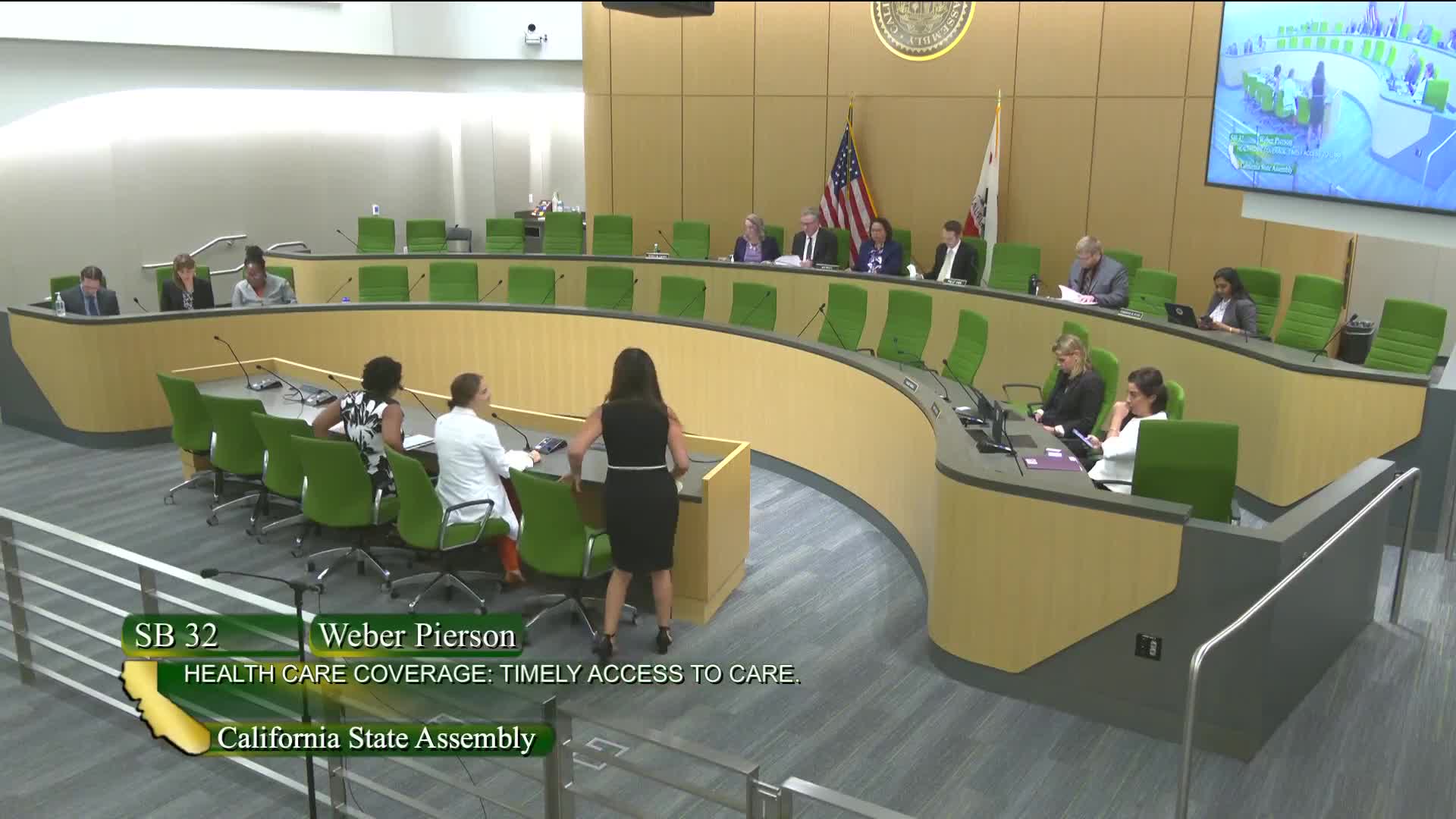
SB 32: time and distance standards for labor and delivery access Sen. presenting SB 32 told the committee the measure would require the Department of Health Care Services, the Department of Health, the Department of Managed Health Care and the Department of Insurance to run a stakeholder process and establish clear time and distance standards for access to hospital‑based labor and delivery (perinatal) units. Proponents said the state faces a maternal‑care access crisis after more than 50 hospitals closed or suspended labor and delivery services in the last decade, forcing many patients to travel long distances.
Doctor Patrice Trowbridge, an OB‑GYN representing ACOG District 9, testified in strong support: “A healthy pregnancy can escalate in minutes. … Immediate access to a property equipped with a labor and delivery unit isn’t a luxury. It’s a medical necessity.” Vanessa Gonzales of the California Hospital Association also testified that a specific time‑and‑distance standard for hospital‑based labor and delivery would help identify gaps in access and hold plans and providers accountable.
The committee recorded a motion to move SB 32 to Appropriations and the measure was advanced to that committee (motion recorded and roll called; outcome: advanced to Appropriations; detailed roll call appears in the hearing record). The author and supporters emphasized the bill is intended to increase network adequacy accountability rather than to mandate new facilities overnight.
SB 646: testing and public disclosure for toxic elements in prenatal vitamins SB 646 would require manufacturers to test each lot of bulk prenatal vitamin products for lead, arsenic, cadmium and mercury; publish results online beginning Jan. 1, 2027; and prohibit sale or distribution of noncompliant products in California. The author described recent studies finding heavy metals in many prenatal products and said the bill aims to give clinicians and pregnant people transparent information to choose safer options.
Susan Little of the Environmental Working Group described independent testing that found lead and cadmium in many products and argued Proposition 65 warnings do not give consumers current or usable information on these contaminants. Dr. Patrice Trowbridge (ACOG) said low‑level exposures during pregnancy are associated with miscarriage, low birth weight and developmental harms and urged support.
Industry groups including the Council for Responsible Nutrition and the Consumer Healthcare Products Association testified in opposition unless amended. Margie Lee (CRN) warned that some low‑contaminant products lack required nutrient levels (for example, sufficient calcium or magnesium) and that consumers might be steered toward nutritionally inadequate products; she urged further engagement and drafting changes. The author and supporters said the bill’s intent is transparency and that responsible manufacturers already test and disclose results.
The committee adopted a motion to move SB 646 as amended to the Environmental Safety and Toxic Materials Committee; the motion was called and recorded (motion: due pass as amended to Environmental Safety and Toxic Materials; outcome: advanced; roll call recorded in the hearing transcript).
Other bills advanced - SB 313 (privacy for parents’ birthplace on birth certificates): Sponsored by Sen. Cervantes, the bill would move a parent’s birthplace from the publicly accessible portion of a birth certificate to the confidential section accessible only to authorized public‑health officials and the child or adoptive parents. The author said it preserves public‑health reporting while protecting privacy; the committee advanced the measure to Judiciary (motion recorded; outcome: advanced to Judiciary).
- SB 297 (valley fever surveillance and screening): Sen. Hurtado described a proposal requiring the California Department of Public Health to annually identify regions with high incidence of valley fever and publish a list. UC Davis Center for Valley Fever director Dr. George Thompson testified about expanding geographic incidence and the need for earlier diagnosis. The committee advanced SB 297 to Judiciary (motion recorded; outcome: advanced to Judiciary).
- SB 324 (Medi‑Cal enhanced care management and community supports): Sen. Menjivar presented SB 324 to require managed‑care plans to prioritize contracting with local community providers for Enhanced Care Management (ECM) and specified community supports, clarify use of hub/intermediary models, and direct data publication and review by DHCS to monitor plan contracting practices. Local nonprofit providers, hubs and many community‑based organizations testified in support; some stakeholders (including children’s hospitals and local health plans) held opposed‑unless‑amended positions that the author said she was addressing. The committee advanced the measure to Appropriations (motion recorded; outcome: advanced to Appropriations).
- SB 418 (codify federal nondiscrimination protections and allow up to 12‑month hormone therapy prescriptions): The bill would codify Section 1557‑style nondiscrimination protections in state law and allow, where clinically appropriate, up to 12‑month prescriptions for hormone replacement therapy (HRT). Supporters said the measure protects continuity of care for patients on long‑term hormone regimens (including transgender patients, menopausal patients and those on HRT as part of fertility care). Opponents raised policy objections to gender‑affirming treatments for minors; the committee voted to send SB 418 to Business and Professions (motion recorded; outcome: advanced to Business and Professions).
- SB 660 (California Health and Human Services data exchange framework governance): The committee considered SB 660 to create a governing body and accountability for the state’s Data Exchange Framework so providers and community partners can share standardized health information securely. Witnesses from community health centers, community‑based organizations and health information organizations described pilots and benefits (reduced readmissions and improved care coordination). Hospitals and some vendors listed concerns and requested additional technical changes; the author said amendments addressing privacy, appeal processes and public comment will be taken in the privacy committee. The committee advanced SB 660 to the Committee on Privacy and Consumer Protection (motion recorded; outcome: advanced to Privacy and Consumer Protection).
Votes at a glance (outcomes recorded on July 1 hearing) - SB 646 — Due pass as amended to Environmental Safety and Toxic Materials Committee (motion carried; roll call recorded in transcript) - SB 32 — Due pass to Appropriations Committee (motion carried; roll call recorded) - SB 313 — Due pass to Judiciary Committee (motion carried; roll call recorded) - SB 297 — Due pass to Judiciary Committee (motion carried; roll call recorded) - SB 324 — Due pass as amended to Appropriations Committee (motion carried; roll call recorded) - SB 418 — Due pass to Business and Professions Committee (motion carried; roll call recorded) - SB 660 — Due pass to the Committee on Privacy and Consumer Protection (motion carried; roll call recorded)
What the hearing made clear Committee members and witnesses framed several crosscutting themes: concerns about health‑care deserts (labor and delivery closures), the need for better transparency for consumer health products, the value of local community providers for Medi‑Cal care coordination, and the technical and legal work required to make statewide health data exchange operational while protecting privacy. Several bills were advanced with the committee and author committing to continue negotiations with stakeholders before floor consideration.
Notes on evidence and votes This article is based on transcripts and roll‑call statements recorded during the July 1, 2025 Assembly Health Committee hearing. Individual roll‑call lines and procedural recordings appear in the hearing transcript. Where the transcript did not include a numerical vote tally for every measure in a single summarized line, this article reports the committee outcome (motion carried/advanced) and cites that the roll call is recorded in the hearing record for exact vote details.
Further steps Each bill advanced to the next committee listed above for additional policy and fiscal review. Sponsors and opponents indicated continued engagement in drafting and technical amendments before floor votes.