Get Full Government Meeting Transcripts, Videos, & Alerts Forever!
Get email alerts on the Menstrual Product Transparency topic
No spam. Unsubscribe anytime.
Committee advances bill to require manufacturers disclose contaminants in disposable menstrual products
Summary
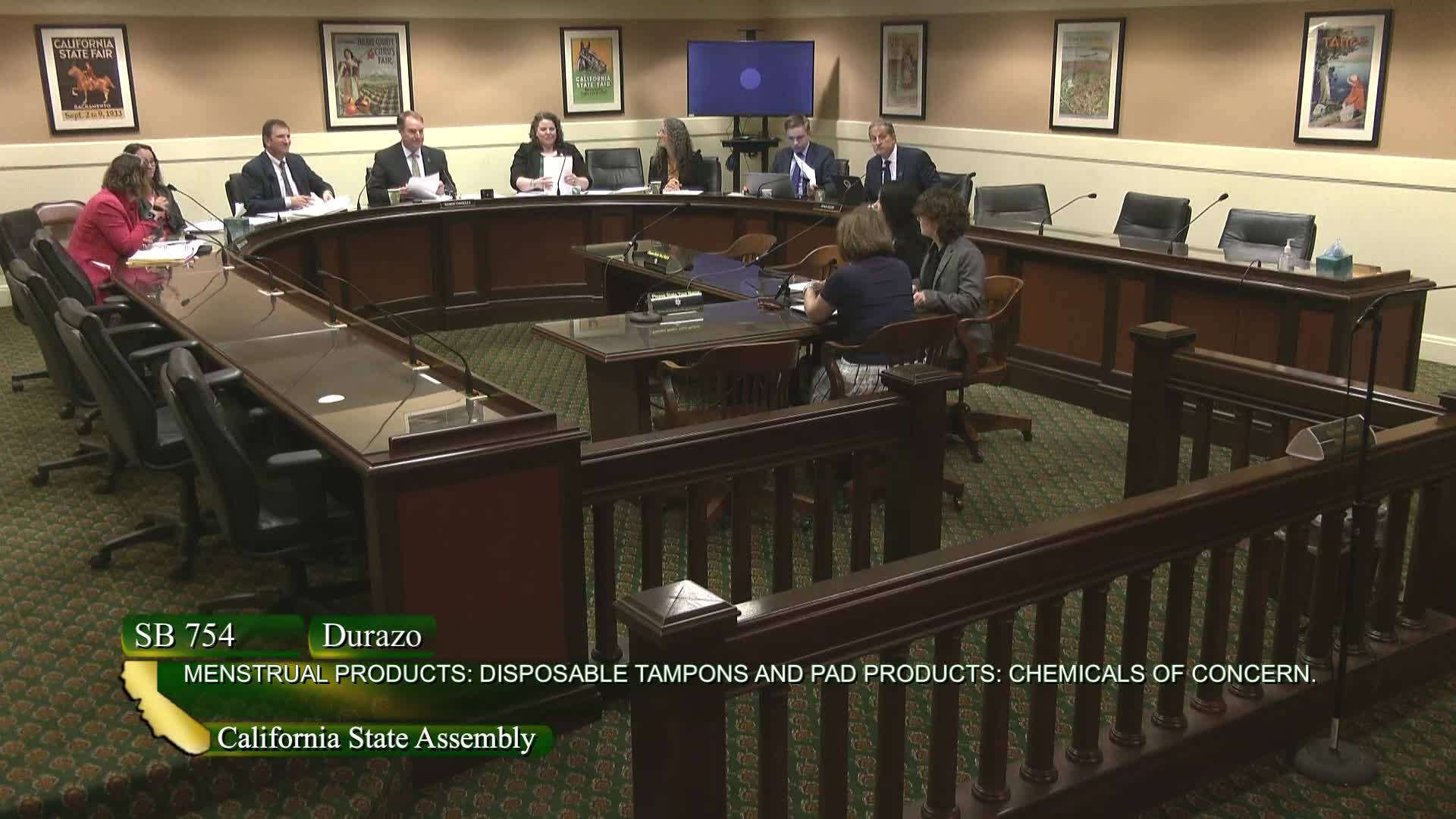
The Assembly Environmental Safety and Toxic Materials Committee voted to advance SB 754, which would require manufacturers of disposable menstrual products to test for and report concentrations of certain potentially harmful contaminants to the Department of Toxic Substances Control (DTSC).
The Assembly Environmental Safety and Toxic Materials Committee voted to advance SB 754, which would require manufacturers of disposable menstrual products to test for and report concentrations of certain potentially harmful contaminants to the Department of Toxic Substances Control (DTSC).
Senator Maria Elena Durazo, the bill's author, told the committee the measure would close a transparency gap: current law requires disclosure of intentionally added ingredients but not unintended contaminants that may appear as manufacturing byproducts. Durazo said peer‑reviewed research found toxic metals in every tampon tested and emphasized the greater absorption risk presented by vaginal tissue.
The bill would require manufacturers to test for four metals—lead, arsenic, cadmium and zinc—and allow DTSC to independently verify those results and publish analytical findings and DTSC—s analysis. Supporters told the committee that collecting and publicizing this data would help monitor product safety and enable further research. Justine Chu Griffith of the California Association of Student Councils said monitoring is especially important for the millions of students eligible under AB 367, which requires free menstrual products in many schools.
Scientists who submitted testimony described studies finding multiple metals across products and said systematic, public data would fill an important public‑health gap. In written testimony introduced at the hearing, environmental epidemiologist Dr. Jenny Shearson and collaborators summarized peer‑reviewed findings that many metals were present at detectable concentrations and urged transparency to enable health evaluation.
Manufacturers and industry groups remained opposed unless amended. Elizabeth Esquivel of the California Manufacturers and Technology Association and representatives of the Center for Baby and Adult Hygiene Products said FDA already regulates these products as medical devices and cautioned the bill could create duplicative testing, unclear thresholds, and public results that might be misinterpreted. They requested clarified methodologies, timelines and appeal processes and said DTSC—s existing Safer Consumer Products program may better coordinate such work.
Committee members voiced support for consumer transparency but questioned technical details such as which chemical species and units (nanograms per gram / parts per billion) would be used and whether publicly posted lab data could be misread without exposure context. The author said amendments have been made to clarify acceptable testing methods and committed to further technical refinement.
The committee recorded the motion to pass SB 754 to the Committee on Appropriations. Supporters urged publication and consumer access to the results; industry asked for tighter technical fixes and a less duplicative approach.