Get Full Government Meeting Transcripts, Videos, & Alerts Forever!
Get email alerts on the Hazardous Waste Fees topic
No spam. Unsubscribe anytime.
Assembly committee advances bill capping DTSC hazardous‑waste fee for infill housing
Summary
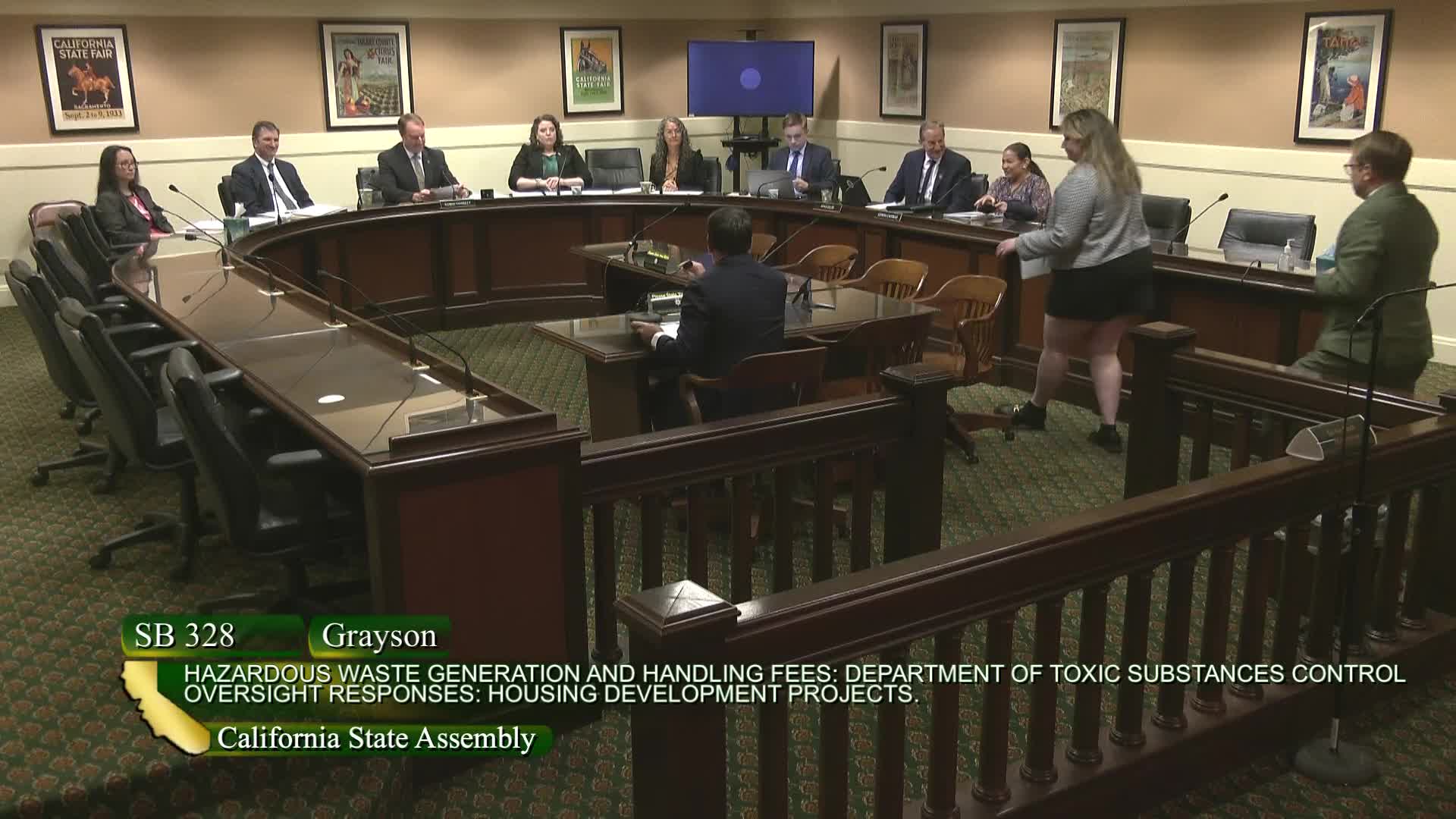
The Assembly Environmental Safety and Toxic Materials Committee voted to pass SB 328 to the Committee on Revenue and Taxation. The bill would cap the Department of Toxic Substances Control(DTSC) hazardous waste generator fee for residential infill and master development projects and set response deadlines for DTSC review of remediation plans.
Assembly members on the Environmental Safety and Toxic Materials Committee voted to pass SB 328 to the Committee on Revenue and Taxation, a bill authored in the Senate that would cap a DTSC hazardous‑waste fee and set timelines for DTSC review of development‑related cleanup plans.
Senator Bill Grayson, the bill—s author, told the committee the measure is intended to prevent "significant cost increases for housing developers who have remediated contaminated soil and returned the land back to productive use." He said the 2022 budget trailer bill SB 158 replaced a tiered, capped fee with a fixed per‑ton charge of $46.20, producing unexpectedly large bills that have threatened infill and community development projects.
The bill would establish a $100,000 cap per project per year for qualifying infill housing projects and a $250,000 cap per project per year for master development projects. SB 328 would also require DTSC to provide an initial response to cleanup plans within set timeframes (60 days for smaller projects and 120 days for larger projects) and to include requests for additional information and applicable timelines in that response.
Supporters said the cap would allow more contaminated urban infill sites to be cleaned and redeveloped. Luis Morante of the Bay Area Council, a bill sponsor, said members —many of them developers—stopped projects after the fee cap was removed. Ally Zaferman, advocacy and policy manager for Housing Action Coalition, described examples including a UC Law San Francisco project that faced an unexpected additional six‑figure assessment after the fee change.
Opponents urged caution about shifting DTSC funding burdens. Dawn Koepke of the California Council for Environmental and Economic Balance said many sectors pay the generator/handling fee and that carving caps for one sector could spread costs to others unless a comprehensive fee reform is pursued.
Senator Grayson acknowledged that consequence and said he is open to further discussions on fee reform that would ensure DTSC remains funded while removing disincentives to remediate and develop infill sites. With a quorum established, the committee voted to pass the measure to the Committee on Revenue and Taxation.
Votes and next steps: The committee recorded the action as "do pass to the Committee on Revenue and Taxation." The committee roll calls during the hearing recorded multiple members saying "aye"; the measure was advanced to the next committee for fiscal and tax consideration.
Why it matters: Supporters say an uncapped per‑ton fee increases remediation costs for infill housing, delaying cleanup and construction on urban sites. Opponents warn that without broader fee reform the shortfall could shift costs to other regulated generators. SB 328 pairs a fee cap with deadlines for DTSC review, aiming to preserve agency oversight while easing development costs.
The Assembly file will move next to the Committee on Revenue and Taxation for consideration of fiscal and tax impacts.