Get Full Government Meeting Transcripts, Videos, & Alerts Forever!
Get email alerts on the Floodplain Permit Appeal topic
No spam. Unsubscribe anytime.
Floodplain administrator's denial of Wingstop tenant permit opposed at appeal hearing; board to issue written decision
Summary
Property owner Core Marwood Plaza LLC appealed the floodplain administrator's determination that a tenant improvement at 3325 Kentucky Ave must meet current building-protection standards. The floodplain administrator recommended denying the appeal; the board heard testimony and will issue a written ruling within 30 days.
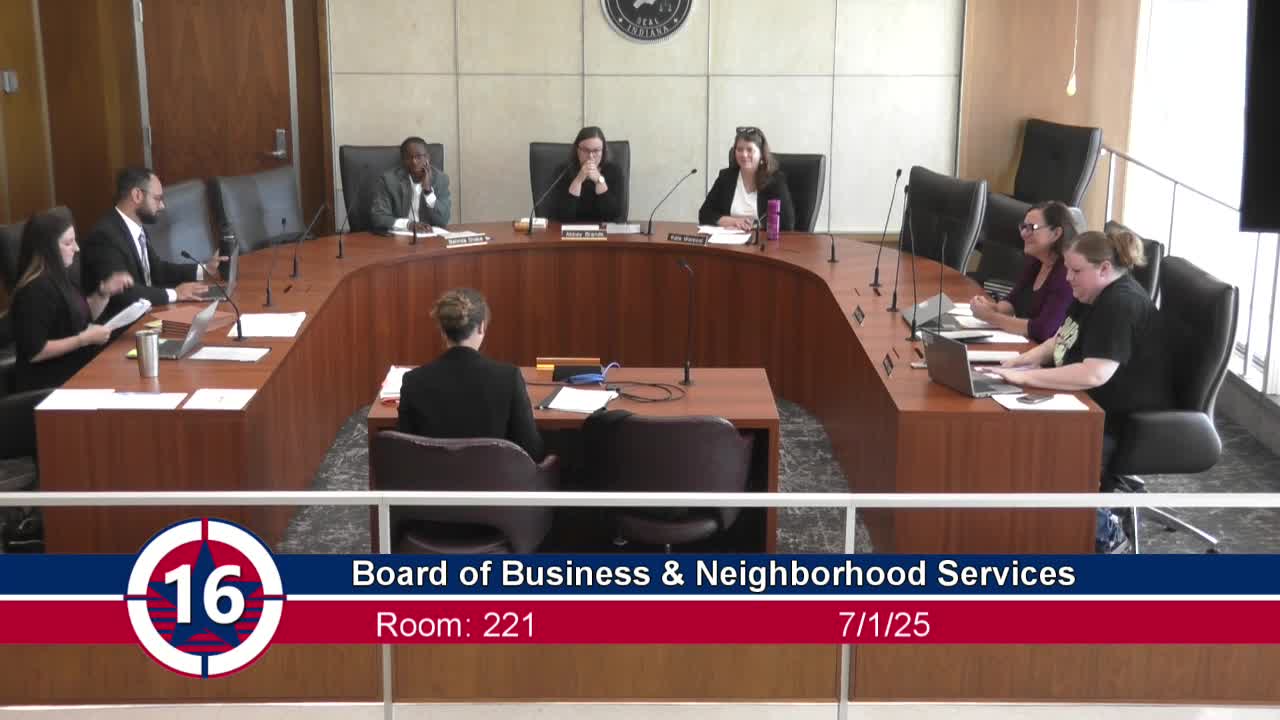
The City of Indianapolis Board of Business and Neighborhood Services on July 1 heard an administrative appeal over a floodplain development permit for tenant improvements at 3325 Kentucky Ave, a retail strip center where a Wingstop unit sought permit approval.
Jessica Finley, attorney for Core Marwood Plaza LLC, said the proposed tenant improvement is less than 3,000 square feet and argued it should be treated as a non-substantial improvement under the flood damage prevention ordinance because its estimated cost ($150,000–$200,000) is well below 50% of the building’s market or assessed value. Finley said the strip center totals about 107,080 square feet with 17 units and noted the owner purchased the property in 2023 before the city’s July 2024 ordinance update. The owner’s position, she said, is that an interior tenant improvement should not require elevating or flood proofing the entire building.
Alena Jones, the City of Indianapolis floodplain administrator (Department of Business and Neighborhood Services), testified she reviewed permit records, engineering review, and the ordinance. Jones read the department’s notice of determination into the record: “Determination. Permit FLD24-00287 cannot be issued unless the plans are altered to reflect bringing the building into compliance with current building protection standards.” Jones said the new ordinance (effective summer 2024) condensed prior rules and that section 565503(a)(11) applies where a structure has had prior improvements since the city’s first floodplain ordinance in 1971; in her interpretation, “any and all” prior improvements trigger the building-protection requirement for subsequent work.
Jones testified that permit and Acela system records indicate multiple prior permits for alterations and repairs at the property, and that applicant-provided project costs across prior permits total in the millions. She said her office requested information about whether the walls between tenant spaces are load-bearing; the applicant did not supply that documentation and instead filed the appeal. Jones told the board that if walls are load bearing, flood proofing could be limited to individual tenant spaces; if not, the entire building would have to meet the standard. Jones estimated flood-proofing the single tenant space at roughly $25,000 (average commercial per-space estimate) versus about $2,000,000 to flood-proof the entire structure.
City legal counsel and Jones emphasized the city’s obligations under the National Flood Insurance Program (NFIP) and federal guidance (44 CFR §60.1, §60.3). Jones said local authorities are permitted — and sometimes encouraged — to adopt standards more stringent than federal minimums and that the city’s adoption of the revised ordinance followed FEMA/IDNR review to maintain NFIP participation. Jones warned that failure to enforce the ordinance consistently could risk suspension from the NFIP and loss of related federal benefits and disaster-assistance eligibility.
Finley argued the permit denial was an incorrect application of the ordinance’s substantial-improvement provisions and raised a constitutional takings concern if the city required full building flood-proofing for a routine interior tenant improvement. City counsel objected to portions of Finley’s oral submission as unsworn testimony; the board heard sworn testimony from Jones and admitted staff exhibits (permit records, the notice of determination, staff report) for consideration.
The board did not issue a final ruling at the meeting; legal counsel reminded members that the board must provide written findings within 30 days. The floodplain administrator recommended denying the appeal and upholding the notice of determination; the appellant reserved time for closing. The board will weigh the evidence presented, including engineering/permit records and ordinance interpretation, and issue a written decision within the 30-day statutory window.