Get Full Government Meeting Transcripts, Videos, & Alerts Forever!
Get email alerts on the Personnel Discipline topic
No spam. Unsubscribe anytime.
Milwaukee civil service board upholds cause but reinstates DPW worker without back pay
Summary
After a June 30 hearing, the Board of City Service Commissioners found cause to discharge a Department of Public Works sanitation operator but voted to reinstate her without back pay, citing cumulative personnel issues including attendance, alleged insubordination and sleep-on-duty incidents.
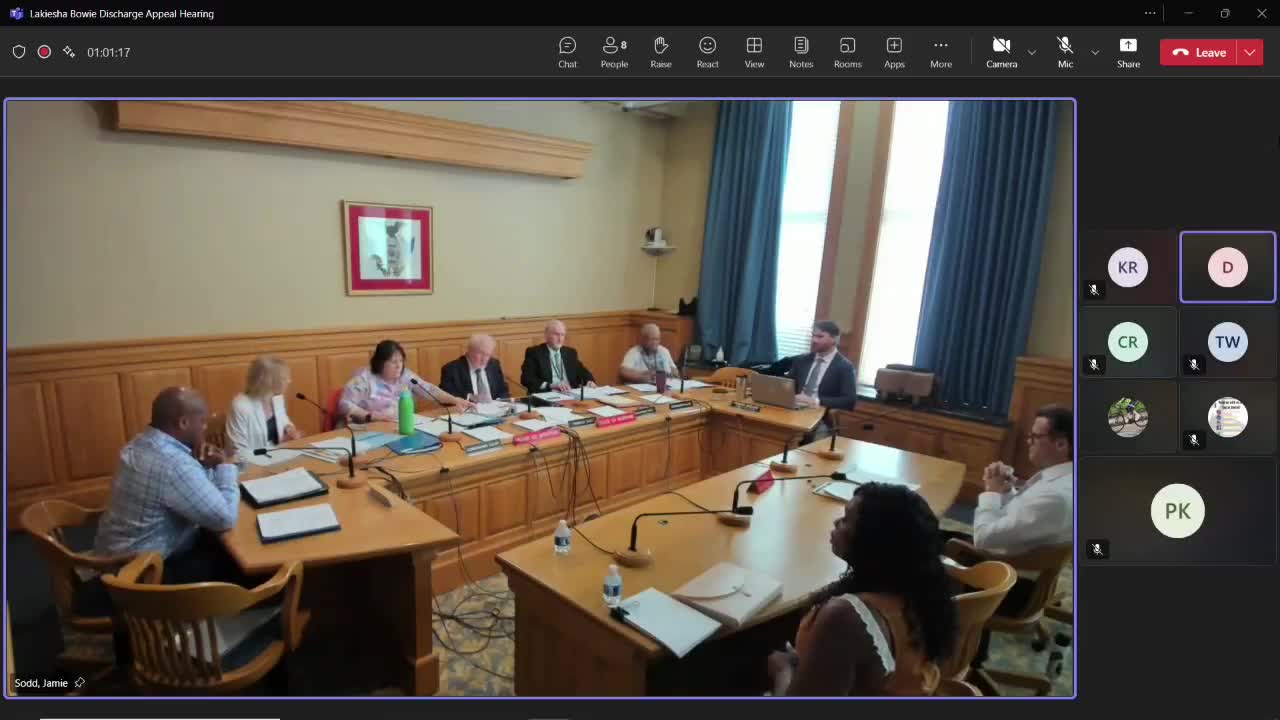
The Board of City Service Commissioners on June 30 heard an appeal from Lakiesha Bowie, a former equipment operator in the Department of Public Works (DPW) Sanitation, and found the department had cause for discharge but voted to reinstate her without back pay.
The commission moved into closed session to deliberate and then returned to announce its decisions. Commissioners voted that, by a preponderance of the evidence, DPW had cause to discharge Bowie. On a follow-up vote the board decided to reverse the department’s termination and reinstate Bowie to her position without back pay (commission vote: 4–1 in favor of reinstatement; Commissioner Cleary recorded a dissenting vote).
Why the decision matters: the case centered on a last-chance agreement Bowie signed in April 2024 and a cluster of attendance and conduct allegations that DPW said occurred afterward. DPW officials told the commission that cumulative issues — including repeated late arrivals, alleged on-duty sleeping during overnight broom assignments and an exchange with a supervisor documented as aggressive language — supported discharge under the last-chance agreement’s terms.
Department evidence and testimony - Chuck Schumacher, operations administration manager for DPW, told the commission the department asked it to "uphold the discharge," saying Bowie had a range of work-rule violations after signing a last-chance agreement and that prior internal investigations had not shown the harassment claims she raised to be germane to the discharge hearing. Schumacher said the city’s presentation would show violations "to include insubordination, idleness, punctuality, and sick leave abuse." - Dan Thomas, DPW administrative services director, reviewed the last-chance agreement on the record and read its terms, saying, "This agreement will be in effect from 04/11/2024 through April eleventh of 20 26." He testified that an employee on such an agreement who accumulates recurring punctuality problems, sleeping on the job, or other rule violations can be discharged, and that the record showed multiple tardies and other incidents. - Fleet supervisor Adam Lopez and sanitation supervisor Cameo Coleman offered technical and on-the-ground evidence. Lopez produced time-stamped facility images and automated-vehicle-location (AVL) logs showing instances when Bowie’s assigned vehicle was idle in yard locations during overnight assignments (one interval cited in DPW exhibits showed a vehicle in Lincoln Yard from about 12:58 a.m. to about 2:14 a.m., roughly 80 minutes). Coleman testified he observed Bowie asleep in a truck during one overnight assignment and described having to reassign routes because of schedule conflicts.
Appellant’s testimony and claims Bowie acknowledged she signed the last-chance agreement but said she signed it under pressure and disputed aspects of the department’s record. She told the commission she had called supervisors to report fatigue on at least one overnight assignment and said the safety concern was the reason she pulled back to a yard, not misconduct. Bowie also disputed the characterization of some late arrivals, saying she often performed vehicle pre-trip work before scanning in and that supervisors had been aware of her routine. She said many sick-leave entries were documented by medical providers and that some absences were for her children's dental emergencies.
Board action and votes at a glance - Approve minutes (Agenda item 3, file 250231): motion to approve carried (minutes approved as submitted). (Recorded during the meeting prior to the hearing.) - Motion to find cause for discharge: passed (commission recorded a finding that DPW had cause to discharge the appellant). - Motion on penalty: the commission voted to reinstate Lakiesha Bowie without back pay (motion carried 4–1; Commissioner Cleary recorded the dissent). The board noted it had considered the last-chance agreement, personnel history, attendance records, AVL data and testimony from DPW witnesses in reaching its decision.
What the record shows and limits on the ruling The commission’s finding of cause reflects the board’s view that the department presented evidence of multiple post‑agreement violations (attendance, alleged sleeping during an overnight route, and conduct toward a supervisor). The decision to reinstate without back pay indicates the board weighed mitigating factors — including Bowie’s length of service and aspects of her testimony — against the violations and chose a remedy short of restoring back pay.
The hearing record also included testimony that harassment complaints Bowie raised were investigated and not sustained by DPW leadership; the commission did not rule on those harassment allegations in this employment appeal. The board’s action was limited to the discharge appeal; any separate claims (for example, discrimination or a harassment complaint) were treated by witnesses as matters for other forums.
Next steps The commission’s action restores Bowie to her former position without back pay. The transcript shows the board completed deliberations and adjourned the meeting after issuing its rulings.
Endnote: The board’s deliberations and votes were conducted under the civil service process for employee appeals; the commission noted it had the authority to deliberate in closed session under the cited Wisconsin statutes during its decision-making process.