Get Full Government Meeting Transcripts, Videos, & Alerts Forever!
Get email alerts on the Wind Energy topic
No spam. Unsubscribe anytime.
Public forum on industrial wind farms draws wide local participation; Act 945 and local controls highlighted
Summary
Washington County held an open discussion on industrial wind farms. Residents and an organized group (Concerned Citizens of the Ozarks) urged caution, citing karst geology, groundwater, wildlife, property-value and decommissioning concerns; others and some justices discussed climate and renewable-energy considerations. County counsel and speakers
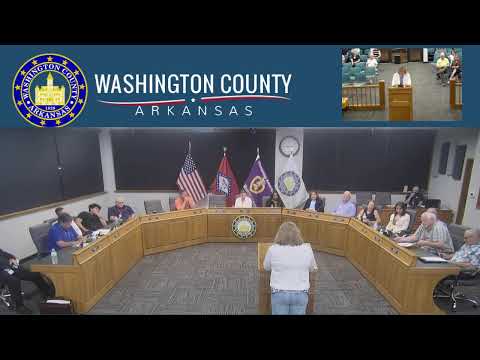
Washington County convened an open public discussion on industrial wind farms during the County Services Committee meeting. The session combined public comment and a presentation by Concerned Citizens of the Ozarks and drew remarks from county justices and attending residents from Lincoln, Prairie Grove and surrounding communities.
Several residents and groups opposed proposed turbine development near Lincoln and other locations. Common themes included concern about Washington County’s karst terrain, potential impacts to groundwater and wells, effects on wildlife (bats, birds and eagles), road damage from construction, and decommissioning liability if developers dissolve. Public commenters cited examples in other counties where turbines failed or were shut down; one speaker noted three collapsed turbines in Missouri in 2024 and current shutdowns affecting that project’s operations. Concern about nondisclosure clauses in lease agreements and limited public notice to neighbors who do not hold large acreage was a repeated theme.
Concerned Citizens of the Ozarks described the legislative response in Arkansas. A group representative summarized the Arkansas Wind Energy Development Act (cited in the meeting as Act 945), which places new disclosure and permitting obligations on developers and shifts aspects of siting and review to the Arkansas Public Service Commission. The speaker said Act 945 requires developers to provide community notice, public hearings, and certain setback standards (for example, multi-hundred- to multi-thousand-foot setbacks for certain sensitive uses); local jurisdictions may adopt rules, but they cannot be less restrictive than the statute.
Justice Rivera Lopez and other justices framed the issue in terms of energy production and climate: Rivera Lopez noted regional renewable-energy shares and argued for a frank discussion about long-term energy mixes. Justice Stafford, who attended an industry meeting in Cincinnati, summarized the developer’s stated approach: developers first sign agreements with private landowners, then undertake testing and, only with positive results and recruitment of landowners, would they seek conditional use permits from local government. The developer representatives, Stafford said, told attendees they would pay for road improvements required for construction and would not use eminent domain against unwilling landowners.
Presenters and commissioners urged increased transparency and community engagement. Angela Ussery of Concerned Citizens of the Ozarks provided a Linktree resource for Act 945 and related materials and said the group has compiled case studies and interviews documenting outcomes in other states. Public comments urged the quorum court to consider setbacks, financial assurances for decommissioning, tax-payment reliability and protections for residents who do not sign leases.
Why it matters: Wind projects raise overlapping land-use, environmental, fiscal and emergency-response questions for counties. Act 945 creates a state-level permitting structure but leaves local zoning and conditional-use processes relevant. The committee did not take action; officials encouraged continued public engagement and noted that any developer seeking a conditional-use permit would come before the planning and zoning process described by county ordinance.