Get AI Briefings, Transcripts & Alerts on Local & National Government Meetings — Forever.
Committee staff summarizes FY 2026 budget package and related bills
Loading...
Summary
Committee staff presented summaries of the fiscal year 2026 FEED (general appropriations) bill and a series of related budget and policy bills, outlining major revenue and appropriation changes, capital outlay, education and health program funding, and several policy provisions tied to implementation of the budget.
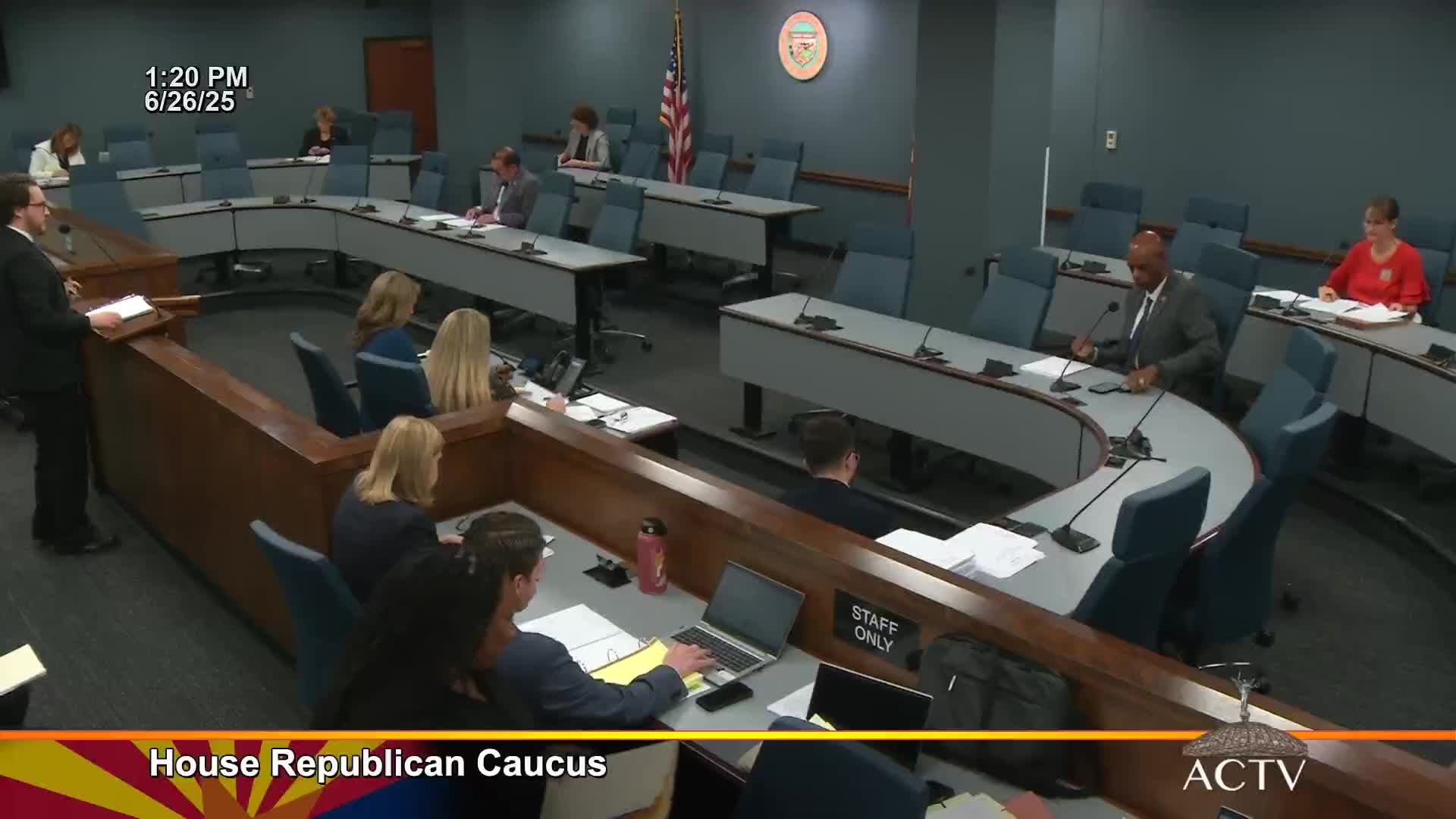
Committee staff on an unspecified date summarized the fiscal year 2026 budget package and related implementation bills for the Arizona Legislature Appropriations Committee.
Committee staff described Senate Bill 17 35, the fiscal year 2026 General Appropriations Act (FEED bill), and said it “appropriates $17,600,000,000 in fiscal year 26,” with about $1,000,000,000 of that amount described as one-time funding. Staff listed several large general fund changes, including “additional revenue of approximately $131,100,000 in fiscal year 20 25 and $62,900,000 in fiscal year 27 due to savings from the enhanced federal medical assistance percentage” and an ongoing savings of “$150,000,000 in fiscal years 2026 through 2028 due to a transfer of monies from the prescription drug rebate fund.”
Major budget and policy items summarized to the committee - Corrections and public safety: Committee staff said the FEED bill includes an ongoing increase of $37,400,000 for the Department of Corrections operating budget and a one-time appropriation of $21,400,000 to provide correctional officers a one-time stipend equal to 4% of their annual salary. Staff also described $5,000,000 ongoing for a 5% salary increase for state sworn officers and DPS dispatchers, and a 15% salary increase for state firefighters (as summarized by committee staff). - Developmental disabilities and childcare: Staff said the package contains $14,800,000 one-time for high-cost developmental disability (DD) program clients in FY 26 and an ongoing increase of $37,400,000 for the Department of Corrections operating budget; additionally, a one-time $37,800,000 was listed for DES assisted childcare assistance. - Capital outlay and transportation: Committee staff summarized the capital outlay bill, saying it “appropriates approximately $729,600,000 in specified fiscal years” and noted a $458,770,000 appropriation from the State Highway Fund in FY 2026 to the Arizona Department of Transportation (ADOT) for highway planning and construction. Staff said transportation projects would also appear in the capital outlay bill. - Higher education: The higher education budget bill (SB 17 42) would increase the maximum amount of lease-to-own and bond transactions ABOR may enter by $325,000,000 and requires JCCR review before ABOR may distribute monies to projects; staff also summarized distribution rules for certain scholarship and promise program funds. - K–12 education: Staff summarized SB 17 44 as increasing charter additional assistance and transportation support by 2% and reestablishing multiple adult and workforce programs. The bill also creates a ninth grade on-track grant program, requiring ADE to award at least $150 for each ninth-grade student funded, capped at 22,650 students in FY 26. - Health and human services: The health-care budget bill (SB 17 41) and human services budget bill (SB 17 43) include a mix of grants, program changes and extensions, including a $3,000,000 one-time grant for an outpatient dialysis treatment center and continuation of developmental disability monitoring pilots and foster care service models. - Other policy and fiscal measures: Staff summarized bills addressing amusements and racing fees, micro business loans, tax exemptions for veterans and pipes/valves used for wastewater, and the establishment of several transportation funds including a Statewide Infrastructure Trust Fund and an Advanced Air Mobility Fund.
Committee process and next steps Committee staff concluded each bill summary by inviting questions; in multiple instances staff said they were available to answer questions but deferred certain technical or sponsor-specific questions to the bill proponents. The transcript excerpt does not record final committee votes or recorded motions for these bills.
Key figures stated to the committee (as summarized by staff) - Total FEED appropriations (FY 2026): $17,600,000,000 (about $1,000,000,000 one-time) - Estimated additional revenue: ~$131,100,000 (FY 2025) and ~$62,900,000 (FY 2027) from enhanced FMAP savings - Ongoing savings from prescription drug rebate fund transfer: $150,000,000 (FY 2026–2028) - ADOT highway appropriation (FY 2026): $458,770,000 from the State Highway Fund - Capital outlay total specified (various years): approximately $729,600,000
No votes or final dispositions for the summarized bills are included in the provided transcript excerpt.