Get Full Government Meeting Transcripts, Videos, & Alerts Forever!
Get email alerts on the Property Maintenance Code topic
No spam. Unsubscribe anytime.
Tacoma committee briefed on International Property Maintenance Code adoption, pilot abatement and Acela rollout
Summary
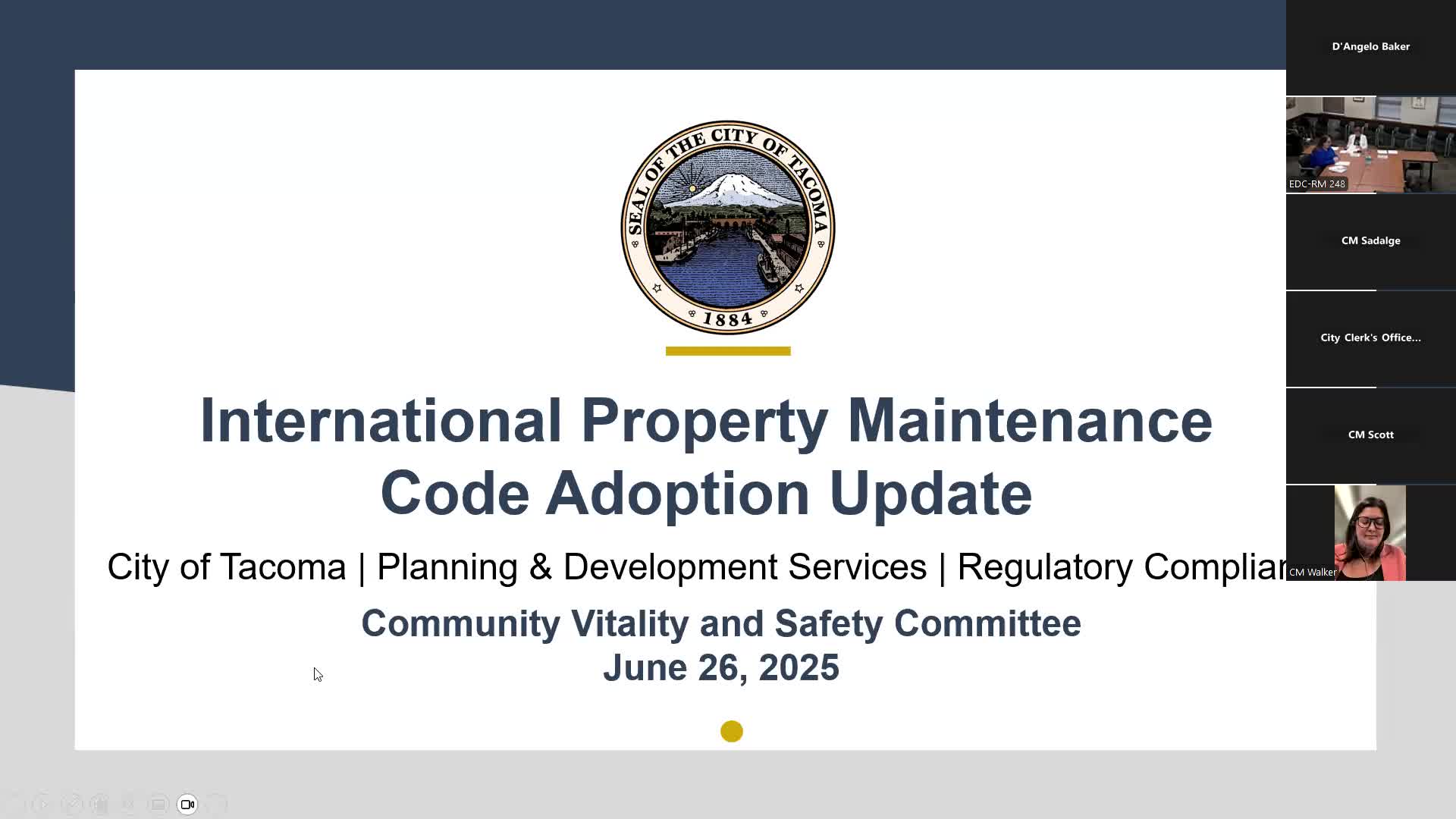
On June 26, 2025, the Tacoma Community Vitality and Safety Committee received an update on the city’s planned adoption of the International Property Maintenance Code, a city-funded pilot abatement program that would use deferred cost recovery or property liens, and the migration of code compliance case management into the Acela platform.
On June 26, 2025, the Tacoma Community Vitality and Safety Committee received an update on the city’s planned adoption of the International Property Maintenance Code, a city-funded pilot abatement program that would use deferred cost recovery or property liens, and the migration of code compliance case management into the Acela platform.
The update was delivered by Mindy Weber, representing Planning and Development Services and the city’s regulatory compliance team. Weber said the International Property Maintenance Code will provide “a unified regulatory framework” that combines structural standards and property maintenance requirements and is designed to integrate with Tacoma’s existing codes.
Weber told the committee the city will apply an “education first approach” in enforcement and build in an escalating penalty structure and due-process protections. She said staff are working to ensure equity safeguards, language access, and mechanisms to support property owners who lack immediate resources. “This pilot program allows us to address more challenging cases that have frustrated neighborhoods, while testing innovative approaches that could be expanded if successful,” Weber said.
Key program elements described by Weber included: - Integration under the city’s Uniform Enforcement Code to standardize procedures across permit compliance and code enforcement and to allow for escalating penalties where voluntary compliance fails. - A test pilot for chronic neighborhood issues in which the city would conduct city‑funded abatement with the property owner’s consent and recover costs later through deferred cost recovery or a property lien. Weber said the pilot is intended to speed resolution for owners who want to comply but lack immediate funds; legal staff are still reviewing limits and repeat-use rules for the pilot. - Migration of code‑compliance case management into the Acela platform to centralize files, add mobile field capabilities (photo upload and in-field updates), and enable better reporting and program tracking.
Weber walked the committee through an implementation timeline: a June–August 2025 phase of legal research, code review and policy development; September–December 2025 drafting of ordinance language and procedures; January–March 2026 code refinement and the city council adoption process; April–June 2026 a 90‑day education and preparation period; July 2026 as the planned start of enforcement; and a comprehensive six‑month review in January 2027.
Committee members responded positively to the update. Council Member Sadaghe complimented the presentation and said she looked forward to the detailed materials coming from staff. Council Member Walker said, “I don't have any questions. I really appreciate the update and that detailed timeline.” Vice Chair Scott and other members expressed support for increased enforcement options combined with education.
During questions, a committee member asked whether the rental‑housing code might be folded into this enforcement framework; Weber said she would need to “research the rental housing code a little bit more” and that staff would follow up. Committee members also asked whether the city‑funded abatement pilot would be a one‑time remedy or could be used multiple times for repeat problems; Weber said legal review is ongoing and staff do not yet have a definitive answer.
No public commenters signed up to speak on the item at the meeting. The committee adjourned following the briefing.
The packet for future committee meetings listed a July 10 briefing on street medicine, a July 24 rental housing code/landlord fairness update, and an August 14 briefing on the BRAVE (Building Resilience Against Violence and Exploitation) program.