Get Full Government Meeting Transcripts, Videos, & Alerts Forever!
Get email alerts on the Elections topic
No spam. Unsubscribe anytime.
Lubbock County elections office outlines legislative changes, equipment and training needs ahead of 2026 cycle
Summary
Elections staff briefed Lubbock County Commissioners Court on multiple recent and pending state bills that will change ballot forms, curbside voting rules, post-election audits and polling operations; officials warned of higher training, overtime and equipment needs and said they have applied for a grant to buy poll pads.
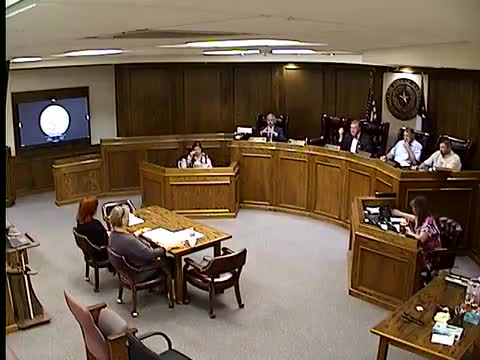
Roxine Stinson, an elections department staff member, told the Lubbock County Commissioners Court during a June work session that a wave of recent and pending state laws will change ballot forms, curbside voting signage and post‑election audit procedures and will affect the department’s budget and operations for 2026 and beyond.
Stinson said the department expects large-scale changes to mail‑ballot inserts, voter registration forms, provisional ballot affidavits and other printed materials because the new rules require larger font and revised wording. “They told us pretty much every form we have in our building is fixing to change,” Stinson said. She advised the court not to order new stock until the final language is released.
The department also described several bills by the identifiers used in the presentation. The transcript references: “House bill 521” (signage for curbside voting), “Senate bill 827” (post‑election audits), “Senate bill 1540” (staff and poll worker address protections), “House bill 3909” (cell‑phone use near polling places), “Senate bill 2753” (changes to election‑night reporting), and other numeric citations as noted in the department presentation. Stinson said the county will track the state’s forthcoming rule language and guidance closely and adjust operations as required.
Stinson described specific operational impacts: curbside voters will be required to sign an affidavit attesting they meet qualifications for curbside voting (without disclosing a disability), and counties will have to update curbside signage and designated curbside parking. She said new audit rules will require risk‑limiting audits plus location‑based manual counts starting in November 2026 and that counties will be required to post audit results on their websites.
The office is monitoring an executive order and related guidance for new voting‑system standards from the Election Assistance Commission (EAC). Stinson warned that if new federal certification standards are enforced as drafted, some counties may need to change equipment. “Right now, this county is not affected because it says that the EAC … there is nobody in this country that has equipment that meets [the new] guidelines,” Stinson said, adding there are multiple lawsuits challenging the executive order.
On equipment and supplies, Stinson said the elections office rotates small memory devices (V‑drives) used to collect ballot results. She said the county had about 1,350 V‑drives in 2017, now has roughly 560, and budgeted to purchase 300 this year at about $66 apiece. She also reported the department has applied for a grant tied to Senate Bill 2217 (referenced in the presentation) to buy poll pads (iPads for poll books) and said she has a contingency plan to buy them from a contract account if the grant is not awarded.
Staffing, training and poll‑worker pay were raised as budget priorities. Stinson said poll‑worker pay is currently $13 and $15 per assignment and training compensation is $10; she recommended raising those rates ahead of heavier workloads anticipated under the new laws. Training needs are expected to increase because of multiple form and process changes; Stinson estimated classes will run 8–12 hours depending on the election and the office aims to keep classes at about 20 trainees each.
Stinson also flagged logistical needs: secure storage for blank mail‑ballot applications and envelopes (locked rooms rather than open access); additional training space (the county jury room is currently used but will be lost during a planned remodel); and anticipated overtime costs because some legislation would extend weekend and Sunday hours and eliminate the gap between early voting and election day. She said the department will coordinate with United Supermarkets (an organizing partner for curbside sites) and other local partners as guidance finalizes.
Stinson described two operational trends counties are considering: balloting‑on‑demand systems that print ballots when voters check in, and expanded logic and accuracy testing requirements that will lengthen pre‑election L&A work. She said some large Texas counties recently moved to ballot‑on‑demand to prepare for changing requirements but recommended Lubbock County wait for final guidance given ongoing litigation and federal rulemaking.
The presentation closed with a request that commissioners consider funding for increased poll‑worker pay, additional V‑drives and a training facility or longer‑term space solution to reduce repeated setup/teardown of equipment. Stinson said the office has already applied for grants and would bring purchase requests back to the court if grant funding is not secured.
Stinson and her staff invited commissioners to visit the elections facility to view equipment and offered to provide regular updates as state guidance becomes available.