Get Full Government Meeting Transcripts, Videos, & Alerts Forever!
Get email alerts on the School Finance Tax Rates topic
No spam. Unsubscribe anytime.
Appoquinimink board finds $4.9 million gap in carryover, proposes tentative tax rates and $2.5 million in cuts
Summary
The Appoquinimink School District reported a sharply smaller year-end carryover after accounting errors and reassessment timing, presented tentative tax-rate recommendations and identified $2.5 million in planned spending cuts ahead of a July 8 vote.
The Appoquinimink School District reported on June 25 that an error in its March financial projection and the timing of New Castle County reassessments have reduced an expected year-end carryover from about $7.9 million to an estimated $3.0 million, the board heard at a special finance workshop.
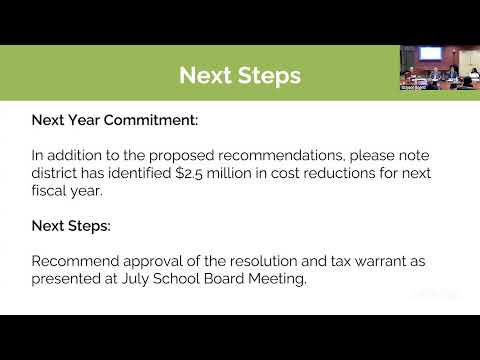
Board leaders said the district will present tentative tax-rate recommendations at a July 8 meeting and that staff have identified $2.5 million in reductions for the 2025–26 fiscal year. The district also said it expects updated assessment figures from New Castle County on or about July 1 that could change the recommended tax rates before the board’s July vote.
Why it matters: The shortfall narrows the district’s financial cushion just as the board prepares the annual tax warrant the county uses to bill property owners. Board officials said the error was in payroll timing and category misclassification that together lowered projected available cash and could affect carryovers and planning for next year.
At the workshop the board president said the March 31 financial position report had projected a $7.9 million carryover and noted that state law requires districts to keep cash on hand equal to two payrolls and to file a financial position report three times a year. After rechecking the report, staff found it had undercounted payrolls and omitted certain stipend and summer-school charges.
District staff described the errors in three parts: an incorrect payroll-count assumption, extra stipend/one-time payments that were not included, and about $1.1 million in summer-school costs recorded to federal accounts that cannot legally pay those expenses and therefore must be funded from operating dollars. The board president summarized the impact: "it looks as though right now, our estimate is we are only gonna carry over $3,000,000 rather than $7,900,000." (Comment attributed in transcript to the board president.)
Officials quantified the payroll issue: the financial report had assumed six payrolls for April–June but there were actually seven; the district estimated a typical payroll at about $2.1 million, so the extra payroll reduced cash-available projections by roughly that amount. The district also said it missed stipend and coaching payouts that occur on different schedules and that summer-school costs were miscategorized, further reducing carryover.
The county reassessment amplified the planning complexity. Staff said New Castle County completed a multi-decade reassessment that increased the district’s assessed base from about $2.7 billion last year to roughly $15.2 billion in the current run of figures used in the draft calculations. Because revenue-neutral rules generally require tax rates to decline when assessments rise, reassessment changes can shift rates substantially; the district said it expects an updated assessed value from the county on or about July 1 that could push the assessed base higher and lead to lower rates than the tentative recommendations.
Tentative tax-rate recommendations: Finance staff presented tentative rates across the four components that make up local property taxes: general operations, debt service, match (various state-matchable programs) and the tuition tax for special education. Using the assessment figures available at the time, staff said the tentative recommendation would produce a total local tax rate of 64.21 cents per $100 of assessed value composed of:
- General operations: 35.73 cents (yielding approximately $54 million in local operations revenue under the draft assessment figure) - Debt service: 7.53 cents (about $11 million) - Tuition tax (special education): 17.59 cents (about $25.8 million needed for projected special-education spending) - Match taxes: 3.36 cents (about $5 million for matching programs)
Finance staff said the calculations used a 2% delinquency allowance and subtracted an "assessments at risk" total of about $245 million (appeals pending) for some tax components; staff also included a 10% allowance on the general-operations conversion to protect against reassessment timing risk. Staff said these assumptions can be adjusted once the county provides updated assessment data.
Special-education costs: Board and staff repeatedly flagged rapidly rising special-education costs as a primary driver of the tuition-tax need. Staff referenced a district presentation earlier in the year showing a large increase in students identified with autism in the RISE program and said unit costs and contracted-placement costs have risen. A staff member said the projected tuition-tax revenue need is about $25.8 million and encouraged additional stress-testing of those projections before the board’s July decision. Examples of placement programs cited in the discussion included the Delaware School for the Deaf (in the Christina School District) and specialized autism programs that the district sometimes uses and pays other districts to provide.
Planned fiscal actions and timeline: The board heard that staff have identified $2.5 million in proposed reductions for 2025–26 and that the board will meet July 8 to set the formal tax warrant to New Castle County. Staff said they will update the calculations after receiving the county’s July 1 assessment data and present a refined recommendation at the July 8 meeting. The district also noted that it cannot assume supplemental assessments that historically yielded roughly a 4% revenue bump during the year because New Castle County suspended supplemental assessments while completing the reassessment, costing the district an estimated $2 million in revenue this year.
Staffing and transition: The board noted the district’s former chief financial officer, Chuck Longfellow, resigned June 2 and that Chuck Longfellow and Scott Kessel have been advising the district through the finance transition. Scott Kessel was identified as assisting the district’s finance team during the transition and led the workshop presentation.
What’s next: The board president and staff emphasized that updated county assessment figures are critical to finalizing rates and that the district will return on July 8 with refined recommendations. Board members urged conservative stress-testing of special-education cost projections and close review of the newly identified accounting issues so the errors are not repeated.