Get Full Government Meeting Transcripts, Videos, & Alerts Forever!
Get email alerts on the Consumer Protection Cfpb Enforcement topic
No spam. Unsubscribe anytime.
House subcommittee hears competing accounts of CFPB enforcement, civil investigative demands
Summary
The House Financial Services Subcommittee on Oversight and Investigations held a hearing titled “From watchdog to attack dog,” hearing sharply divided testimony over the Consumer Financial Protection Bureau’s enforcement tactics under former Director Rohit Chopra and the impact of civil investigative demands on small businesses.
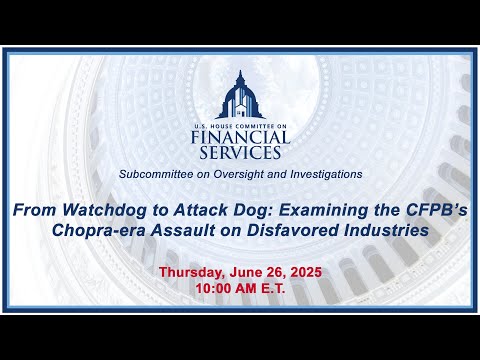
The House Financial Services Subcommittee on Oversight and Investigations held a hearing titled “From watchdog to attack dog: Examining the CFPB’s Chopra-era assault on disfavored industries,” drawing sharply divided testimony about the Consumer Financial Protection Bureau’s enforcement practices.
The hearing featured four witnesses and multiple members of Congress trading competing accounts of the bureau’s recent work. Republican members and outside attorneys urged reforms to the bureau’s use of civil investigative demands — or CIDs — saying the CFPB used the tool to pressure and burden legally operating firms. Democratic members and former CFPB staff defended the bureau’s enforcement record and warned that staffing cuts and withdrawn cases under current leadership have reduced consumer protections.
Why it matters: witnesses described concrete business impacts, disputed legal theory and cited court rulings and statutory processes the panel said should constrain future CFPB activity. The debate could inform pending oversight proposals and legislative reforms such as CID process changes and stricter Administrative Procedure Act compliance.
James Kim, a former CFPB enforcement attorney and now a partner at Cooley LLP, told the panel the bureau has sometimes “issued interpretive rules, guidance documents, and advisory opinions that supposedly interpreted or clarified federal consumer financial laws, but in reality sought to change the substance of those statutes and rules.” Kim urged that CFPB actions be driven by transparent data collection and public rulemaking rather than what he called “siloed top down decisions from agency leadership.”
Jennifer Bassett, chief executive officer of Pacific Rim Alliance Corporation, described a three‑year investigation and multiple CIDs she said were undirected and highly burdensome. “Since the start of this targeted enforcement campaign, we've closed 35% of our locations and laid off a third of our staff,” Bassett said, adding her firm currently operates “30 branches across 5 states and employ[s] 80 people.” She told members the bureau issued three CIDs since July 2022, that responding required producing “over 11,000 pages of documents” and reviewing an asserted 3,800,000 emails, and that legal fees had reached “nearly half a million dollars.” Bassett said two petitions the company filed asking the CFPB to narrow the demands were denied.
Devin Watkins, an attorney at the Competitive Enterprise Institute, gave examples he said illustrated overreach, including enforcement actions the bureau brought over call-wait times, rent-to-own leases, and a mortgage firm whose owner had made public comments. Watkins called for civil investigative demands to be reviewed by a judge for scope and probable cause before businesses must comply.
Morgan Harper, director of policy and advocacy at the American Economic Liberties Project and a former CFPB staffer, defended the agency’s work under Chopra, citing agency returns and enforcement results. “The CFPB has processed over 10,000,000 consumer complaints, returning on average over $1,400 each,” Harper said, and she cited an aggregate figure she gave in testimony that the bureau returned “$21,000,000,000 to harmed consumers.” Harper also criticized recent administrative decisions that withdrew or dismissed pending enforcement matters and that rescinded previously negotiated consent orders.
Members of Congress pressed witnesses on legal constraints and oversight. Representative Green, the subcommittee’s ranking member, framed the hearing as part of a broader dispute over agency funding and enforcement priorities; Representative Waters, ranking member of the full committee, said the bureau had returned substantial relief to consumers and urged the committee to require the acting CFPB director to testify. Chairman Hill and several Republican members emphasized adherence to the Administrative Procedure Act and objected to what they described as enforcement-by-press-release or enforcement-by-manual rather than by rulemaking.
Witnesses and members referenced specific enforcement actions and court outcomes discussed in testimony: a terminated Toyota consent order that had called for roughly $60 million in penalties (and nearly $48 million to be returned to consumers, according to one witness), dismissed or withdrawn actions involving Zelle-related reimbursements for fraud against JPMorgan and others, and a Capital One enforcement matter that a witness said involved alleged consumer overcharges on interest. Witnesses also cited the Townstone Financial settlement and later litigation tied to allegations of unfair steering and free-speech concerns.
The panel requested additional written responses. The chair said written questions would be forwarded to the witnesses and asked for responses by July 31, 2025. Members also sought to enter documents into the hearing record; some unanimous‑consent requests were granted and others were objected to.
The hearing featured repeated recommendations for reforms: witnesses and members proposed judicial review of CIDs, clearer rulemaking under the Administrative Procedure Act, and statutory or procedural changes to limit use of supervisory or investigational tools that witnesses called overly broad. Democratic members warned that cuts to CFPB staff and the dismissal of enforcement matters under current leadership have reduced the agency’s capacity to monitor large technology and financial firms and to return funds to consumers.
The subcommittee concluded the hearing after agreeing to collect written follow-up answers from the witnesses and to enter selected documents into the record where unanimous consent was obtained or not objected to.