Get Full Government Meeting Transcripts, Videos, & Alerts Forever!
Get email alerts on the Class Certification topic
No spam. Unsubscribe anytime.
Parties Tell Court They Have Stipulation to Certify Class; Judge Limits Liability Phase to Fault, Not Damages
Summary
Plaintiffs said they reached a proposed stipulation to certify a class for the liability phase of trial. The presiding judge confirmed the liability phase will not require proof of monetary damages, leaving damages for a later phase.
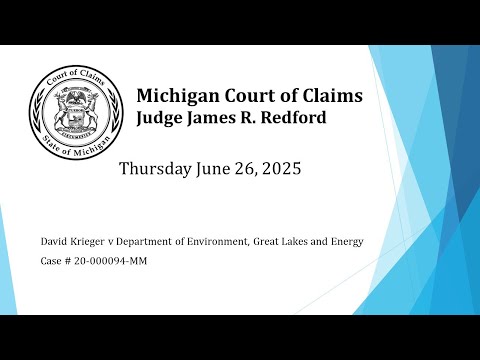
Plaintiffscounsel told a Michigan court on June 26 that the parties have "essentially reached a proposed stipulation" to certify a class for the first (liability) phase of trial, and the presiding judge confirmed the liability phase will address fault but not require proof of monetary damages.
At a status conference in the consolidated case captioned Great Lakes Energy et al., lead case 20-094MM, Jason Thompson, representing the plaintiffs, said the parties had worked through "lengthy discussions" and were finishing language for a stipulation to present to the court. Thompson asked the court to confirm whether the liability phase would require "proofs as to harm to property," distinguishing between proof of the fact of an injury and expert testimony quantifying damages in dollars.
The presiding judge responded that he did not anticipate requiring proof of damages during the liability phase and that a plaintiffs' failure to offer damages proof in that phase would not preclude seeking damages later if liability is found. "I would not anticipate that during the liability phase ... we would be requiring proof of damages," the judge said, adding that bifurcation was adopted to separate liability from remedy issues.
Why this matters: The court's clarification narrows what jurors will decide in the first phase and may shorten the liability trial by excluding time-consuming expert valuation testimony. Plaintiffs and defendants said they expect to finalize the stipulation and tender it to the court promptly.
Counsel on both sides indicated they accept the court's framing. Plaintiffs' counsel said the parties would finish and present the stipulation "in short order." Defense counsel likewise said they did not expect damages proof in the liability phase and would proceed accordingly.
The conference record shows the court and parties discussing the technical distinction between "harm" and "damages." Plaintiffs' counsel described "damages" as the expert valuation of diminution in property value and "harm" as the fact of an injury under inverse condemnation principles, and sought assurance the latter would not have to be proved in phase one.
The judge asked plaintiffs to finalize the stipulation for class certification and to tender it to the court quickly; counsel indicated they would do so.
The parties and the court also discussed related scheduling and procedural items during the same status conference, but the class-certification stipulation and the court's limitation of the liability phase to liability elements (not monetary valuation) were the central outcomes on this topic.
The conference transcript records the exchange and counsel's agreement that the stipulation would be completed and filed for the court's approval.