Get Full Government Meeting Transcripts, Videos, & Alerts Forever!
Get email alerts on the Historic Preservation Norwood Central topic
No spam. Unsubscribe anytime.
Norwood commission approves $25,000 study of Norwood Central MBTA station
Summary
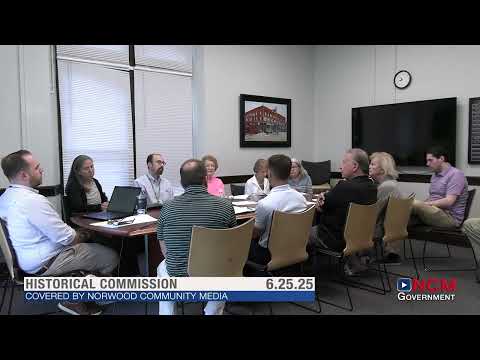
The Norwood Historical Commission voted to use a $25,000 state earmark to commission a preservation- and systems-focused feasibility study of the Norwood Central Station building owned by the MBTA, and asked town staff to draft a scope of work for procurement.
The Norwood Historical Commission voted to use a $25,000 state earmark to fund a feasibility study of the MBTA-owned Norwood Central Station building and asked town staff to draft the procurement scope for that work. The motion was made by Cheryl Doyle and seconded by Tony Yesco; members voted in favor.
Commission chair Judith Howard opened discussion by noting community requests to preserve the station and said the town does not own the building; the MBTA does. MBTA and outside consultants have already completed two reports: a property-condition assessment and a separate retail-use feasibility study. Those reports found the building structurally serviceable but in need of significant tenant-facing capital work and code upgrades to be usable for retail. Consultants told the group a food-and-beverage operator would likely be the best commercial fit and that a long-term lease and tenant-funded buildout could be needed because upgrades could cost at least $100,000.
Commissioners, MBTA representatives and town staff discussed which repairs the MBTA would pay for and which would be tenant responsibilities. MBTA staff said federal and transportation-restricted capital funds limit what the authority can apply to non-transportation improvements, but the agency can negotiate tenant-improvement arrangements such as rent abatement to incentivize private investment.
The commission asked the MBTA to consider applying for Community Preservation Act (CPA) funds and noted that CPA awards require the owner to accept a historic preservation restriction on the property. Commissioners and town staff said the $25,000 earmark (FY25 funds, with an available extension into FY26) should be used for a study that focuses on preservation priorities (envelope and historic features) as well as mechanical and systems assessments needed to scope future construction and estimate costs.
Jason Adams, the town procurement officer, advised that an architectural preservation consultant could be selected within the $25,000 cap using standard procurement approaches for architectural services (quotes rather than a full RFP at that dollar level), and recommended drafting a clear scope of work and contacting firms in advance to confirm what the $25,000 budget would cover. Commissioners asked that the scope be written to avoid duplicating previous work and to emphasize preservation-focused deliverables and cost-to-cure estimates useful for future CPA or MBTA procurement.
"I'm gonna make a motion that we use the $25,000 from the state to do a study on the building at Norwood Central to include the historic exterior and mechanicals and anything else seen fit with the cost to be kept below $25,000," said Cheryl Doyle. The motion was seconded and then amended to ask Jason Adams and John Chantrula to prepare a draft scope of work for commission review; the amended motion carried.
Economic development staff said an improved station could support nearby businesses and suggested the town pursue an incubator/pop-up leasing approach or marketing assistance to attract operators, and noted that returning ticket sales to a station storefront could change the economics for the MBTA. Commission members emphasized they do not want the study to be "a study for study's sake" but to produce cost estimates and preservation direction that can be used in an MBTA RFP or tenant solicitation.
Next steps: town staff will draft a scope of work and solicit quotes from preservation consultants within the $25,000 budget, provide the draft to the Historical Commission for review, and return to the group with recommendations and potential timelines for CPA application or MBTA RFP coordination.