Get Full Government Meeting Transcripts, Videos, & Alerts Forever!
Get email alerts on the Hotel Resort Development topic
No spam. Unsubscribe anytime.
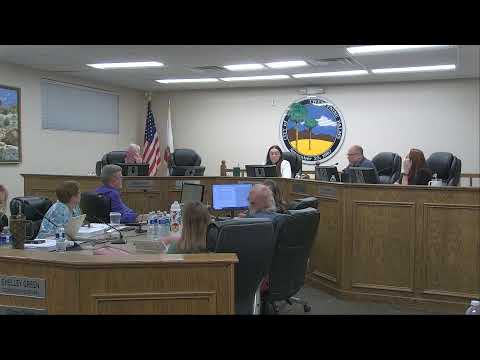
Planning commissioners recommend Oveland resort project and mitigated negative declaration, send proposal to City Council
Summary
The Twentynine Palms City Planning Commission voted 4-0 to recommend a mitigated negative declaration and forward the Oveland resort proposal to City Council, after hours of public comment that split sharply between proponents who cited jobs and tax revenue and opponents who urged a full environmental impact report.
The Twentynine Palms City Planning Commission voted 4-0 to recommend adoption of a mitigated negative declaration and to forward the Oveland resort proposal to the City Council for final action.
The project, described in staff materials as the “Evelyn project,” covers about 152 acres north of Sullivan, east of Leer Avenue, west of Shoshone Valley Road and south of Highway 62. The proposal would place roughly 42 acres into a commercial-tourist development envelope containing about 100 cabin units, two lodges, a restaurant and a small retail/general store, and would place the remaining roughly 110 acres in a new open-space/conservation zone. The applicant described the proposal as “an outdoor oriented boutique hotel that serves as a base camp for 29 Palms, the Joshua Tree National Park,” and said the plan has been reduced from earlier versions: “we have decreased the development envelope by over 30%, decreased the number of cabins from a 130 to 100, and proposed and decreased the proposed square footage by 27%,” Luke Searcy, director of development for the applicant, told commissioners.
Why it matters: The commission’s recommendation is advisory; City Council approval is required for the general plan amendment, rezoning, development code changes and the conditional use permit. The project drew more than 60 written comment letters and more than 60 speakers during a multi-hour public comment period, with proponents citing local jobs and tax revenue and opponents raising CEQA, wildlife, water, lighting and neighborhood impacts.
Project details and staff recommendation Staff described the application as a bundle of actions: a general-plan amendment, a rezoning to a commercial-tourist designation for the development envelope, a new open-space/conservation zone for the outer acreage, development-code amendments and a conditional use permit. Staff’s written materials and the CEQA consultant recommended a mitigated negative declaration rather than an environmental impact report (EIR).
Under the presented plan the development envelope would include approximately 100 cabin units averaging about 284 square feet each, two lodges (up to 25 feet tall), two lodges’ associated amenities including a restaurant open to the public, a general store, two phases of construction, about 25 on-site employee housing units (described by the applicant as not intended for families), a pool with limited public passes and an outdoor movie screen. Project speakers and materials repeatedly referenced a large surrounding conservation parcel intended to remain undeveloped.
Public comment split and key concerns Sixty-six written letters and more than 60 public speakers were entered into the record. Speakers in favor argued the project would generate jobs, overnight stays and tax revenue and provide a conservation buffer: “It also aligns with city's economic and environmental goals,” said Dr. George (as recorded) who described the project as occupying 42 of 152 acres and surrounding 110 acres of open space.
Opponents pressed for a full EIR and raised multiple technical concerns. Several speakers, including local conservation groups and retired biologists, said key biological surveys were incomplete or conducted outside species’ active seasons and that surveys cannot substitute for mitigation. “The proposed project is in a habitat linkage connecting the marine base to the national park,” said Gary Hund, recorded as a retired U.S. Fish and Wildlife Service biologist, arguing that the linkage and potential impacts to desert tortoise, burrowing owl and other special-status species require an EIR.
Traffic and vehicle-miles-traveled (VMT) questions were also raised. Commenters and an attorney who identified themselves as a land-use/CEQA attorney argued the traffic analysis did not include a VMT study and that the project is described by the applicant as a destination resort rather than a local-serving hotel.
Lighting, water and infrastructure Neighbors and several environmental speakers highlighted concerns about light pollution and the outdoor movie screen. Staff and the applicant said lighting would be designed to meet dark-sky standards and that the project team aims to achieve International Dark-Sky Association lodging certification; staff noted the project must meet the city’s lighting code (chapter 19.78) and included conditions requiring shielded, downward-facing fixtures. The applicant said the outdoor screen would be oriented away from many western neighbors and that the team is proposing shielding measures.
On water and wastewater, staff and consultants said the project’s estimated water demand is below the state threshold requiring a formal Water Supply Assessment (500 equivalent dwelling units), and that a wastewater system design would require Regional Water Quality Control Board permits; staff also noted standard conditions and mitigation measures would be required before grading or building permits are issued.
Commission action and outcome After discussion the commission voted to recommend adoption of the mitigated negative declaration and to forward the general plan amendment, rezoning, development-code amendment and conditional-use permit to City Council. The transcript records a roll-call vote with four recorded “ayes” and an excused absence for the vice chair. The vote was recorded as: - Commissioner Krusiak — yes - Commissioner Paul Hana — yes - Commissioner Walker — yes - Chair Keir — yes (vice chair Garcia recorded as excused earlier in the meeting)
The commission explicitly recorded that it is an advisory body and that the City Council will make the final determinations.
What remains open Speakers and several commissioners asked staff to return with additional analysis and possible modifications prior to Council action. Common requests included: (1) an independent or supplemental biological survey timed to species’ active seasons, (2) a vehicle-miles-traveled/transportation impact analysis or clarification of the traffic study’s assumptions, (3) clearer commitments on employee-housing occupancy and local hire, (4) specifics on community-benefit commitments (shuttle service, local-hire guarantees, business promotion), (5) additional consideration of access location and frontage-road alternatives rather than using Leer Avenue as the primary entrance, and (6) tighter limits or conditions on outdoor-screen hours and other operational details. Several commissioners signaled they wanted more time to consider design changes, frontage-road alternatives and community-benefit commitments before the Council public hearing.
Next steps The Planning Commission’s recommendation and the project record will be forwarded to the Twentynine Palms City Council. Council staff and applicants must complete required permits and conditions listed in the staff report before grading or building permits can be issued. If Council approves the project, many mitigation measures and conditions of approval identified in the staff report will be enforced during permitting and construction.
Speakers quoted in this report are recorded as in the planning commission transcript; all quotes are attributed to the speaker recorded in the transcript.