Get Full Government Meeting Transcripts, Videos, & Alerts Forever!
Get email alerts on the Land Use topic
No spam. Unsubscribe anytime.
Manhattan CB2 approves resolution opposing proposed charter changes that would shorten land‑use review
Summary
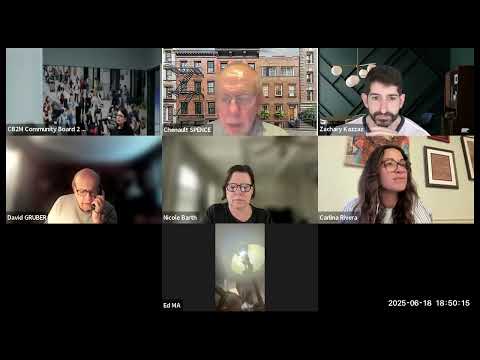
Manhattan Community Board 2 on June 18 approved a resolution opposing recommendations from the mayor's Charter Revision Commission that would shorten the Uniform Land Use Review Procedure (ULURP) and shift or weaken local review roles. The vote followed an extended debate about housing production, community input and the mayor's proposals.
Manhattan Community Board 2 voted June 18 to approve a resolution opposing proposed city charter changes that would shorten the Uniform Land Use Review Procedure (ULURP) and alter the roles of local review bodies.
The full board adopted the land‑use resolution after extended debate. The board secretary recorded nine votes opposing the measure and three abstentions; the remaining members voted in favor and the resolution passed. The committee that drafted the text did not have quorum at its June meeting, a point noted in the discussion.
The resolution, presented by First Vice Chair Eugene Yu, lists specific objections to recommendations from the mayor's Charter Revision Commission and related proposals. It opposes reducing ULURP from 90 days to 60 days, objects to running simultaneous community board and borough president reviews, calls for clearer definitions of so‑called "categorically beneficial" projects, and warns against creating a mayor‑appointed three‑member panel that could override City Council decisions.
Why it matters: ULURP is the city's principal public review process for rezonings and large land‑use changes. Board members who supported the resolution said shortening review time or reallocating decision authority would reduce opportunities for local input on projects that shape neighborhoods.
Discussion highlights - Eugene Yu (First Vice Chair, Manhattan CB2) read the committee's recommended language and emphasized the resolution's request that the Charter Revision Commission preserve the precertification phase and fund community boards to handle larger applications. He also urged post‑action analysis of major rezonings. - Ryder Kessler (Board member) framed the broader context: "One of the core causes of the spiraling housing crisis is a lack of production," he said, and argued the city needs tools to accelerate housing supply. He said he supported reforms in principle but was concerned by parts of the mayor's proposal. - Sean Ryan (Board member) pressed for more housing and said permitting barriers have contributed to rising rents: "It's the moral thing to do to build more housing and to build a lot of it," he said. - Other speakers, including Janine Kiley, Arturo Fernandez and Shirley Secunda, debated whether the mayor's suggested changes would improve predictability or would reduce meaningful local oversight.
What the resolution says (summary) - Opposes shortening ULURP from 90 to 60 days. - Urges the commission to account for and preserve the precertification stage when developers consult communities before formal filings. - Opposes concurrent community board/borough president reviews and undefined "categorically beneficial" shortcuts. - Opposes creation of a three‑member, mayor‑appointed panel with power to override the elected City Council. - Recommends additional resources for community boards to evaluate complex land‑use applications and a post‑rezoning metrics process to assess outcomes (housing units added, displacement analysis, land‑use mix, square footage).
Next steps: Board staff said they will transmit CB2's resolution to the Charter Revision Commission and plan to testify during the public comment period. The Commission's public comment window and hearings were cited during the meeting as closing in early July.
Board context: Speakers noted the district has limited large vacant sites and pointed to past local campaigns to secure more affordable units in specific projects (for example, 388 Hudson and other local rezonings) as evidence the board has pushed for housing within the constraints of existing processes.
Ending: With the resolution adopted, Manhattan CB2 will include the text in its public testimony to the mayor's Charter Revision Commission and continue to monitor hearings and ballot proposals that may follow later this year.