Lifetime Citizen Portal Access — AI Briefings, Alerts & Unlimited Follows
Committee on Transportation and the Environment approves FY26 report, restores limited sustainable energy funding and funds safety, transit, sidewalk projects
Loading...
Summary
The Committee on Transportation and the Environment voted June 25, 2025, to approve its report and recommendations on the District’s FY2026 local budget, restoring limited funding to the Sustainable Energy Trust Fund and the Anacostia River Cleanup Fund while funding safety, bus‑priority, sidewalk, bike‑share, and plaza initiatives.
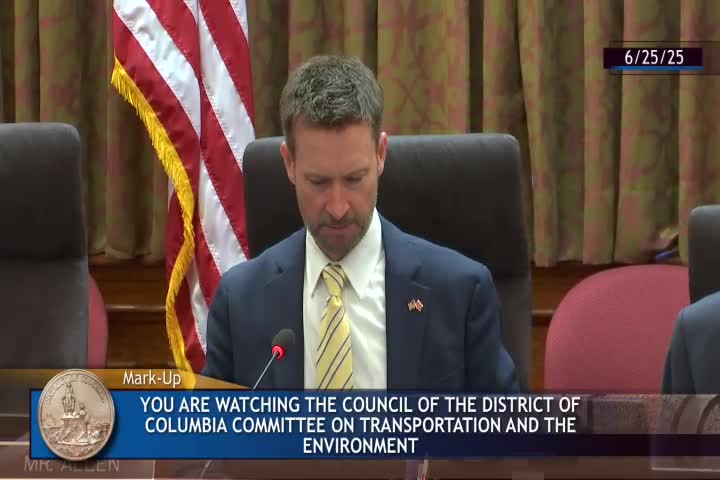
The Committee on Transportation and the Environment voted June 25, 2025, to approve its report and recommendations on the District’s FY2026 local budget, restoring some environmental funds cut in the mayor’s proposal and reallocating capital to transportation safety and accessibility projects. Councilmember Charles Allen, Ward 6 and chair of the committee, presided over the meeting, held in Room 500 of the John A. Wilson Building and on Zoom.
The committee’s report seeks to reverse parts of the mayor’s proposed reductions to the District Department of Energy and Environment (DOE) and related programs while also identifying new fee changes and reallocations to cover priorities. Chair Allen said the mayor’s proposal included a proposed $71 million sweep from the Sustainable Energy Trust Fund (SETF) — part of roughly $140 million the committee says has been swept across two years — and described the mayor’s plan as significantly reducing DOE’s resources. The committee restored $3.1 million to the SETF for FY26 and reallocated $5.3 million to the SETF across the financial plan. Allen said DOE’s FY26 budget under the mayor’s plan would have been about $77 million less than FY25 funding levels.
The committee also fully restored a $1.9 million proposed sweep from the Anacostia River Cleanup and Protection Fund and preserved program funding for small grants and contractors that support river cleanup and environmental education, the report states. On the Green Bank, the committee noted the mayor cut the SETF contribution from $7 million in FY25 to $3.5 million in FY26; the report did not restore the full contribution but set aside $250,000 for capacity building and planning related to a possible bond issuance or other capitalization strategies to help the Green Bank move toward financial independence.
On transportation and safety, the committee’s recommendations reallocate capital to maintain bus-priority investments after the mayor’s proposal reduced a planned bus-priority capital program (described in the budget as a five‑year $92.4 million investment adjusted to a six‑year $73 million investment). The report reallocates $30.5 million in unallotted funding within the bus‑priority program across the capital improvement plan to preserve bus‑lane and signal‑priority upgrades. The committee also identified nearly $13.8 million in additional sidewalk investments, $10.3 million to alley repair and maintenance, and a $2.3 million enhancement to bike‑share capital for stations and asset replacement.
The committee committed funds to components of the Strengthening Traffic Enforcement, Education, and Responsibility Amendment Act of 2024 (the "Steer Act"). The report identifies $7.1 million to fund safety components of Steer, including $600,000 from the Committee on Public Works and Operations to support the immobilization framework (booting and towing) and related program elements. Chair Allen described the immobilization framework as a tool to make vehicles with repeated violations eligible for booting and towing and tied release to payment of outstanding fines and completion of a driver safety course.
The report preserves several policy protections the committee said would have been weakened under the mayor’s Budget Support Act subtitles: it strikes proposed subtitles that would repeal the parking cash‑out law and allow continued purchase of gas vehicles for the District fleet, and it removes provisions that would pause requirements in the Building Energy Performance Standards (BEPS) program and weaken net‑zero standards. The committee also proposes transferring $173,000 to the Committee of the Whole to fund a senior manager position at the Department of Buildings to assist with green building issues and BEPS/net‑zero compliance.
The committee recommended funding for the Public Life and Activities Zone program (the "Plaza Act"), allocating $112,000 in FY26 and $1.5 million in the financial plan to launch pedestrianized corridors and $172,000 to implement a block‑party pre‑authorization and expedited application program. Chair Allen framed the choice as a tradeoff between continuing one‑day open‑streets events and creating year‑round pedestrian zones that can support businesses and community activity.
To raise modest revenue without harming core services, the report includes subtitles adjusting several Department of Motor Vehicles fees, including registration fees tied to vehicle shipping weight and incremental increases in residential parking permit fees for additional vehicles at the same address. The report also increases the public‑space fee for month‑long construction debris receptacles and eliminates the commercial/residential price distinction for those permits. The committee estimated the fee changes would generate a net $926,000 in FY26.
Chair Allen and committee members emphasized the constrained fiscal context: the District CFO issued a downward local revenue forecast for FY26–29 averaging about $342.1 million per year, Congress’s March continuing resolution removed a longstanding provision allowing the District to spend as planned and forced the District to reduce FY25 spending by about $1.13 billion, and the City Administrator issued a hiring freeze (City Administrator Order 2025‑1) that limited agencies’ ability to replace staff.
The committee approved the report with leave for staff to make technical, editorial, and conforming changes. Chair Allen said the report preserves certain climate and environmental commitments where possible but acknowledged the committee “couldn't fix everything” and that further work will proceed at the full Council.