Get Full Government Meeting Transcripts, Videos, & Alerts Forever!
Get email alerts on the Tribal Relations Benefits Courts topic
No spam. Unsubscribe anytime.
Tribal leaders and legal scholars urge Michigan to codify protections for tribal general welfare benefits and explain tribal courts
Summary
Leaders from the Nottawaseppi Huron Band of the Potawatomi and Michigan State University law faculty told the House Judiciary Committee that Michigan should codify protections for tribal general welfare benefits and recognize the role of tribal courts.
Representatives of Michigan tribes and a Michigan State University law professor told the House Judiciary Committee on Feb. 20 that state statute should clarify how tribal general welfare benefits are treated and described the role and jurisdiction of tribal courts in Michigan.
Dori Rios, chairwoman of the Nottawaseppi Huron Band of the Potawatomi, urged the committee to consider legislation that would prevent state agencies from treating tribal general welfare benefits — programs such as housing assistance, elder care, education stipends and funeral assistance — as income that jeopardizes eligibility for state‑administered programs. Rios cited 26 U.S. Code § 139E as federal recognition that tribal general welfare programs are grounded in government authority and are excluded from federal taxable income; she said the Internal Revenue Service has noted that consistent state‑level treatment requires intergovernmental coordination or legislation.
“We fully support codification of protections for the benefits we provide our citizens, who are also Michigan citizens, with the respect, clarity, and legal consistency they deserve,” Rios said, urging legislative collaboration among Chair Leitner’s office, the governor’s office, the Department of Health and Human Services and tribal governments.
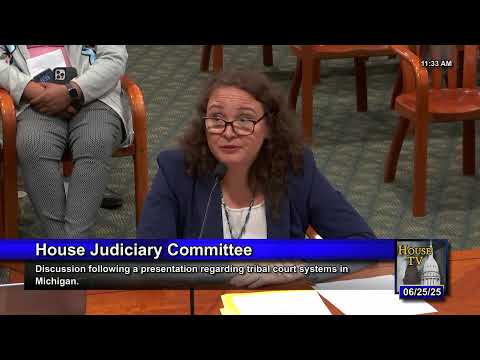
Winona Single, associate professor at Michigan State University College of Law and director of the Indigenous Law and Policy Center, provided an overview of tribal courts in Michigan, explaining that all 12 federally recognized Michigan tribes have tribal court systems, generally including trial and appellate levels, and that tribal courts apply tribal constitutions, tribal statutes, customary law and applicable federal law. Single described the limits on tribal criminal jurisdiction over non‑Indians historically created by Oliphant v. Suquamish and the statutory expansions Congress enacted, including the Tribal Law and Order Act and subsequent reauthorizations of the Violence Against Women Act that permit special tribal criminal jurisdiction for certain crimes when statutory conditions are met.
Single noted that four Michigan tribes as of 2023 have implemented the conditions necessary to exercise expanded criminal jurisdiction over non‑Indians and described restorative justice approaches such as Healing to Wellness courts that many tribal courts operate. She highlighted existing cooperative mechanisms between tribal and state courts, including the Michigan tribal‑state‑federal judicial forum and Michigan Court Rule 2.615, which facilitates recognition and enforcement of tribal court judgments by state courts.
Both presenters emphasized intergovernmental collaboration. Rios referenced a resolution by the United Tribes of Michigan adopted on 02/20/2025 supporting statutory protections; Single said tribal courts are modern institutions that resolve civil and criminal matters, administer juvenile justice and operate specialty courts including healing and wellness courts.