Get Full Government Meeting Transcripts, Videos, & Alerts Forever!
Get email alerts on the Data Governance topic
No spam. Unsubscribe anytime.
Data task force urges statewide data-sharing tools as Senate bill advances
Summary
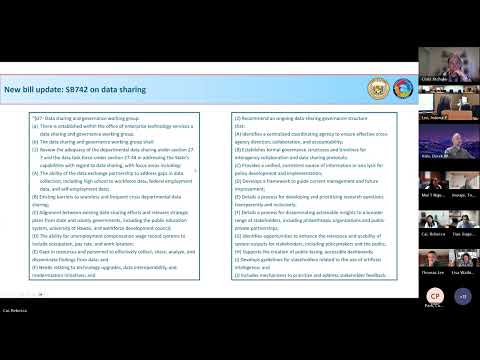
Members of the state's Data Task Force discussed scope, enforcement and tool needs for a proposed statewide data-sharing and governance working group established in Senate Bill 742, and reported partial tool funding in a House draft budget.
At a Data Task Force meeting, staff from Enterprise Technology Services (ETS) and state agency representatives discussed how a proposed statewide data-sharing and governance working group created by Senate Bill 742 should operate, who it should cover and how enforcement would work, while noting that some requested data-governance tools were included in a recent House draft budget.
The discussion centered on three linked questions: which agencies and data the guidelines should cover, which authority should enforce them, and whether ETS should provide shared tools (a master data management platform, a data-governance tool, a geospatial platform and AI governance tooling) that departments would use while retaining ownership of their own data.
"We want to make sure that they're in solid before we roll them out," Rebecca (Data Task Force staff, Enterprise Technology Services) said of seven draft guidelines under review by the CIO, the controller and the attorney general. She said the drafts remain under review and that the group needs to clarify whether the guidelines should be ETS documents or products of the Data Task Force, and how review and enforcement should proceed.
Rebecca also told members the draft House budget (House draft 1 of House Bill 300) included funding for several tools the task force requested: a data-governance tool, a master data-management tool, an AI-governance tool and related platforms. "The tools and the resources we asked for were approved in the House Bill 300 draft 1 last week," she said.
Department representatives said shared tools and reporting would help enforcement and reduce duplicated effort. "The only way to enforce this is gonna be within the workforce, within the agencies," Derek (Department of Health representative) said, adding that departments should report enforcement issues back to ETS and the task force so common problems can be identified.
Public and nonprofit participants welcomed the idea of clearer statutory scope but cautioned the group to remain aligned with current law. "I just wanna be mindful to stick to what the current version of the statute reads now," Thomas (TensorSource member) said, urging the task force to avoid overreaching the authority created for the chief data officer and related roles.
Members discussed Senate Bill 742's proposed working group as a companion to other pending bills that would require or expand data sharing (transcript references include bills described as Senate Bill 1491 and House Bill 131). Rebecca said the working group would be required to inventory departmental datasets and produce a year-end report on what data departments hold and what they need from others, which she said would compel departments to document refusals to share data in those reports.
The group spent time on technical and privacy challenges. Rebecca described a proposed statewide master data-management platform as a way to let agencies identify a resident without exchanging personally identifiable information: "I just put a 1 in there and the state secured platform would know that, oh, 1 from Rebecca's department means this person and here's the need that person has without revealing any private information, any PII data."
Some members raised concerns about microdata release and respondent confidentiality. "If we could release the microdata by law, we'll greatly reduce the willingness to respond," Dr. Tian (DBAD) said, noting survey-response and legal limits on sharing person-level records. Dr. Tian and others emphasized that many datasets already shared in aggregate should remain protected at microdata level and that access control and clear use cases are necessary.
The task force also considered whether to ban a Chinese-owned AI tool referenced in the meeting (named in discussion as "DeepSeq/DeepSeek") on state devices for nonpublic data, and whether a departmental memo or statewide directive would suffice. Derek recommended making the guidance explicit in the AI policy and in communications to staff; he said a memo from the CIO and controller could be an appropriate channel to prohibit use of non-licensed consumer tools for protected data.
Rebecca said ETS envisions a federated model: departments would retain ownership and responsibility for their data, while ETS would provide enterprise licensing and act as a center of excellence to support departments' data governance, data quality and sharing work. "Each department you own your data. You always own your data," she said.
The task force agreed to continue refining the guidelines and to revisit law wording as needed. Rebecca said she would solicit member input ahead of the next meeting and proposed moving June's meeting to June 23 to follow the state's Data and AI summit. Her listed action items included sending (1) a request for panel volunteers and topics for the Data & AI summit and (2) a poll about availability for a June 23 meeting, and asking members to consider whether statutory language needs clarification to define the task force's scope and relationship with a prospective data-governance working group.
Votes or formal actions were not recorded during the session; no bill was voted on by the task force during the meeting.
Ending
Members asked that future meetings address implementation and enforcement details, the relationship between the Data Task Force and the potential data-sharing working group established by the Legislature, and the governance of shared tools. Rebecca said the task force will continue discussion and solicit written input from members before the next meeting.