Get Full Government Meeting Transcripts, Videos, & Alerts Forever!
Get email alerts on the Public Health Substance Use topic
No spam. Unsubscribe anytime.
Oxnard committee backs ordinance to prohibit nitrous oxide sales and use
Summary
The Community Services, Public Safety and Housing Development Committee voted 3-0 June 24 to recommend the City Council introduce an ordinance to prohibit nitrous oxide in Oxnard; staff described outreach and enforcement plans and cited state misdemeanor provisions referenced in the report.
The Oxnard City Community Services, Public Safety and Housing Development Committee on June 24 voted 3-0 to recommend that the City Council introduce an ordinance by title only and waive further reading of an ordinance adding articles to Chapter 7 of the Oxnard city code to prohibit nitrous oxide.
Committee members said the ordinance is intended to respond to rising youth use and retail sales of flavored nitrous oxide products. Committee member Perez asked whether the city has partners that can provide prevention and education materials to young people. Perez said, “I know this has come out of the development of what we're seeing with the impacts on youth specifically,” and asked about outreach to young people.
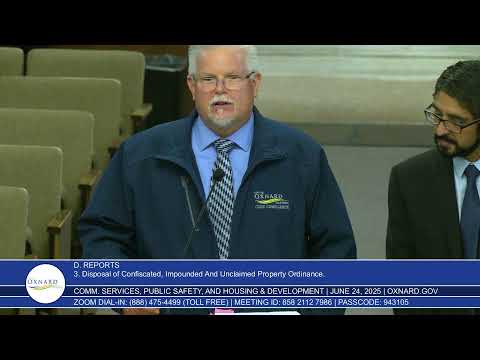
Deputy City Attorney Andrew Gonzalez and Oxnard Police Department staff described current and planned outreach. Officer Steve Ramirez said the Oxnard Police Department partners with Ventura County Public Health on outreach and school training. “Just remember the nitrous, in this aspect is illicit. We can call it a drug,” Ramirez said, adding that public-health authorities provide limited statewide educational materials and that local partnerships are the main channel for youth outreach.
Staff explained two related Oxnard code provisions in the draft: a general prohibition and a targeted prohibition on flavored nitrous oxide products (listed in the report as sections 7-372 and 7-373). The report also references state law; staff read a Penal Code provision during the meeting (read aloud in the transcript as “penal code section 38, 3 8 1 b”). Gonzalez described an outreach plan modeled on the city's recent flavored tobacco work: if the ordinance is adopted, staff would notify retailers — using a retailer contact list gathered during tobacco compliance work — and coordinate with schools and community groups.
The committee recorded affirmative votes from Committee member Perallo, Committee member Perez and Chair MacArthur; the motion carried 3-0. Staff said they will pursue outreach to schools, Boys & Girls Club and other partners and that police and environmental-health compliance activities would support enforcement if the ordinance is adopted.