Get Full Government Meeting Transcripts, Videos, & Alerts Forever!
Get email alerts on the Education Charter Schools topic
No spam. Unsubscribe anytime.
Tennessee charter commission previews Public Chapter 275 changes, plans rules and hearings
Summary
The Tennessee Public Charter School Commission on June 23 reviewed provisions of Public Chapter 275 of 2025, which takes effect July 1, and discussed the rules, staffing and public‑meeting procedures the board will use to implement the changes.
The Tennessee Public Charter School Commission on June 23 reviewed provisions of Public Chapter 275 of 2025, which takes effect July 1, and discussed the rules, staffing and public‑meeting procedures the board will use to implement the changes. The meeting was discussion-only; commissioners did not take votes. Staff said they will present emergency and permanent rules and related commission policies at the commission’s July meeting and run a rule‑making hearing before a final October vote.
The commission’s Executive Director, Tess Stovall, framed the session as a briefing: "We are thrilled to have this discussion this morning with the Commission to really ground you all in what Public Chapter 2 75 does and then the implications that it will have on the Commission." Hayden Pendergrass, director of external affairs, summarized what he described as five principal changes in the law, including an effective date of July 1.
The most immediate operational change the commission discussed is flexibility on charter‑term length for renewal appeals. Hayden Pendergrass said that, under the new law, the commission may set renewal appeal charter terms between five and 10 years; "all new start terms will still be 10 years."
Staff and commissioners also discussed several procedural and structural shifts in the statute. The State Board of Education will now create the common application and scoring rubrics in consultation with the commission, and the commission will receive and post additional materials that previously were filed with the Department of Education or local education agencies (LEAs). Letters of intent for new‑start applicants can be received by authorizers beginning Dec. 3, 2025, and final new‑start applications are due Feb. 1, with the statutory review timeline remaining 90 days for an initial review, a 30‑day window for amended applications and 60 days for the final review of amended applications, staff explained.
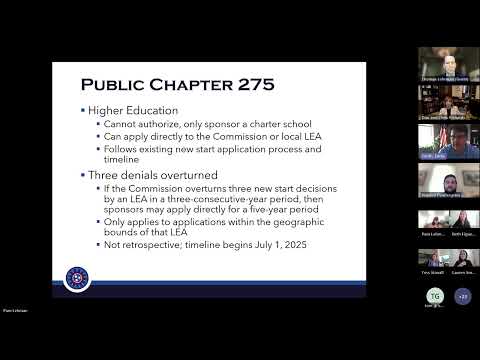
The act also creates three new application pathways. First, state institutions of higher education may sponsor or submit applications under the new‑start process; the law does not prescribe a required governance structure for a higher‑education sponsor, so applicants must describe the proposed relationship between the university and the charter’s governing board in their application. Commissioners asked staff to consider what governance models the commission would prefer, and suggested rule or policy language that would require applicants to explain accountability arrangements and any shared services.
Second, the law establishes a geographic trigger that lets sponsors in a district apply directly to the commission if the commission overturns three new‑start denials from that district within a consecutive three‑year window. Hayden Pendergrass clarified that the trigger is prospective and applies only to commission votes after July 1; October commission votes will be the first to count toward the three‑vote threshold.
Third, the law created a replication pathway for operators that have at least one public charter school in operation for at least one full school year. Under replication, operators may apply to open a materially similar school within the same district where they already hold authorization. Staff said replication applications will use a simplified application and a separate rubric, but will otherwise follow the new‑start timeline and result in a standard 10‑year charter term unless the operator is eligible for renewal appeal treatment later.
Commissioners pressed staff on how the commission should define "academic focus" and what degree of grade‑band or program change would be allowed under replication. Several commissioners said the commission should write a rule that is strict about replication while including an exceptions process for well‑documented, compelling proposals. Commissioner Lauren asked whether a classical elementary operator that wants to open a classical high school would qualify as replication; staff said that such borderline cases are exactly why the commission will need clear rule or policy language.
The commission’s legal staff and authorizing director also reviewed procedural questions about amended applications and finality. Beth Figueroa, director of authorizing, reiterated the statutory timeline and noted that, under the new law, an amended application submitted to the commission would be subject to the commission’s review and, for commission decisions on amended applications, the commission’s decision is final and not appealable to the commission again.
Commissioners and staff discussed how the commission will handle public input for applications submitted directly to the commission (rather than to a local LEA). Staff recommended keeping a public meeting in the district where the school proposes to operate, citing transparency and local input as reasons for that practice, but noted a public meeting is not statutorily required for new starts and would be an additional expectation of sponsors who apply directly to the commission. Several commissioners asked that any testimony from an LEA asserting fiscal harm be supported by documentation that staff can evaluate.
Ashley Thomas, general counsel, described how the commission will approach implementation: rules will address fixed requirements such as fees, application completeness and deadlines, while commission policies will give the commission flexible guidance for decision making and can be updated more quickly. Staff said they will file emergency rules for July first‑and‑final reading and pursue the longer permanent‑rule process with public rule‑making hearings before the October meeting. Staff also proposed a statutory maximum initial application fee of $2,500, matching other authorizers and the commission’s prior practice.
Commissioners raised operational concerns, including staffing capacity to handle a direct‑application and appeals calendar that could run from December through October and the need to set aside additional meeting time. Beth Figueroa said the commission may need a special called meeting in late August or early September to hear the Metro Nashville Public Schools (MNPS) appeals because MNPS conducted amended‑application votes in June rather than July. Staff said they will poll commissioners to set that special meeting date and will post logistics on the commission website.
No binding actions were taken at the meeting; staff will return to the commission with proposed emergency rules, permanent‑rule drafts and commission policies in July, and with a rule‑making hearing and second‑reading material in October. Staff also said they will prepare an FAQ for stakeholders and compare the information the commission will request with the standard materials LEAs use now so commissioners can review any differences before adopting rules.
The discussion leaves several discrete items for staff rule drafting and policy work: definitions for "academic focus" and replication exceptions, governance documentation for higher‑education sponsors, a public‑meeting format and evidence requirements for LEA testimony, fee and timeline language, and staffing and scheduling for the new direct‑application and appeals cycles. The commission adjourned after scheduling follow‑up work for July and noting the need for a special called meeting for MNPS appeals.