Get Full Government Meeting Transcripts, Videos, & Alerts Forever!
Get email alerts on the Sfrf Liquidation Reallocation topic
No spam. Unsubscribe anytime.
NC Pro: SFRF cash must be liquidated by Dec. 31, 2026; proposed budget would let state reallocate unspent awards
Summary
NC Pro staff told SFRF recipients that all State and subrecipient SLFRF funds must be liquidated (cash paid out) by Dec. 31, 2026. A section in the proposed state budget (5.9) would allow NC Pro to reallocate appropriated project line items that cannot be spent, subject to reporting and matching restrictions.
Tommy, NC Pro staff, told attendees of an NC Pro webinar that every dollar of the State and subrecipient State and Local Fiscal Recovery Funds (SFRF/SLFRF) award must be liquidated — cash paid out — by Dec. 31, 2026. "These funds have to be liquidated. Cash has to be out the door, 12/31/2026," Tommy said.
The requirement matters because the federal SLFRF program allowed states a longer obligation window but a shorter liquidation window. North Carolina obligated nearly all of its award by Dec. 31, 2024 (Tommy said the only remaining amount was "20¢" the state will return to the U.S. Treasury), but the state now has a firm liquidation deadline of Dec. 31, 2026 for all levels of subrecipients.
Tommy said the Office of State Budget and Management/NC Pro is relying on the U.S. Department of the Treasury's 2022 final rule and accompanying FAQs in interpreting the deadlines and the difference between "obligated" and "liquidated." He emphasized that liquidation means payment — not just recording an accounts payable — and that the office will work with agencies and recipients through the next 18 months to meet the deadline.
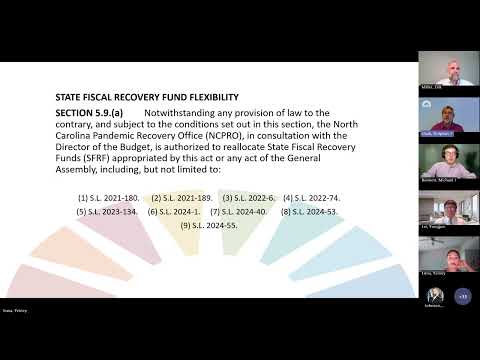
A provision in the proposed state budget, labeled as section 5.9 in the materials Tommy presented, would give NC Pro limited authority to reallocate funds among appropriated SFRF projects if certain conditions are met. Under the language Tommy summarized, reallocations would be allowed only when: (1) the appropriated funds have not been expended by Dec. 31, 2025; and (2) there is a reasonable expectation that the funds will not be expended. Tommy said additional requirements apply, including reporting to the General Assembly and matching of fund types.
"5.9 a ... gives NCPRO the ability to reallocate the funds in existing SFRF projects that are not going to be spent by the period of performance," Tommy said, noting the period of performance referenced in the slides is Dec. 31, 2026. He added that the reallocation authority carries reporting obligations and limitations designed to keep reallocations transparent.
Tommy described those reporting requirements: NC Pro must notify the General Assembly 30 days before any reallocation plan is executed, detail the plan, report when it is executed, and later report expenditures from the reallocated funds. Tommy said the office is gathering data now — including responses to a questionnaire NC Pro distributed — to identify projects that cannot spend their allocations and projects that might need additional funds.
Tommy and others stressed that the budget language requires care in pairing funds by category. SFRF projects are classified, he said, into revenue-replacement and non-revenue-replacement categories; if funds are reallocated across categories the state has only a small margin to justify the change.
A question from Shadi clarified what Tommy meant by "projects." "When you say projects in this case, are we talking about, you know, DEQ147, DEQ148, DEQ149, those projects as opposed to subrecipient projects?" Shadi asked. Tommy confirmed: the term refers to the line-item projects the General Assembly appropriated in 2021 and given NC Pro project numbers (for example, DEQ147).
Tommy also explained how different recipient types are treated: beneficiaries who received a check are treated as expended and are not tracked further; subrecipients (and sub-subrecipients) must have funds liquidated by Dec. 31, 2026. "If you have subrecipients, same applies to them. Your subrecipients have to be liquidated by 12/31/2026. If your subrecipients have subrecipients, they also have to be liquidated by 12/31/2026," he said.
On support for recipients, Eric, NC Pro staff, described ongoing monitoring and technical-assistance work with Deloitte and others to identify low-, moderate- and high-risk recipients and to provide training focused on project closeout. "The training started in April ... we started that one with project closeout," Eric said. NC Pro is running monthly technical-assistance sessions (recorded and posted to ncpro.nc.gov) and weekly Tuesday office hours to help with finance, payment requests and closeout questions.
Tommy said the state is also watching whether the U.S. Treasury will extend the liquidation deadline; if the federal deadline is extended to June 30, 2027 or later, the presented state budget language would become moot. "If the deadline for SFR funds is extended to 06/30/2027 or later, all this is out the window," he said, but he added NC Pro is actively in discussions with Treasury and other states.
On closeout costs, Tommy said Treasury guidance allows a narrow closeout-cost period (he referenced an April 30, 2027 date for closeout costs). He said the office will provide separate guidance on what closeout costs qualify and that those costs are distinct from program expenditure costs.
Tommy closed by urging recipients to work with their grant managers and the NC Pro data team, which has begun reporting on cash balances and expenditure projections. "We are going to start talking with you more. We're also building out a process for the ability to do this. It's not going to be easy, but we think that it's worthwhile so as to minimize the repayment of funds to the U.S. Treasury," he said.
NC Pro staff announced that slides and session recordings will be available on the NC Pro website and that staff will remain online after the session for individual questions.