Get Full Government Meeting Transcripts, Videos, & Alerts Forever!
Get email alerts on the Economic Development topic
No spam. Unsubscribe anytime.
Committee reviews tech-economy strategy; councilmembers agree to move sponsorship to Savigny and request progress updates
Summary
Consultants presented an eight-month tech-economy study recommending a Lexington Tech Council, workforce strategies and marketing. Councilmember Savigny accepted formal sponsorship of the effort and the committee asked for ongoing updates.
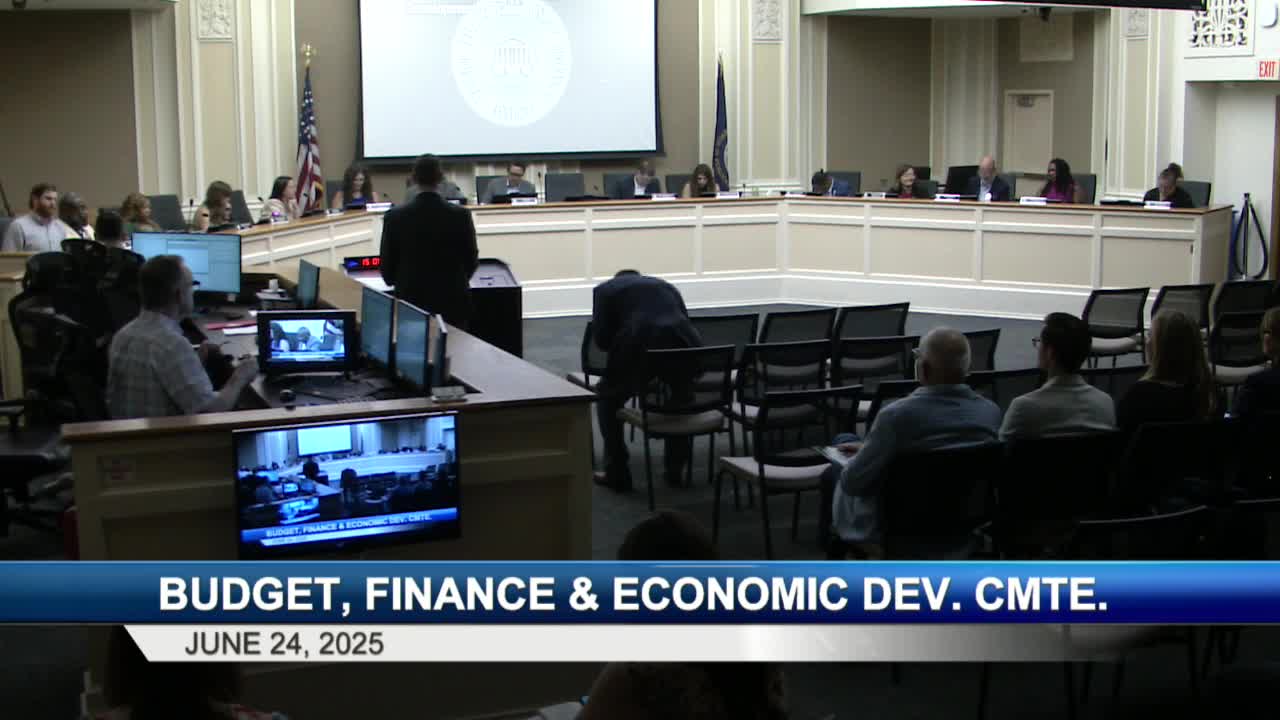
Consultants from Economy Partners presented final recommendations on June 24, 2025, to the Lexington City Budget, Finance, Economic & Development Committee for a technology-driven economic development strategy focused on AgTech, HardTech (advanced manufacturing and materials), HealthTech, BioTech and digital business services.
Jonathan Doreen, principal and project director with Economy Partners, told the committee the analysis found flat growth in traditional core tech industries but strong and growing demand for tech talent deployed across several local industry clusters. "There is no one-size-fits-all STEM or tech job," Doreen said, summarizing the firm's review of local job-posting demand, university research outputs and industry needs.
The report recommended four broad strategies: (1) elevate a tech council as a convener and front door for the ecosystem, (2) grow tech employment by prioritizing linkages among employers, students and training providers, (3) support innovation and entrepreneurial capacity, and (4) invest in marketing and storytelling to raise Lexington's profile. The consultants proposed 16 specific actions and provided high-level cost estimates, including a multi-year funding model to seed a tech council and scale programs.
Councilmember Scott Savigny (item sponsor) said the study had been procured to produce actionable steps and budgets. "We want actionable steps and some sort of cost associated with it," Savigny said. He noted the council had previously included $90,000 in the FY 2026 budget to begin work under what the consultants called Strategy 2 (workforce and employer connections).
Committee members asked about sequencing, private-sector co-funding and oversight. Jonathan Doreen and Joseph Simpkins, senior economist with Economy Partners, said the recommended sequence begins with a dedicated convener and pilot investments to scale existing programs. Doreen said public seed funding typically helps create continuity that attracts private sponsors later: "Once that is there and there's a little bit of a brand and continuity built around it, we've seen a lot of examples of folks leveraging corporate funding." Liz Rogers, the city's chief information officer, said the city would act primarily as convener and supporter and provide assistance on storytelling and coordination.
Several councilmembers pressed for checks on public spending and asked for regular reporting. Councilmember Greg Gray asked whether any stakeholders had committed co-funding; Kevin Atkins, chief development officer, said seed funds are needed first and private partners often follow. Councilmember Beth Baxter asked for clarity about who would lead a tech council; the consultants said the typical model uses initial public support to hire a dedicated staff person and demonstrate value, then move to a blended funding model with membership, fees and corporate sponsors.
Vice Mayor Wu raised housing concerns, asking how workforce attraction would account for housing availability. Economy Partners said housing was outside the scope of the study but acknowledged stakeholders brought it up repeatedly; they offered to research housing approaches as a follow-up.
After discussion, Councilmember Savigny moved that the council formally take ownership of the topic, request annual updates to the committee (first update requested in February–March 2026), and proceed with the initial $90,000 workstream. The motion was seconded and passed by voice vote. Committee members also voted to change the official sponsor of the tech-ecosystem item to Councilmember Savigny.
The consultants left the committee with an implementation path focused on (a) establishing a small convener organization or tech council, (b) investing in targeted workforce initiatives and employer connections, (c) strengthening entrepreneurial services and "front-door" access for startups, and (d) crafting a coordinated marketing strategy once early outcomes can be shown.
Committee members asked staff to return with an implementation plan, clear metrics and regular reporting to monitor how public funds are used and how private partners are engaged.