Get Full Government Meeting Transcripts, Videos, & Alerts Forever!
Get email alerts on the Weed Abatement topic
No spam. Unsubscribe anytime.
Council discussion centers on weed abatement, private lots and tree-removal authority amid heavy rains
Summary
Following a wet spring, the mayor and council debated the limits of city authority, contractor capacity and resident responsibilities for overgrown private lots and fallen trees. The city reported recent cuts and cited code section authorizing removal of hazardous trees.
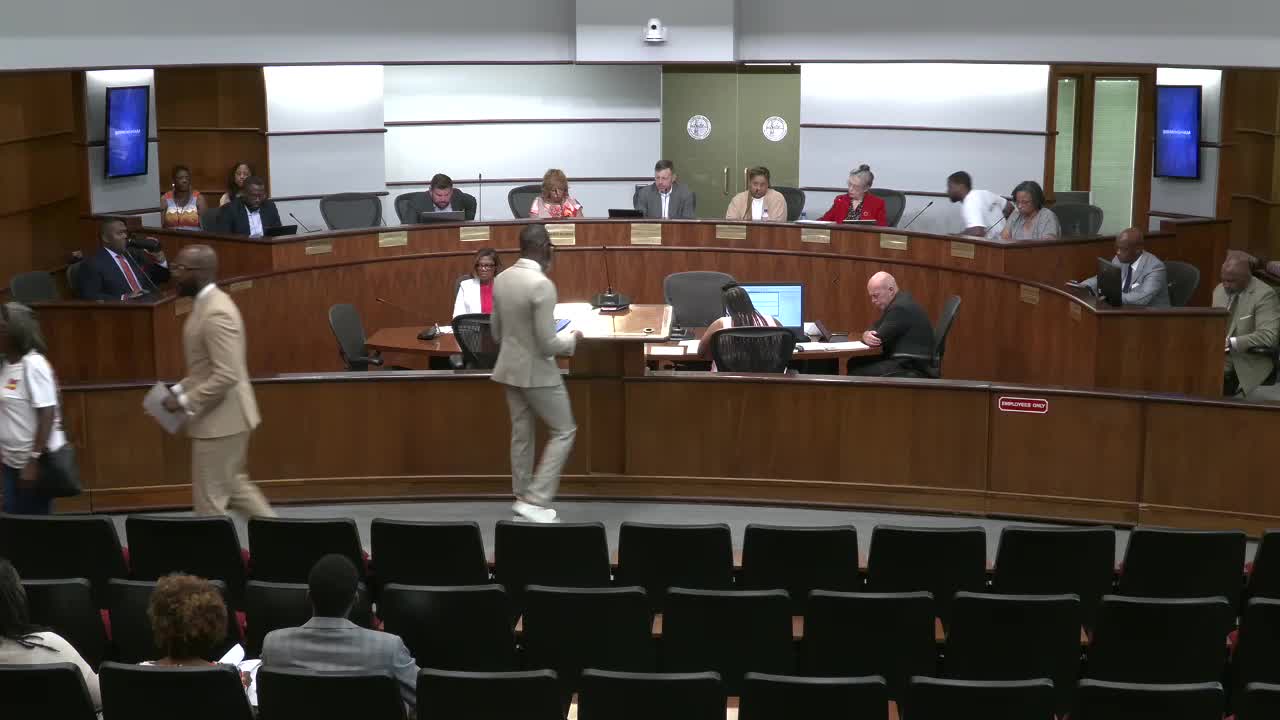
Mayor Randall L. Woodfin and council members spent significant time on June 24 discussing weed abatement, private-lot mowing, fallen trees and the limits of city authority after an unusually wet period.
The mayor said May and June rainfall in Birmingham had been well above normal — “in the last 55 days, it’s rained 36” — and that rain had contributed to faster grass growth and a backlog in mowing. He told the council that the city and contracted crews cut 400 acres and serviced 645 blocks in a seven-day window in June and collected 1,582 bags of litter in the same period. The mayor said the city had contracted out more than $2,000,000 in private-lot mowing this fiscal year and that the FY2025 budget included $2.7 million for weed abatement, with a recommended FY2026 allocation of $3,000,000.
Council members pressed staff on legal limits for city action on private lots and on whether public funds may be used to remove trees on private property. The administration explained the process for contracting to cut private lots — which requires permits, planning and legal review and can be time-consuming — and noted that state law limits immediate city action against private property owners. Regarding trees, the council referenced city code Section 2-5-321, which authorizes the city to require removal of dead or diseased trees on private property when such trees constitute a hazard to life or property; the code requires written notice to the owner and excludes acts of God.
Council members and staff encouraged neighbors and community groups to help seniors and others who cannot maintain lots. Several councilors suggested partnering with churches, volunteer tool banks and neighborhood groups for service days. Councilor Moore and others urged residents to use the city’s GIS and Jefferson County tax records to locate and notify property owners. Council discussion also noted the role of the county and state in tax-lien sales and enforcement, which affects accountability for absentee owners.
Public comment reinforced the council discussion. A resident, Tyrone Richardson, asked why 311 had not resolved an ongoing dumping and drainage problem on his street; staff later confirmed the case was under investigation by Public Works, PEP and planning staff.
Why it matters: Overgrown private lots and fallen trees affect neighborhood health, property values and public safety. The council identified constrained city capacity, legal limits under state law and heavy rainfall as compounding factors and emphasized neighborhood-level cooperation while staff pursues enforcement channels.
Looking ahead: Staff said the city will continue to use contractors and city crews where authorized, follow the code notification process for hazardous trees per Section 2-5-321, and work with community partners to encourage neighborly assistance for maintenance.