Get Full Government Meeting Transcripts, Videos, & Alerts Forever!
Get email alerts on the Short Term Rentals Bill 9 topic
No spam. Unsubscribe anytime.
Hours of public testimony at Maui hearing splits residents and owners over Bill 9 short-term rental phaseout
Summary
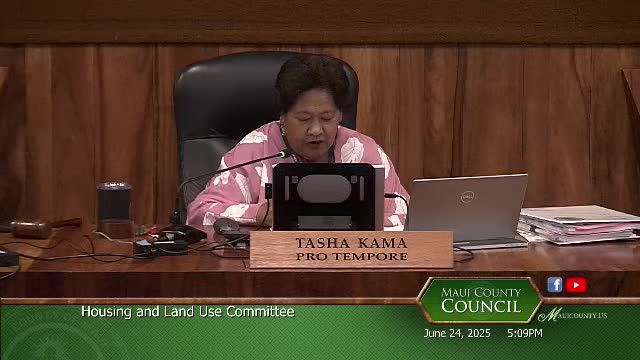
Chair Tasha convened a recessed meeting of the Maui County Housing and Land Use Committee on June 24, where the committee took several hours of public testimony on Bill 9, a proposal to amend Maui County Code chapters 19.12, 19.32 and 19.37 to limit or phase out short‑term (transient vacation) rentals in apartment districts.
Chair Tasha convened a recessed meeting of the Maui County Housing and Land Use Committee on June 24, where the committee took several hours of public testimony on Bill 9, a proposal to amend Maui County Code chapters 19.12, 19.32 and 19.37 to limit or phase out short‑term (transient vacation) rentals in apartment districts.
The proposal and the hours of testimony mattered because advocates said converting units now used as short‑term rentals could return housing to local families still displaced after last year’s Lahaina fires, while opponents warned of large job losses, legal challenges and no clear path to create affordable units from the supply that would be taken off the short‑term market.
Supporters who testified described multi‑generational displacement and housing insecurity. Kanella Ing, identifying herself as born and raised on Maui, said the measure is “a rare chance to do the right thing, to return thousands of homes” to local families. Nia Fitzpatrick, who said she grew up on the island and has family members forced to move off island, said she was “strongly in support of Bill 9” and urged the council to “vote from the heart.” Several speakers linked the proposal to the post‑fire housing emergency and cultural loss in Lahaina.
Opponents included short‑term rental owners, managers and some business advocates who said the economics and logistics of converting many units to long‑term housing are unclear. Brian Banks, who identified himself as a 26‑year full‑time Maui resident and a short‑term rental owner, said he “strongly oppose[d] Bill 9,” argued many vacation rental owners break even or lose money after taxes and local spending, and said conversion would not necessarily yield units that local families could afford. Realtor and long‑time resident Jeremy Stice said the bill “creates nothing” and warned it could cause layoffs and empty units that would not become viable long‑term homes.
Several speakers quoted or cited economic estimates in their testimony: one referenced a UHERO estimate the bill could lead to about 1,900 lost jobs; others used broader ranges heard in testimony (as high as 1,900–3,800 job losses) or cited statewide figures offered by testifiers (for example testimony that Hawaii has roughly 89,000 short‑term rentals and that converting units could return thousands to the local market). Testimony also included counts and self‑disclosures: at least one testifier said he owns four short‑term rental units; other testifiers and speakers cited numbers such as 6,000–7,000 units as the potential scale of conversions mentioned during the meeting.
Several owners and managers proposed alternatives or mitigations: register and regulate all short‑term rentals, require local management, create a registration fee to fund enforcement and identify illegal listings, or use public funds (transient accommodations tax, other revenues) to buy affected units for long‑term housing. Supporters of the bill proposed concurrent programs to help small local owners keep properties (tax exemptions or targeted support for local long‑term rental conversions) and urged the council to tie any phase‑out to programs that place units into local hands.
Committee procedure: Chair Tasha explained that, because the committee expected a large volume of testimony, the committee would not take questions of administration while testimony was being received to avoid veering into deliberations; staff called testifiers in groups and enforced a three‑minute limit per speaker. The committee recessed for a 10‑minute mid‑meeting break and agreed to continue oral testimony until either testimony is complete or the meeting resumes the next day.
At the end of the evening the committee recessed and scheduled a continuation: staff announced the committee would reconvene June 25 at 1:00 p.m. for additional oral testimony with written testimony still accepted via the county’s e‑comment system.
The hearing made clear the policy tradeoffs facing the council: community members and Native Hawaiian advocates emphasized returning housing to local families and protecting cultural continuity in places such as Lahaina; owners and some business speakers warned of economic dislocation, enforcement challenges and litigation risk. Committee members indicated they will continue to take testimony at the scheduled follow‑up session and then consider next steps, which may include formal briefing from the administration and legal counsel before deliberations.
A note on process and evidence: the committee heard extensive testimony pro and con; no formal votes or final actions on Bill 9 were taken during this session. The committee session and the extended public record will inform any future amendments, phase‑out schedules, or companion policies the council may adopt if it advances the measure.