Get Full Government Meeting Transcripts, Videos, & Alerts Forever!
Get email alerts on the Cannabis Permitting topic
No spam. Unsubscribe anytime.
Yolo County supervisors deny Outdoor Properties’ Capay Valley cannabis-use permit appeal
Summary
The Yolo County Board of Supervisors voted to deny an appeal from Outdoor Properties LLC seeking a cannabis use permit at a Capay Valley site, citing a multi-year record of noncompliance with county and state cannabis rules, outstanding taxes and fees, unresolved enforcement notices and repeated community complaints.
The Yolo County Board of Supervisors on Tuesday denied an appeal by Outdoor Properties LLC seeking a cannabis land-use permit for a Capay Valley site, adopting staff findings that the applicant and property owner had repeatedly failed to meet county and state regulatory requirements.
Staff framed the decision as one about compliance, not only future promises. “To deny the cannabis abuse permit. The last slide. In closing, the cannabis the compliance history of both the property owner Loma West LLC and the licensee out of properties LLC demonstrate an inability to operate under the regulatory framework of the cannabis licensing ordinance, the cannabis land use ordinance, and state law,” staff presenter Jeff Anderson told the board during the hearing.
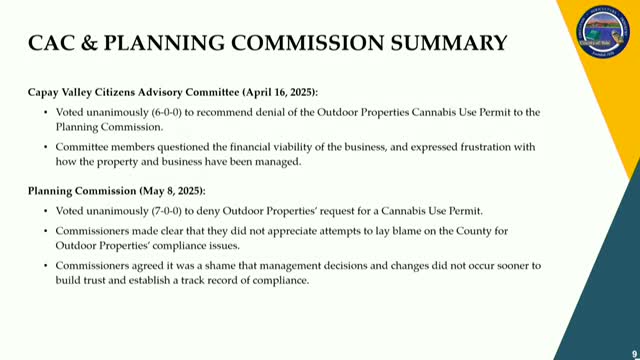
The board followed a recommendation from the planning commission, which had earlier voted to uphold staff’s initial recommendation to deny processing of the permit application. Deputy County Counsel Eric Macy explained the procedural posture: denying the permit now avoids the time and expense of a full permit and environmental review if staff and the planning commission conclude the application should not be approved.
Why it matters: the Capay Valley cannabis land-use rules limit the number of cultivation permits at eligible sites; county staff told the board that if the permit is denied the site would be removed from the list of locations eligible for future permits in the Capay Valley, effectively ending the applicant’s ability to obtain a permit at that address under the county’s CLUO rules.
Staff and county inspectors summarized multiple compliance shortfalls documented in a staff report and a packet of findings the board adopted. Christina Gonzales, a Yolo County cannabis inspector, said the licensing unit has tracked unpaid cultivation and property taxes and recently tightened renewal rules after allowing renewals during a market downturn. “We allowed cultivators to renew, in response to the declining market and the prices of cannabis per pound. ... We have since stopped and require them to come in compliance with both property taxes and cannabis taxes,” Gonzales said.
Gonzales told the board the operation’s cultivation taxes were about nine quarters delinquent at the time of the hearing and that the county’s access to accurate tax liability is limited when operators fail to comply with the state track-and-trace reporting system. She said the last verified outbound manifest in track-and-trace for the site was November 2024.
Marissa Jeweller, Integrated Waste Management Division director, described unpaid county fees on the property and the county’s collection steps. “The current amount that was on last year’s lien cycle was $499.50 … The current outstanding balance on the account is $734; they are set to go to lien the next year,” Jeweller said, noting staff had begun repeated notifications without receiving communication from the property owner.
Staff also cited unpermitted structures and a large generator installed at the site without clear permitting or utility-payment records; community complaints dating back to roughly 2019 about noise and odor; an outstanding notice-of-violation that the applicant did not appeal; and other unpaid accounts related to the operation.
The applicant, Thomas (Tommy) Christie, who said he stepped into the ownership group in 2020, urged supervisors to give the operation another chance and described significant capital investment at the facility. “Support from the board of supervisors means a lot to a small business,” Christie said during his presentation, arguing that the site’s owners and lenders were prepared to restructure operations and bring in new management. Christie also described millions of dollars invested in the facility and told the board the operation had stopped cultivating several quarters earlier.
Public comment was strongly divided but tilted toward denial. Neighbors described repeated nuisance impacts and a long pattern of missed obligations. Resident David Bateman urged the board to deny the appeal: “I strongly urge the board to deny this appeal,” he said. Jason Harper, a former property manager, and other neighbors described long-standing dissatisfaction and distrust. Several speakers said cleanup and community outreach by the applicant had been belated.
Procedural outcome and effect: Supervisor Barajas made the motion to deny the appeal; Supervisor Fredericks seconded. The board voted to deny the appeal, adopt findings supporting denial and determine the denial was exempt from the California Environmental Quality Act in accordance with the exemption cited in the staff report. The board’s action sends the planning commission and staff instructions consistent with denying Zone File 20-22-83’s request for a cannabis-use permit; staff advised that a denial at this point removes the site’s eligibility under the CLUO for future Capay Valley permits.
What the record shows and what remains unclear: County inspectors documented delinquent cultivation tax reporting, an unpaid integrated-waste lien and a history of community complaints; staff said the county lacks a complete dollar figure for the cultivation-tax arrears because of limits on available DFS (Department of Financial Services) data and incomplete track-and-trace reporting. The applicant estimated unpaid tax exposure “upwards of … $100,000” during the quarters he said the operation stopped cultivating; the county did not present a verified total tax dollar amount at the hearing.
Next steps: Because the board denied the appeal, staff will not process the application further for that location. County staff and the planning commission will record the action and the site will be ineligible for another Capay Valley cannabis use permit under the CLUO, staff said. No court-appeal timeline was described during the hearing.
This article is based on the Yolo County Board of Supervisors public hearing record, staff reports and public testimony presented during the board meeting.