Get Full Government Meeting Transcripts, Videos, & Alerts Forever!
Get email alerts on the Transportation Traffic Calming topic
No spam. Unsubscribe anytime.
Carlsbad council delays Barrio traffic-circle project, asks staff for alternate calming options
Summary
City council voted unanimously to postpone awarding a contract to build five traffic circles in the Barrio, directing staff to return by July 29 with alternative traffic-calming options and targeted community outreach after concerns about parking loss, grant deadlines and design trade-offs.
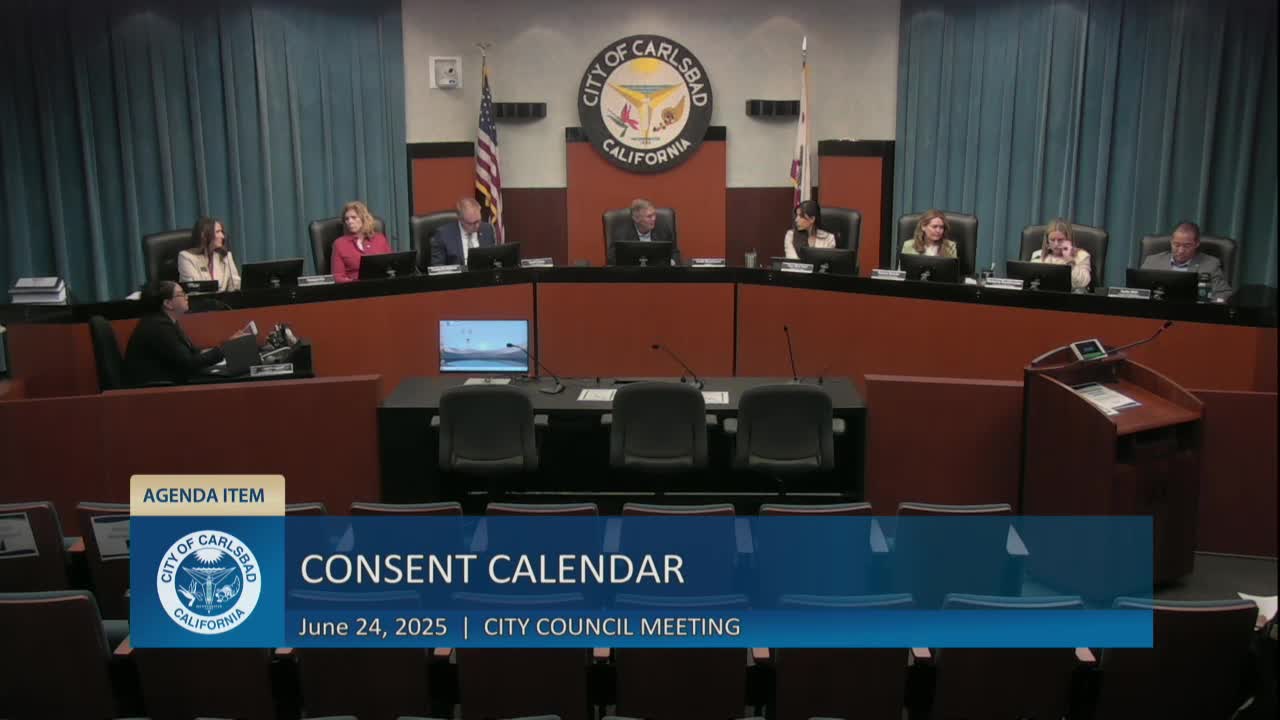
The Carlsbad City Council on June 24 voted unanimously to delay awarding a contract to build five traffic circles in the Village and Barrio area and directed staff to return to the council on July 29 with alternative traffic-calming options, outreach plans and any hybrid designs.
Council member Burkholder, who pulled the item from the consent calendar, said residents are concerned about parking loss after the state’s daylighting law and asked staff to examine other traffic-calming tools such as speed cushions, stop signs and raised crosswalks. "I don't want any parking spaces lost in the barrio for any project," Burkholder said during the discussion.
The council’s action follows staff presentations that said the project was developed through the Village and Barrio master plan with outreach dating back to 2014. Tom Frank, the city’s transportation director and city engineer, told the council the March materials initially listed 46 parking spaces to be removed; further review reduced that to 38, and 11 of those would be lost regardless of the city’s decision because of the state daylighting law.
Jason Haber, intergovernmental affairs director, explained the federal funding structure: the city requested $5 million through a congressional community project funding process and secured authorizations in the federal appropriations bill. Staff said the authorization allocates $4 million to the traffic-circle portion and $1 million to a lighting project. Haber warned that rescoping the project would require de‑obligation and reauthorization through Caltrans and federal review (including NEPA), a process that would likely push beyond fiscal-year deadlines and put at risk the $4 million for the traffic circles.
Council members and city staff also discussed timing and bids. Staff reported construction bids are valid through Aug. 5; a brief delay to gather additional community feedback could be accommodated if the council acts before that date. The city’s utilities director, Amanda Flessey, said the project also packages sewer and water infrastructure work beneath the proposed intersections, and removing the traffic circles would require redesign of those infrastructure plans.
Fire Chief Mike Calderwood told the council the department can traverse the proposed designs but prefers raised crosswalks and strategically placed crossings for some parts of the Barrio; he said the areas near Jefferson and Oak might tolerate a more ornamental entrance while other spots would be better served by different measures.
After discussion, Burkholder moved to have staff return with non-traffic-circle options (stop signs, speed cushions) and hybrid alternatives; the motion — amended to allow hybrid concepts and to schedule the item for a July 29 council meeting with outreach in the interim — passed unanimously.
The council asked staff to include in the July 29 report: (1) additional neighborhood outreach and methods to notify prior participants, (2) technical comparisons of traffic circles versus speed cushions, stop signs and raised crosswalks, (3) updated parking impact counts for the Barrio specifically, and (4) funding ramifications if the council chooses options that differ from the Caltrans‑authorized design. Staff said it would report on identified additional parking opportunities on Madison and Chestnut streets, possible red‑curb changes that could yield more spaces, and a later review (targeted for 2026) of parallel-to-diagonal conversions on eligible streets.
The council’s deferral preserves the bid window through early August and leaves the current federal funding authorizations intact if the council decides in July to proceed with the Caltrans‑authorized traffic‑circle design.