Get Full Government Meeting Transcripts, Videos, & Alerts Forever!
Get email alerts on the Public Safety Bond Needs topic
No spam. Unsubscribe anytime.
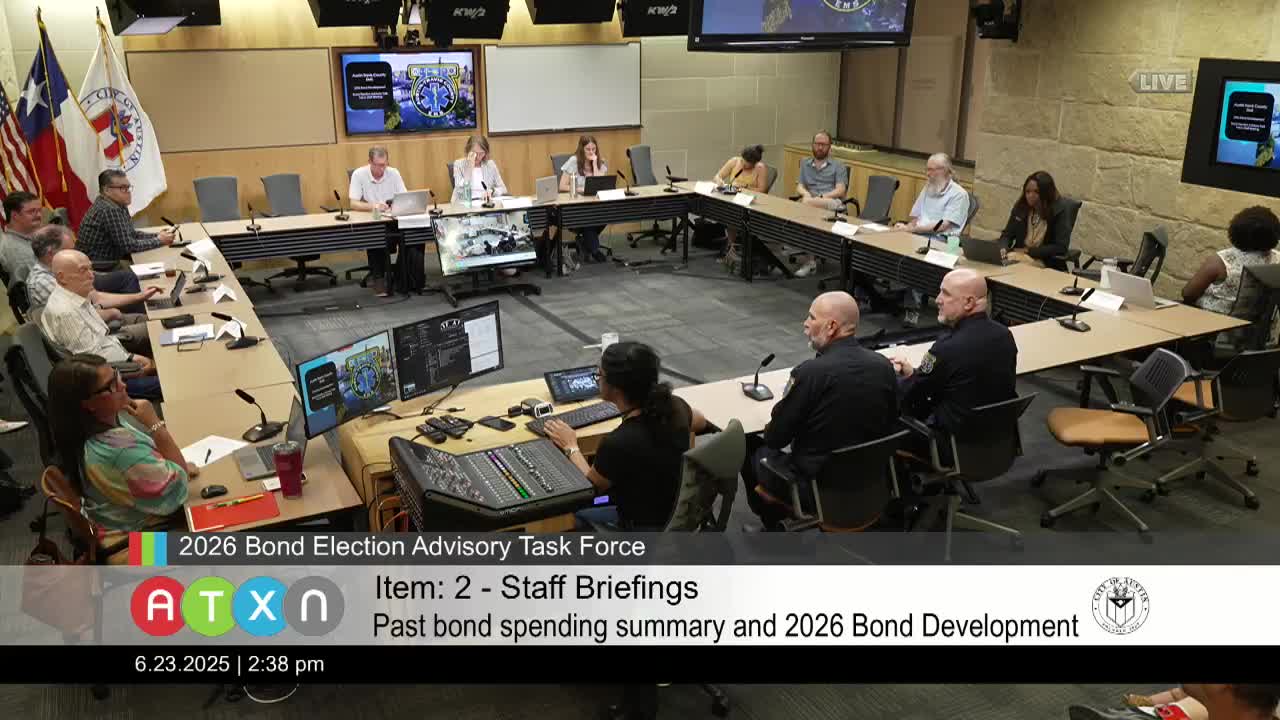
EMS, fire and police present station needs and scoring rubrics for 2026 bond
Summary
Austin-Travis County EMS, Austin Fire Department and Austin Police Department briefed the bond task force on past bond spending, service trends and the technical scoring criteria they plan to use to prioritize capital projects for the 2026 bond.
Three public-safety agencies presented their 2026 bond priorities and the technical scoring frameworks they will use to evaluate projects.
Assistant Chief Steven White of Austin-Travis County EMS told the task force the agency operates 44 EMS stations and handled "almost 140,000 calls for service" in 2024. He said the department has 714 authorized sworn paramedics and EMTs and 99 civilian staff and serves a daily population the presentation listed as about 1.3 million across Travis County. White described a proposed scoring matrix built around six guiding principles (affordability, sustainability/resilience, innovation, equity, customer trust and proactive prevention) with affordability, equity, prevention, and innovation each weighted heavily in their rubric.
White also reviewed past bond and capital activity: bond allocations in 2006 and 2012 funded station projects, and the 2018 bond provided an unprecedented $25 million for renovations. He said the department allocated $98.3 million for five new stations and had spent $79.2 million to date on those projects; additional gap funding earlier required certificates of obligation to complete some work.
Assistant Chief Thayer Smith and Fire Chief Joel G. Baker presented Austin Fire Department needs. AFD reported about 1,303 sworn members and roughly 110,000 incidents last year, operating from 54 stations and 104 apparatus with 154 civilian staff. Like EMS, AFD described a rubric focusing on equity, affordability, innovation, sustainability/resilience and proactive prevention. Smith said many recent joint EMS/AFD projects from the 2018 cycle are now operational and that the department has prioritized stations in areas of high density and high growth where response coverage has deteriorated over the last decade.
Representatives of the Austin Police Department (Patrol Commander Richard Eagle, Assistant Chief Lee Rogers and Chief Administrative Officer Michelle Schmidt) described APD's guiding principles for scoring projects, which mirror citywide priorities: equity, affordability, innovation, proactive prevention, community trust and sustainability. APD told the task force it has about 1,480 sworn officers, four dedicated substations and averages about 23,800 calls per month. The presenters said APD received bond funding in 2006 and 2012 but not in 2018, and that a recently built public-safety headquarters was funded with certificate of obligations rather than a general obligation bond.
Task force members asked questions about funding sources and intergovernmental cooperation. Members pressed EMS on the mix of city and county funding, and EMS said it is funded from the city general fund with a contract arrangement with Travis County and that billing revenue returns to the general fund. APD representatives described a small electric-vehicle pilot and said rollout will require coordination with Austin Energy for charging infrastructure and resilience planning.
Presenters emphasized that capital investments alone will not change response performance without operational staffing commitments: departments said station additions and renovations must be paired with personnel and other operating resources to improve response times over time.
Ending: The three departments left the task force with draft scoring rubrics and data on past capital spending; the rubrics will feed staff and working-group discussions as the bond package is developed.