Get Full Government Meeting Transcripts, Videos, & Alerts Forever!
Get email alerts on the Parks Green Infrastructure topic
No spam. Unsubscribe anytime.
Residents and nonprofits urge 2026 bond to prioritize parkland, trees and green infrastructure
Summary
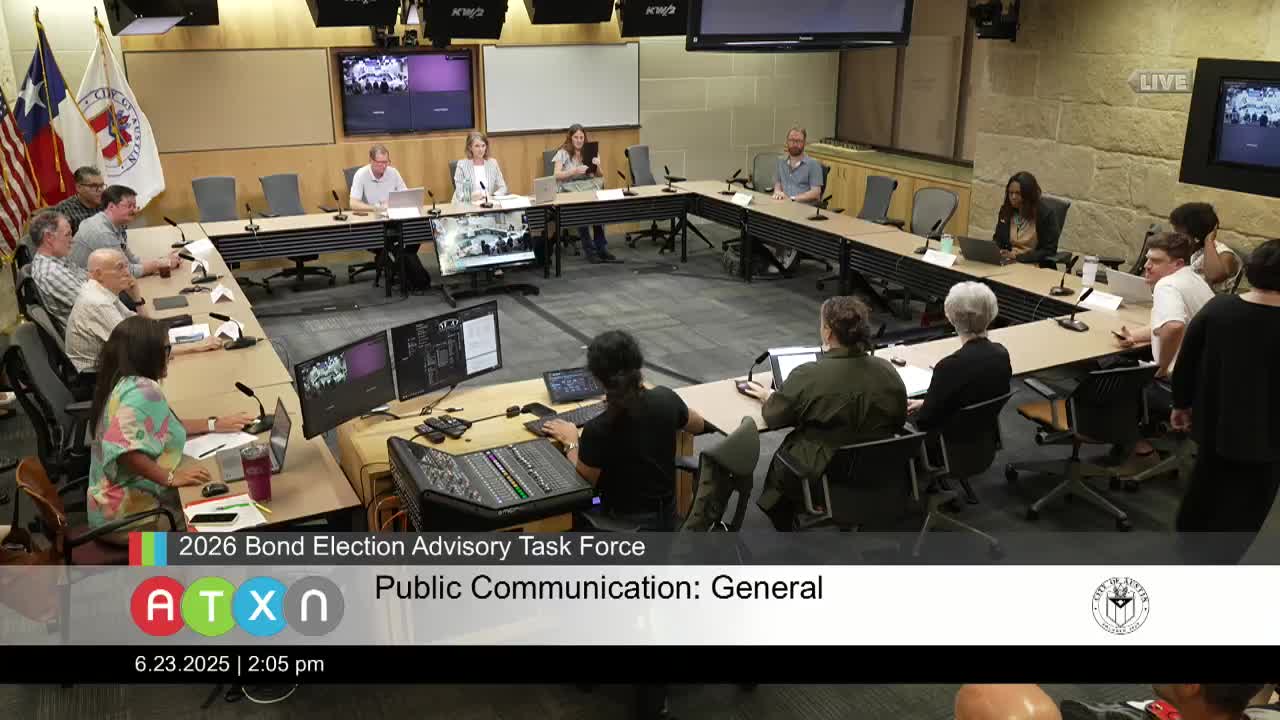
Speakers at the 2026 Bond Election Advisory Task Force meeting on June 23 pressed the task force to fund land acquisition, urban forestry, maintenance and workforce programs in the 2026 package.
At the June 23 meeting of the 2026 Bond Election Advisory Task Force, residents and nonprofit representatives urged the panel to prioritize parkland acquisition, urban forestry and green infrastructure in the bond package.
The comments, made during the meeting's citizen-communication period, reflected concerns about Austin's declining national park rankings and the financial and time pressures that make land acquisition difficult. Jess Manichia, a Crestview resident and board member of Evergreen Austin, told the task force that Austin's ParkScore ranking has slipped over time and argued that "parks are a powerful catalyst for economic vitality and community well-being." She said Austin ranked 19th when her son was born in 2012, 30th in 2015 and 44th in the 2024 ParkScore ranking.
The case for land acquisition was echoed by Melba Watley of Evergreen Austin, who noted long-term trends in local bond funding and growth: "The last time a park bond package funded only land acquisition was 1992 for Barton Creek Wilderness Park," she told the task force, adding that much of the city's secured green space dates from earlier eras of acquisition. Watley also cited an Evergreen Austin poll of 400 voters in 2024, saying 88% agreed the city should acquire land now because "when it's gone, it's gone forever."
Nonprofit partners described how city investment in green infrastructure can multiply public benefits. Ben Bertram, of TreeFolks, called trees "green infrastructure" and urged attention to tree canopy, maintenance and planting programs to reduce urban heat, improve air quality and provide other ecosystem services. Valerie Tamberry, also with TreeFolks, cited published research and said urban tree canopy can sequester carbon and cool summer daytime temperatures by 2 to 10 degrees in shaded areas.
Clark Smith, CEO of American YouthWorks, urged the task force to consider workforce-linked investments that pair conservation and green-infrastructure projects with youth job-training programs. Smith described the organization's Conservation Corps and said the model "maximizes city dollars" by combining infrastructure work with workforce development.
Several speakers urged the task force to consider both acquisition and the ongoing operations and maintenance costs that follow capital projects. Ryan Saunders, a District 3 resident, presented a separate idea for a neighborhood-center program to incentivize smaller-scale, walkable development; he positioned it as complementary to green infrastructure by increasing local business activity and pedestrian access.
The task force did not take formal action on the public comments, but staff and members acknowledged the themes as they proceed with drafting bond recommendations and scoring criteria.
Ending: Speakers asked the task force to consider early land purchases, tree-planting and workforce partnerships when framing bond asks, and several pledged to follow up with staff and working groups as the package is developed.