Get Full Government Meeting Transcripts, Videos, & Alerts Forever!
Get email alerts on the Greenwood Trust Reparations topic
No spam. Unsubscribe anytime.
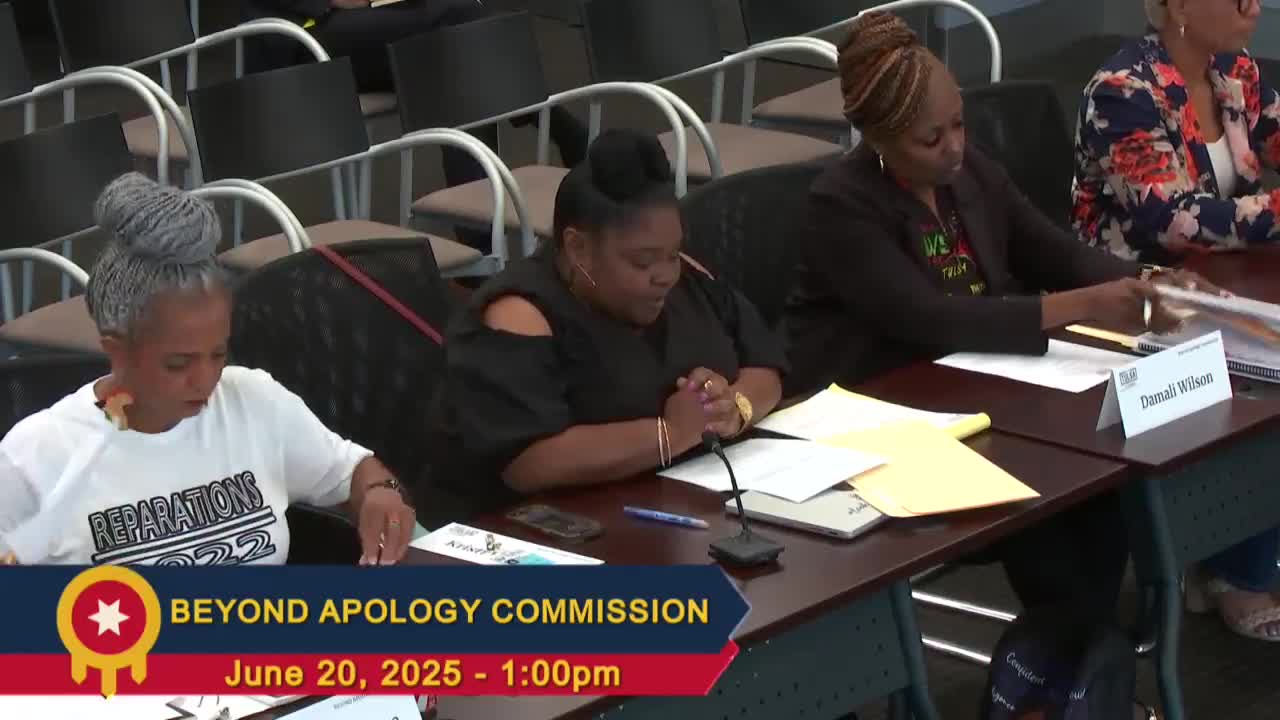
Beyond Apology Commission urges community oversight of Greenwood Trust, sets July 22 meeting
Summary
At its June 20 meeting the Beyond Apology Commission reviewed Tulsa's "Road to Repair" framework and the Greenwood Trust, pressed for descendant and community oversight of mass-grave work, criticized Partner Tulsa's CDC formation process, and set a public community meeting for July 22 to begin implementing its eight thematic subcommittees.
The Beyond Apology Commission on June 20 pressed for formal community oversight of the Greenwood Trust and scheduled a public community meeting for July 22 to begin organizing volunteer subcommittees tied to the commission's eight themes.
The commission's chairwoman said Mayor G.T. Bynum's "Road to Repair" proposal includes a private Greenwood Trust intended to "raise $105,000,000 by 06/01/2026," but emphasized the trust is not a finished award and must include accountability to survivors, descendants and North Tulsa residents. "I just wanna make clear that we understand that we did not just get a $105,000,000," the chairwoman said, urging that Beyond Apology be involved in oversight and accountability.
Why it matters: The commission has been the primary vehicle for collecting community recommendations that informed the Road to Repair. Commissioners and community leaders who participated in the original Beyond Apology listening sessions have warned that a private trust must not replace the community-led framework that produced the commission's eight themes: education, systems change, financial compensation, community and economic development, housing, land, health and wellness, and cultural identity.
Major actions and votes
- The commission approved its May 16 meeting minutes (motion by Commissioner Damali Wilson; vote recorded as "Aye"). - The commission voted to hold a first community meeting on July 22 at 6:00 p.m. (motion by Commissioner Matisse; motion approved). - The meeting adjourned by motion later in the session (motion approved).
What commissioners discussed
Greenwood Trust and community accountability: The chairwoman reviewed the Road to Repair announcement and repeated several points from community listening sessions that produced the commission's recommendations. She described the Greenwood Trust as a "private charitable trust" that could fund housing, cultural preservation and direct legacy support for survivors and descendants, and said the commission's eight themes "align directly with this vision and provide a framework for community driven accountability and expansion." She urged that Beyond Apology or a clearly descendant-centered oversight role be included so the community does not see the recommendations taken "to a whole another different kind of thing away from them."
Mass-graves oversight and transparency: Commissioners and council members raised concerns about the prior mass-graves oversight process. Councilor Hall Harper said the earlier oversight group, created under a past administration, dissolved as questions grew and communications migrated from public meetings to email and text threads. "They went to email, no Zoom meetings, and then veil... then it's a text messages," Hall Harper said, adding that the result was a loss of public trust. Hall Harper and the chairwoman noted that archaeologists on prior teams requested searches at additional locations but were directed to focus elsewhere; they urged reconvening oversight with descendant participation and public transparency. Dr. Alicia Oduwale, an archaeologist mentioned in the discussion, was cited as a professional who had requested broader investigation.
Concerns about Partner Tulsa and the Kirkpatrick Heights CDC: Councilor Hall Harper said she does not support how a community development corporation (CDC) associated with Partner Tulsa was being formed, alleging that her input was ignored and that selections for board slots were made without a community election. "They have basically disregarded my input and basically have excluded my participation in the CDC," Hall Harper said. She recommended community-controlled selection processes, including the possibility of community elections, to ensure legitimacy.
Subcommittees, community meeting and participation: Commissioners agreed to use the eight themes that originated in Beyond Apology's four community meetings as the initial structure for subcommittees. The commission will intentionally invite the more than 200 participants from those listening sessions to a July 22 interest meeting, but stressed that subcommittee membership and formal chairs will be determined by the commission. "I want them to know that we're gonna have, education committee... they're welcome to participate," the chairwoman said. Commissioners discussed whether committee meetings would be public (they will be) and how to balance invited participation with open public attendance.
Communications and public engagement: Commissioners flagged a need for a more visible communications presence. The chairwoman proposed short-term social media updates and video recaps of the commission's work and community meetings; staff said some City communications channels already exist and the commission could meet with the communications office about short- and long-term plans. "We need to have that presence," a commissioner said, noting the importance of public visibility as private fundraising for the trust proceeds.
National partnership and technical assistance: The commission discussed outreach to a national reparations model led by Robin Rue Simmons and a program called First Repair. The chairwoman said Robin Rue Simmons "said yes" to exploring partnership and technical assistance, including co-authored briefs and a national platform for Tulsa's model.
Community context and next steps: Commissioners emphasized that much of the work will be community-driven and that the commission must not substitute for descendant leadership. The chairwoman said she will follow up with staff and commissioners to prepare for the July 22 community meeting and asked commissioners to indicate preferred subcommittee assignments by email in the coming week.
Quotes from the meeting
"I just wanna make clear that we understand that we did not just get a $105,000,000," the chairwoman said, repeating that the $105 million referenced in the Road to Repair announcement is a fundraising goal for a private trust, not a sum already awarded to the city.
"They have basically disregarded my input and basically have excluded my participation in the CDC," Councilor Hall Harper said of Partner Tulsa's early selection process for a proposed community-development corporation.
"We've got some work to do," the chairwoman said, urging commissioners to prepare for community outreach and for public scrutiny as the commission moves to implementation.
Ending
The commission set July 22 at 6 p.m. as a public, in-person community meeting (commissioners indicated the meeting will be in Greenwood or a similar North Tulsa venue) and directed staff to circulate invitations, meeting logistics and a short survey asking commissioners which of the eight themes they plan to lead or serve on. Commissioners emphasized that the commission's next month will focus on community outreach, clarifying oversight roles for the Greenwood Trust, reconvening mass-graves oversight with descendant representation, and developing an initial communications plan to share progress publicly.