Get Full Government Meeting Transcripts, Videos, & Alerts Forever!
Get email alerts on the Resource Extraction Cup topic
No spam. Unsubscribe anytime.
Commission grants conditional use permit for sand and gravel operation with added buffer and conditions
Summary
The Kearney City Planning Commission recommended approval to the City Council of a conditional use permit for a sand and gravel resource‑extraction operation east of Cherry Avenue, with conditions requiring setbacks, stormwater controls, screening and a 10‑foot landscape buffer on the east when extraction reaches that edge.
The Kearney City Planning Commission recommended approval to the City Council of a conditional use permit (CUP) to allow resource extraction (sand and gravel) on property east of Cherry Avenue and south of 11th Street, subject to 18 standard conditions and a specific modification requiring a 10‑foot landscape buffer along the east property line when extraction reaches that edge.
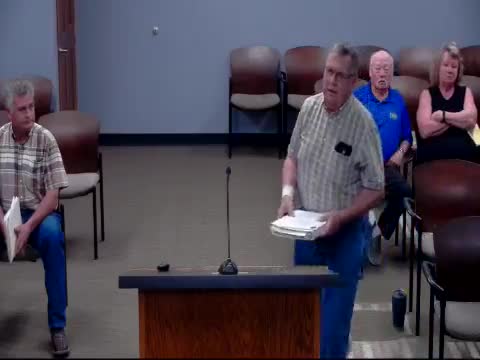
Applicant Roger Harters (representing landowner) presented the proposal and said operator Keith Becker intends to extract roughly two acres of gravel per year from the roughly 30‑acre site and use topsoil removed during extraction to raise portions of the property about 2 feet to get them out of the 500‑year floodplain. Harters said the operation would use berms, tree rows and staged stripping to reduce blowing sand, and that sand would be pumped back into ponds after initial extraction in the first two years in typical extraction phasing.
Multiple nearby residents opposed the CUP at the hearing. Sharon Rose, who identified her address as 4407 East 11th Street and said her property is adjacent, said her house has had basement flooding three times and she worries the operation could raise the groundwater table and damage her property value. Other neighbors described prior problems with blowing sand from an existing pit to the east that had drifted onto Interstate 80 and along local roads and asked how the city would mitigate dust and sand movement.
City planner Melissa Doherty O'Hara summarized staff findings. Staff recommended approval with conditions including: a minimum 50‑foot setback for extraction and 50‑foot setback for stockpiles from property lines (no extraction within the 50‑foot setback), a 10‑foot landscape buffer yard and opaque screening along the north, south and west property lines, a maximum stockpile height of 35 feet, and stormwater controls. Staff noted that the CUP includes routine reporting and that operators must be identified so staff can respond to complaints. The staff report also stated that, historically, Kearney had not required an engineered geotechnical study resolving groundwater impacts for similar sand and gravel CUPs but that such a study would be necessary to provide hard numbers if the commission or neighbors demanded it.
Commission discussion covered the potential effect on the water table, the frequency and scale of extraction, traffic patterns (applicant said material typically goes to county projects and county hauling will determine routes), and mitigation for windborne sand. Commissioners and the applicant discussed vegetative windbreak options including cotoneaster and evergreens and the practical tension between requiring a permanent buffer while the operator may be irrigating and cropping the ground in early years.
The commission amended the staff conditions by adding to condition 8 a subsection (b) requiring: “At such time the extraction area reaches the extent of the east side of the operation, a minimum 10‑foot landscape buffer yard must be installed, and the opaque screen shall meet the requirements of section 46‑107(B) of the Unified Land Development Ordinance.” The commission also approved an initial CUP duration of five years (the staff‑recommended initial duration) with the possibility of nonrenewal or revocation if conditions are violated. The commission’s motion approving CUP number 2025‑02 (as recorded) carried with all commissioners present voting in favor.
Melissa O'Hara noted that the CUP will next be reviewed by Kearney City Council at its July 8 meeting and that the council is the final decision‑maker. She also said that if complaints arise the city can require changes, amendments or, in extreme cases, revoke the permit. Harters told the commission he intends to control dust and erosion and said he owns machinery to maintain the site and plant cover as needed.
The record shows neighbors remain concerned about groundwater and blowing sand; staff told the commission that a geotechnical study would be required only if the commission or applicant asked for hard numbers on groundwater impacts. The planning commission’s approval includes conditions intended to mitigate visual, dust and setback impacts and creates a process for staff oversight and potential enforcement through the five‑year CUP term.