Get Full Government Meeting Transcripts, Videos, & Alerts Forever!
Get email alerts on the Gender Affirming Care topic
No spam. Unsubscribe anytime.
Prince George's County task force approves recommendations to expand gender-affirming care and LGBTQI+ services
Summary
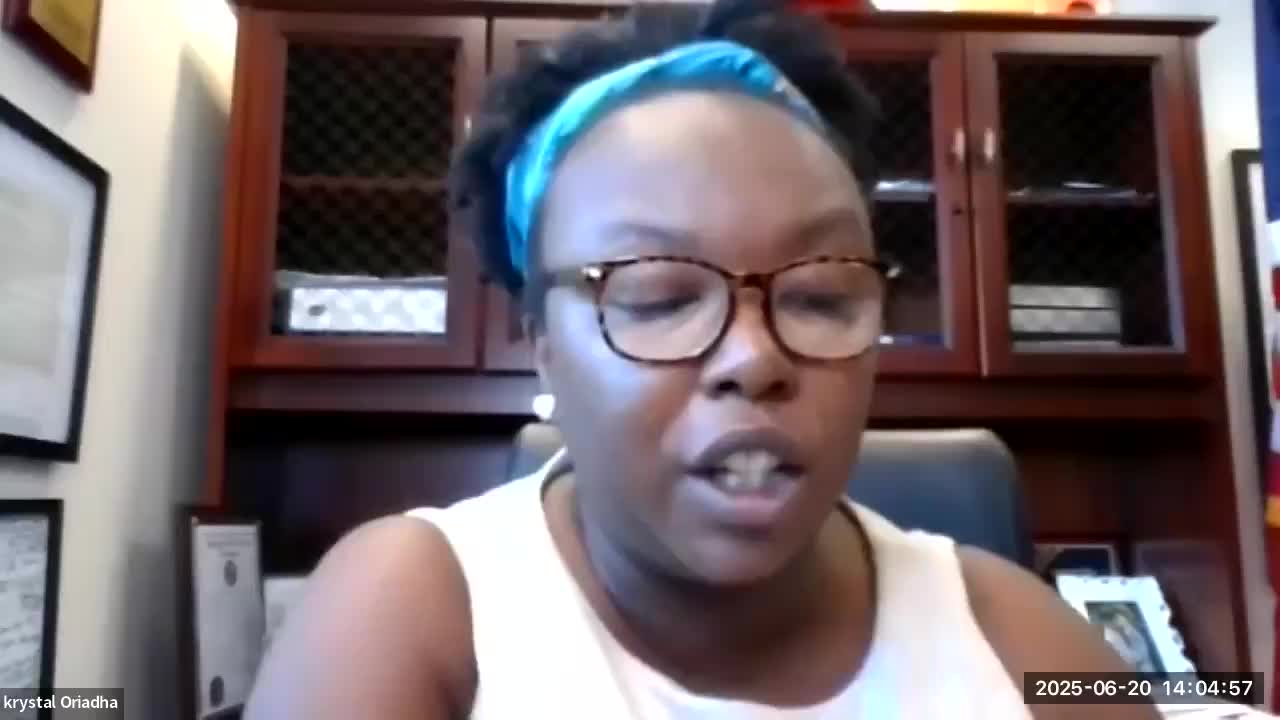
Prince George's County Councilmember Crystal Orieva, cochair of the county's LGBTQI+ Task Force, said the group voted to forward a set of recommendations aimed at improving access to gender-affirming care and other LGBTQI+ services in the county.
Prince George's County Councilmember Crystal Orieva, cochair of the county's LGBTQI+ Task Force, said the group voted to forward a set of recommendations aimed at improving access to gender-affirming care and other LGBTQI+ services in the county. The package will be transmitted to the full County Council and the County Executive's office after a final offline review and member sign-off.
The task force's recommendations cover clinical access, financial assistance, workforce and agency practices. Councilwoman Crystal Orieva, vice chair of the County Council and cochair of the task force, summarized proposals that include creating a gender-affirming care support fund to provide grants or vouchers for uncovered services such as voice therapy and travel costs for low-income residents; hiring two to three care navigators in the Health Department or funding equivalent nonprofit partners; and offering targeted startup grants of $50,000 to $100,000 to clinics that pledge to add trans-specific services and agree to fast-track permitting and inspections.
The recommendations also call for expanding tele-mental health contracts that specialize in trans-competent counseling and subsidizing up to 10 sessions per resident per year; a patient privacy and shield ordinance intended to mirror Maryland's new shield law to bar county agencies from cooperating with out-of-state operations targeting gender-affirming care; and comprehensive cultural competency training mandated for first responders, detention staff, health-care contractors and school nurses.
Other items the task force approved include: mobile gender-affirming health services added to existing county mobile clinics for neighborhoods with transportation barriers; youth and family support initiatives in partnership with schools, including quarterly parent education and peer programs; a public equity dashboard and a data review board to publish metrics such as wait times and denials for gender-affirming care; peer-led mental-health support groups; revisions to intake forms to reflect chosen name, pronouns and gender identity; and public signage and nondiscrimination practices to make affirming spaces more visible.
"Transparency drives accountability and helps the county to spot severe gaps quickly," Orieva said when presenting the recommendation for a public equity dashboard. She opened the meeting by describing the task force's goal to "create space in our county to ensure that all communities feel represented and seen," and closed by noting the recommendations will be condensed into a report for member review before formal submission to the council and executive.
Members agreed to approve the full list of recommendations as presented, with one caveat: a member asked staff to re-check whether LGBTQ+ sensitivity training for law enforcement is already in place. The cochair said the group would proceed with the vote with the understanding that, if the training already exists, that recommendation would be removed from the final report.
The task force recorded a motion to approve the recommendations; the motion carried with no objections recorded during the voice/hand vote. The meeting also approved minutes from the May 16, 2025 meeting by the same voice/hand process.
The task force is expected to finalize the recommendation report offline, include contributors' names and prior presentations, and then transmit the package to the County Council and the County Executive for consideration. Implementation steps such as staffing, budgeting and ordinance drafting were not finalized during the meeting and will require follow-up with agency staff and the executive office.