Get Full Government Meeting Transcripts, Videos, & Alerts Forever!
Get email alerts on the Alpr topic
No spam. Unsubscribe anytime.
Austin resident urges police oversight commission to probe police use of license-plate readers
Summary
A community member urged the newly formed Commission on Police Oversight to investigate Austin Police Department searches of automated license-plate reader (ALPR) data and raised national examples of misuse and misreads.
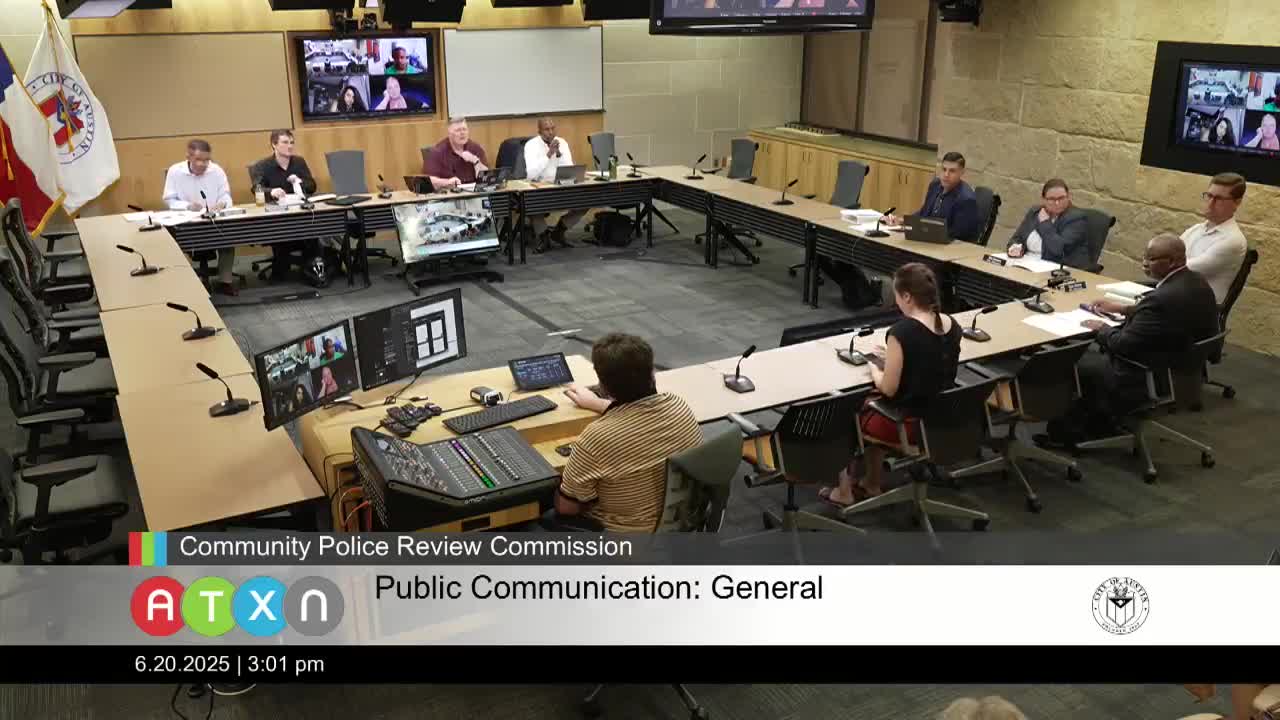
Marina Roberts told the Commission on Police Oversight on June 20 that she is “deeply troubled” by the Austin Police Department’s use of automated license-plate readers (ALPRs) and asked the commission to investigate APD’s searches of ALPR data.
Roberts noted that a one-year city pilot of ALPRs allowed by City Council in early 2024 expired and that the city manager intends to bring a new ALPR proposal back to the council in coming months. She said ALPR vendors such as Flock and Axon largely profit from selling access to aggregated vehicle-location data and that the databases they compile can let a stranger search a person’s movements.
“The companies selling ALPRs … act as data brokers,” Roberts said. She told commissioners that research does not show a measurable crime-reduction effect from ALPRs and warned about routine plate misreads. She cited a randomized controlled trial she said found roughly 35–37% of supposed license-plate hits were misreads and pointed to high-profile misuse or misread incidents nationwide, including an Aurora, Colorado, arrest that led to a $1.6 million settlement after an ALPR misread and disclosures that officers had abused ALPR access in other jurisdictions.
Roberts also referenced local audit findings. She said city auditors found that roughly 20% of APD ALPR searches lacked a documented investigative justification and asked the commission to use its community-review authority to investigate whether officers have used ALPRs to stalk or otherwise abuse access to location data.
Commissioners acknowledged Roberts’ remarks and said they would review how complaints and audits related to ALPR searches are handled by APD and OPO, and would raise the issue with staff responsible for complaints and investigations. The commission did not take formal action at the meeting.
Why it matters: ALPR systems collect location and timestamped vehicle sightings that can be aggregated to reveal patterns of travel. Community members argued to the commission that oversight is needed to ensure searches have lawful justifications, that vendors are not acting as broad data brokers without appropriate safeguards, and that known misreads do not lead to misidentification and harm.