Get Full Government Meeting Transcripts, Videos, & Alerts Forever!
Get email alerts on the County Budgeting topic
No spam. Unsubscribe anytime.
Marathon County board begins 2026 budget work, emphasizes early committee input
Summary
County administrators and committee chairs outlined the 2026 budget process June 19, stressing levy limits tied to net new construction, capital planning, and committee-level review of mandatory and discretionary services.
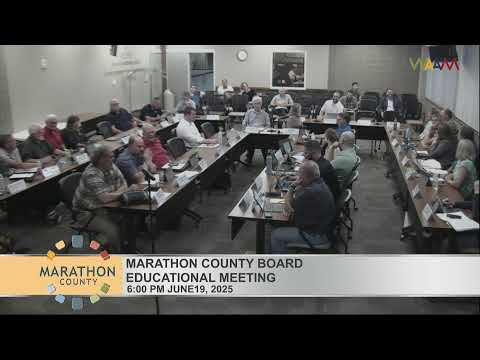
Marathon County administrators and standing committee chairs presented a budget development orientation and kickoff to the Marathon County Board of Supervisors on June 19 at the Marathon County Courthouse, laying out key assumptions for the 2026 operating and capital budgets and asking supervisors to provide early, committee-level direction.
The presentation, led by Administrator (referred to in the meeting as Sam) and HR/Finance Committee Chair John Robinson, explained that Wisconsin levy limits tie allowable property tax growth to net new construction rather than inflation and that Marathon County’s 2025 property tax levy is roughly $57–58 million. The administrators urged supervisors to review department program lists, fee schedules and the five-year capital improvement plan and to provide prioritized policy direction in standing committees between now and September.
Why it matters: Levy limits tied to net new construction constrain how much additional property tax revenue counties can raise, increasing the importance of prioritizing services, fees and capital projects. Presenters highlighted that net new construction has ranged recently from about 1.59% to 2.32%, and that Marathon County’s equalized value (excluding TIDs) is in the billions, a factor that reduces the county’s tax rate even as levy dollars rise.
Key points from staff included: counties must distinguish operating and capital budgets (borrowing is allowed for capital but not for operating); fund balance and a working capital designation support cash flow; the county has a rollover policy for unused CIP funds; and many programs are partially or largely funded by non-levy sources (grants, fees, sales tax).
Administrators asked supervisors to set budget priorities (employee compensation, health insurance, new positions, capital reserves use, public charges/fees) and to use standing committees to examine program-level mandatory vs. discretionary services and fee schedules. They also noted federal and state funding uncertainty — including possible Medicaid or SNAP changes — that could affect pass-through funding for local programs.
Supervisor John Robinson and other board members said early, frequent input is essential; staff said HR/Finance will present budget assumptions and committee-level materials in coming weeks, with a proposed budget to be presented to the full board on Sept. 30 and a public hearing to follow in October.
The presentation packet included tables and historical slides showing long-term trends in equalized valuation, levy and tax rate, five-year debt service schedules and CIP rollover history. Administrators said a fund balance policy is expected in July alongside the audit report.
The board did not take any final budget votes at the June 19 meeting; staff instructed supervisors to review committee materials and fee appendices and to bring program priorities to standing-committee meetings this summer.
The administrators summarized next steps: standing-committee review of mandatory/discretionary program lists, public charges (fees) review, capital requests and presentation of budget priorities at the July HR/Finance meeting.